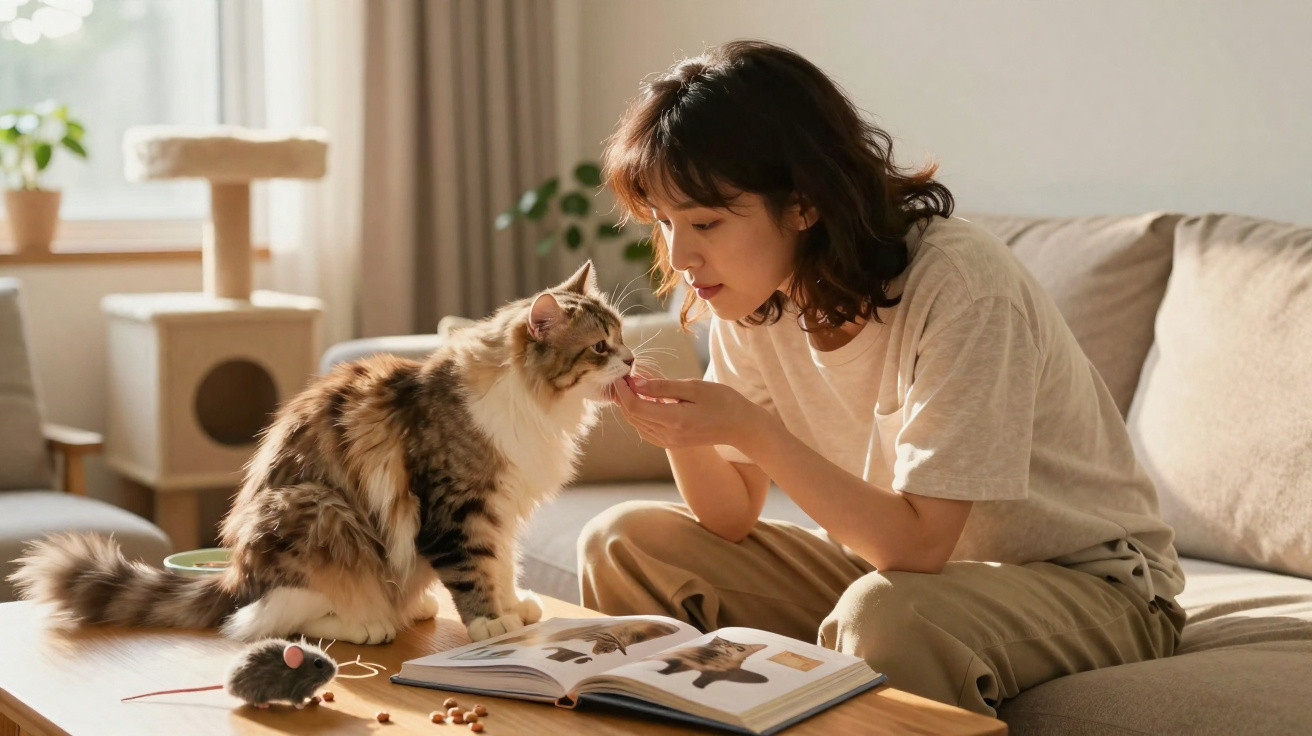
Many owners wonder every day what is going on in their house cat’s mind. When a cat sits on the windowsill staring outside, it is easy to ask: is it content? When it lies curled up at the foot of the bed, you may think: is it attached to me, or simply to the warm blanket? One small behavioural detail can provide a surprisingly clear answer.
What it really means when your cat licks you
Cats do not communicate through words as we do; instead, they rely on posture, eye contact and touch. Licking is one of their most powerful signals. Many owners are surprised to learn that, when a cat licks a hand, arm or even someone’s face, it usually means more than simple curiosity.
“If your cat licks you calmly and while relaxed, it often shows trust, wellbeing – and yes, something very much like love.”
Licking has an important place in feline communication from the very beginning. Immediately after birth, a mother cat licks her kittens dry and clean. This strengthens their bond, reassures the young and stimulates circulation and breathing. Cats retain this instinctive behaviour throughout their lives.
When your adult house cat licks you, it is partly copying these caring gestures. It sees you as part of its “social group” – someone it considers familiar and safe.
Licking as social grooming behaviour
Behaviour researchers refer to cats grooming one another as “social grooming”. Cats within groups that get on well will often lick each other. It is not solely about cleanliness; above all, it reinforces social bonds.
- The cats blend their scents and create a shared scent profile.
- They reduce stress because pleasant touch releases feel-good hormones.
- They communicate: “You belong with me, and I feel safe with you.”
Applied to humans, this becomes particularly interesting: if your cat licks you gently while appearing relaxed, it is placing you within that same trusted social group.
How to tell when your cat’s licking shows genuine affection
Licking alone is not enough to interpret the message; the surrounding context matters. Cats always “speak” with their whole body, so look for several signals at once.
Typical signs of affectionate, relaxed licking
If your cat displays one or more of the following signs, its licking is usually a sign of affection:
- Relaxed body: Its muscles appear loose and its body rests heavily against you.
- Slow blinking: Its eyes are half closed and its expression may even seem to “smile”.
- Ears facing forwards: The ears are relaxed and pointed forwards, or move only slightly.
- Soft purring: The purr is steady rather than hurried.
- Calm breathing: There is no panting or rapid chest movement.
Your cat may occasionally give your skin or clothing fibres a gentle nibble between licks. As long as this is not painful and the rest of its body remains relaxed, it is often part of this kind of “grooming routine”.
“The combination of gentle licking, relaxed ears and a loose body is one of the clearest signs that your cat feels secure with you.”
When licking becomes a warning sign
Licking does not always indicate wellbeing. Cats may use the same gesture to relieve stress or to communicate: “This is becoming too much for me.” Once again, the difference lies in the overall body language.
Ears held back: your cat wants a break
The ears are a crucial indicator. If they are turned clearly backwards or flattened, tension is rising. This is especially apparent in the following situation:
- Your cat is lying on you and purring.
- You stroke its head, back or tummy.
- It suddenly gives your hand several very quick licks.
- At the same time, its ears move backwards and it draws its head slightly away.
It is then very likely signalling discomfort. Your cat wants the contact to end before it becomes seriously irritated. Many owners miss this precise moment, then wonder why a clawed paw or a bite follows shortly afterwards.
“Three quick licks with the ears held back are often a polite message: ‘Stop, I’ve had enough now.’”
When licking is linked to stress
In some cases, a cat may lick itself raw because of frustration or nervousness. This licking can appear almost compulsive: the same area is groomed repeatedly, often on the tummy, flanks or legs. There is usually a deeper issue behind it, ranging from boredom to pain or skin conditions.
If this behaviour occurs frequently, the first step should always be a visit to the vet. Physical causes need to be ruled out before behavioural training can be useful.
When licking simply means greed
As charming as it may sound, your cat may sometimes lick you simply because you smell of food. Anyone who has recently handled a piece of sausage or fish can become a tempting target for “grooming”, even if there is barely anything left to see.
A quick smell check can help you assess the situation: if your fingers or arms strongly smell of food, you can take the behaviour fairly calmly. Even so, this type of licking still shows that your cat wants to get close enough to inspect you thoroughly.
A quick overview: what licking can mean
| Situation | Body language | Likely meaning |
|---|---|---|
| Calm licking on the sofa | Ears forwards, relaxed body, slow blinking | Affection, wellbeing, bonding |
| Quick licking while being stroked | Ears back, head moving away | Discomfort, desire for a break |
| Licking after cooking or eating | Alert eyes, inquisitive nose | Interest in food, curiosity |
| Constant licking of its own body | Sometimes tense posture, bald patches | Possible stress or illness – vet required |
How to respond appropriately when your cat licks you
Understanding your cat’s behaviour correctly can do a great deal for your relationship. First of all, it helps not to humanise every gesture. Cats love differently from dogs – usually more quietly, subtly and in brief moments.
If your cat is licking in a relaxed way, you can:
- speak softly to it or gently scratch its favourite spot;
- simply enjoy the closeness without constantly stroking it;
- accept the moment rather than demanding “more” than it chooses to offer.
If you notice the “stop signals”, end the interaction respectfully. Slowly move your hand away, and do not stand up abruptly; instead, give your cat time to find a new position. If this happens repeatedly, it is worth looking more closely: perhaps your cat simply dislikes certain types of touch or particular areas of its body being handled.
When professional help is needed
Anyone who is unsure can contact a vet experienced in behaviour or a coach specialising in cats. They can assess video recordings or observe the interaction between person and cat directly in the home. Such support is particularly worthwhile in cases of chronic stress, aggressive responses or self-injurious licking.
For many owners, even a single consultation can be eye-opening. Small changes to everyday life – more places to retreat to, fixed routines and a more suitable approach – are often enough to help a house cat respond more calmly and show affectionate signals more frequently again.
Why misunderstandings between people and cats are so common
Many people expect cats to behave like dogs. They hope for exuberant greetings, constant cuddling and uninterrupted closeness. Cats work differently. They choose both the moments and the form of affection themselves – and that is exactly what makes them distinctive.
Those willing to read these subtle differences often realise how much affection is present in everyday life: a brief rub against the leg, a slow head-butt against the hand, a quiet lick on the finger when nobody is watching. All of this forms part of a silent dialogue that grows stronger with every successful interaction.
This seemingly insignificant licking is a key piece of the puzzle. With a little practice, you will become better at recognising whether your cat is merely tasting the remains of your last snack from your finger – or telling you: “I feel safe with you.”















Comments
No comments yet. Be the first to comment!
Leave a Comment