
Marking a dog’s birthday is one of the truly lovely occasions to enjoy and share on social media.
Part of the appeal is working out your companion’s age in ‘dog years’. The long-standing rule of thumb is to multiply each year of a dog’s life by seven human years.
It is an appealingly straightforward sum. It is also incorrect.
A 2020 study showed that dogs do not age at a constant rate of seven times that of humans. During certain periods they age far more quickly than humans, while at others the pace slows, creating an entirely new calculation.
How the dog-age formula was developed
To establish the revised dog-age formula, scientists took blood samples from 104 dogs - all Labrador retrievers and mostly unrelated - ranging from puppies to 16 years old.
Next, they sequenced methylation patterns across tens of thousands of DNA locations, comparing these results with available methylation data from 320 people aged between 1 and 103.
DNA methylation is a chemical tagging system that helps control which genes are turned on and off.
As people grow older, methylation patterns at tens of thousands of sites within DNA alter in consistent, predictable ways. Scientists can use these patterns to create an ‘epigenetic clock’: a molecular assessment of biological age.
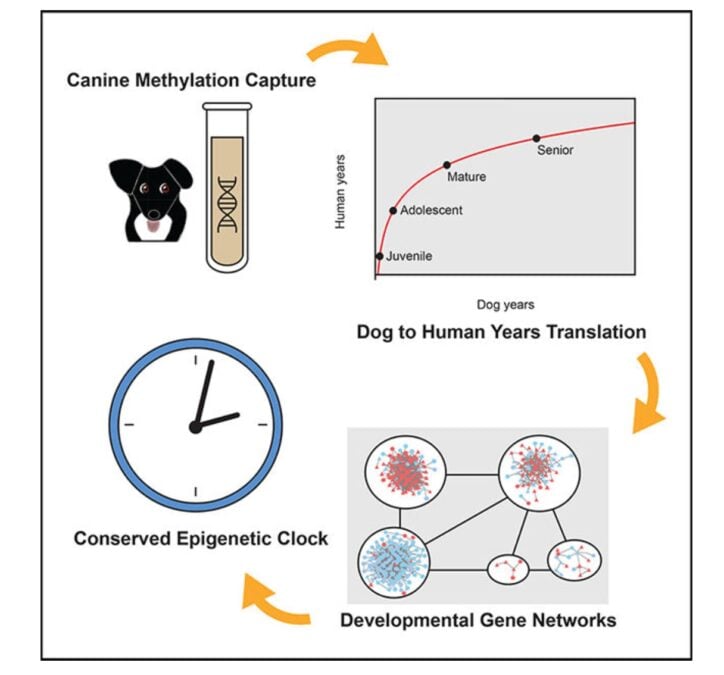
An illustrated summary of the study’s key findings. (Wang et al., Cell Systems, 2020)
The study found that the methylation patterns of young dogs most closely resembled those of young humans, and those of older dogs increasingly resembled older humans. However, differences appeared between these life stages.
Put another way, dogs seem to undergo much of their biological ageing very early in life, after which the process decelerates.
The molecular clock corresponded closely with several important physiological milestones. For instance, an eight-week-old puppy had an epigenetic age roughly equivalent to that of a nine-month-old human.
The team devised a mathematical equation for converting dog age to human age: human age = 16 × ln(dog age) + 31, in which ln(dog age) is the natural logarithm of the dog’s age in calendar years.
Under this formula, a one-year-old dog is approximately 31 in human years; a two-year-old dog matches a 42-year-old person; and a four-year-old dog is in midlife, at about 53 human years old.
The rate continues to slow, so a 12-year-old dog is roughly the equivalent age of a 71-year-old human.

Limits of the dog-age calculation
One limitation is that the research examined Labradors only. The scientists note that breeds with markedly different lifespans may follow different age-conversion curves.
Evidence also suggests that larger dogs have shorter lives than smaller ones, that mixed-breed dogs live longer, and that spayed or neutered dogs also have longer lifespans. Dogs of differing breeds or sizes - or those differing in one of these other respects - may therefore age at different speeds.
A chihuahua is unlikely to age in the same way as a Newfoundland, however much the little dog may think it is as large as the Newfie. Yet research examining their DNA methylation has not been carried out, so this remains unknown.
The purpose of this work was not simply to make a more accurate dog-age calculator, although it is certainly an enjoyable new fact for dog lovers.
The researchers also sought to establish what changes in DNA as mammals age.
What dog ageing can reveal about mammals
Comparing dogs, humans and mice, the researchers identified 394 genes with methylation that changed similarly with age across all three species. These genes formed five linked networks, with most involved in development.
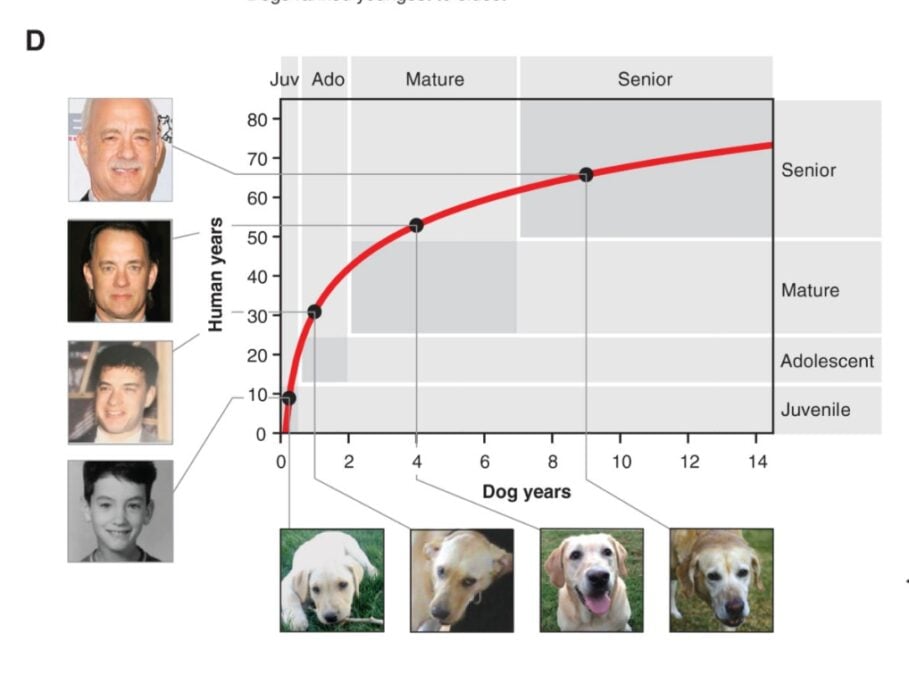
The revised dog-age formula shown as a graph, comparing the ageing of Tom Hanks and a Labrador. (Wang et al., Cell Systems, 2020)
This finding indicates that ageing may not be wholly distinct from development. Rather, at least part of the molecular machinery that builds an organism may keep changing throughout life, making ageing a continuation of development.
Mammals divided by millions of years of evolution may therefore possess strikingly similar molecular hallmarks of ageing. If these hallmarks can translate biological age across species, dogs may offer a particularly valuable view of the ageing process.
Related: Having a Dog in The House Could Improve Children’s Respiratory Outcomes
As the study authors write: "Dogs share nearly all aspects of their environment with humans, including factors associated with aging such as diet and chemical exposure."
Dogs could consequently help scientists better understand human ageing, and humans could likewise help illuminate ageing in dogs.
The ultimate aim is to identify interventions that enable both humans and dogs to enjoy longer, healthier lives.
For the moment, however, there is a new trick for dog-birthday parties.
When somebody next says their dog is 47 in human years, you can politely point out that they have calculated it incorrectly.
Read the full report in Cell Systems.
This article was fact-checked by Rachel Garner and edited by Peter Dockrill. Although we take pride in our process, we are only human. If you notice an error, please tell us.

















Comments
No comments yet. Be the first to comment!
Leave a Comment