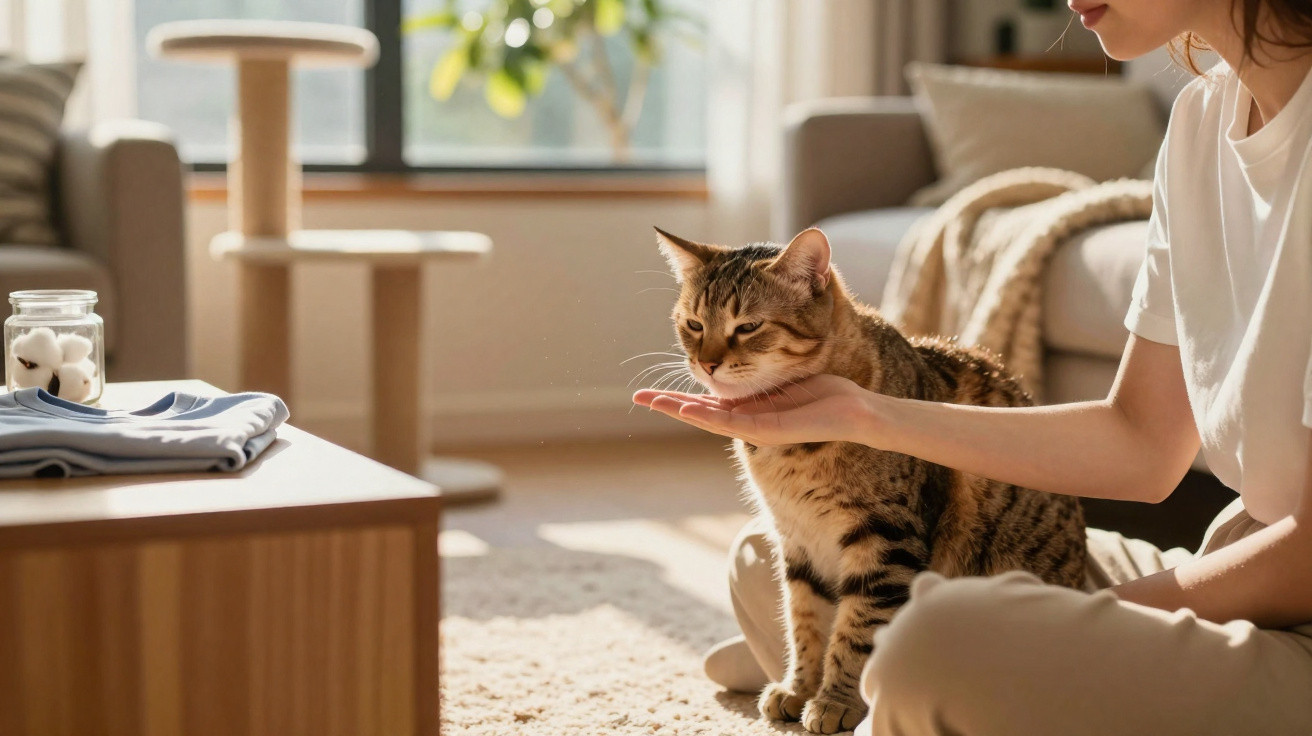
Have you ever wondered whether your cat could identify you in a line-up?
New findings indicate that they probably can - although not quite as you might imagine.
Earlier research showed that just 54% of cats were able to recognise people from their faces alone.
So, how does your cat know who you are?
Examining cats’ sense of smell
A study published today in PLOS One indicates that cats can recognise their people through scent. This ability has not previously been investigated and could reveal an additional dimension to the bond between cats and humans.
Cats are frequently labelled aloof or indifferent towards the people around them, yet an increasing body of research suggests otherwise. We already know that cats learn the names given to them, that cats and their guardians develop their own ways of communicating, and that most cats choose social interaction with people over food - a decision that even dogs find difficult.
This latest research now shows that cats can distinguish their people by smell, just as they use scent to identify the feline companions in their close social groups.
Yutaro Miyairi and colleagues at Tokyo University of Agriculture examined whether 30 cats could tell the difference between the scent of their guardian and that of an unfamiliar person.
The cats were given a plastic tube containing swab samples taken from beneath the armpit, behind the ear and between the toes of either their guardian or a person they had never encountered. An empty plastic tube was also presented as a control.
What the study found
The cats spent more time sniffing the scent of an unknown person than they did the scent of their guardian or the empty tube.
The briefer sniffing time suggests that cats recognised their guardian’s scent quickly and then moved on. By contrast, when presented with swabs from an unfamiliar person, they sniffed for longer, using their highly developed sense of smell to obtain information about the odour.
Comparable patterns have been recorded before: kittens spend longer sniffing the scent of unfamiliar female cats than that of their own mother, while adult cats sniff the faeces of unfamiliar cats for longer than those belonging to cats in their social group.
The results of this new research may suggest that humans, too, belong in our cats’ social circle.
The feline brain and nose
The researchers also observed a tendency for cats to use their left nostril when sniffing familiar scents, whereas unfamiliar scents were more commonly investigated with the right nostril. Once cats had spent some time sniffing and became accustomed to an odour, however, they changed from using the right nostril to the left.
Although this may seem an unusual result, a similar pattern has been identified in dogs. Existing research indicates that this nostril preference could mean cats use the right hemisphere of the brain to process and categorise unfamiliar information, with the left hemisphere taking over once a habitual response has formed.
Why cats rely on scent
Cats use scent both to collect information about their surroundings and to communicate.
Exchanging scents - through cheek-to-cheek rubbing and grooming one another - helps cats recognise members of the same social circle, sustain group unity and identify unfamiliar cats or other animals that could represent a threat or should be avoided.
Known smells may also reassure cats, easing stress and anxiety while fostering a feeling of safety in their surroundings.
If your cat seems distant and behaves as though you are a complete stranger when you return from a holiday, it may be because you smell unfamiliar. Try showering with the products you normally use at home and changing into your usual clothes. Recognisable scents should help you and your cat return to your familiar routine more quickly.
And if your cat spends plenty of time sniffing another person, remember that this does not mean they like that person more. Your scent is probably simply familiar and takes less effort to investigate. Rather than being novel and intriguing, it may offer something better: making your cat feel at home.
Julia Henning, PhD Candidate in Feline Behaviour, School of Animal and Veterinary Science, University of Adelaide
This article is republished from The Conversation under a Creative Commons licence. Read the original article.














Comments
No comments yet. Be the first to comment!
Leave a Comment