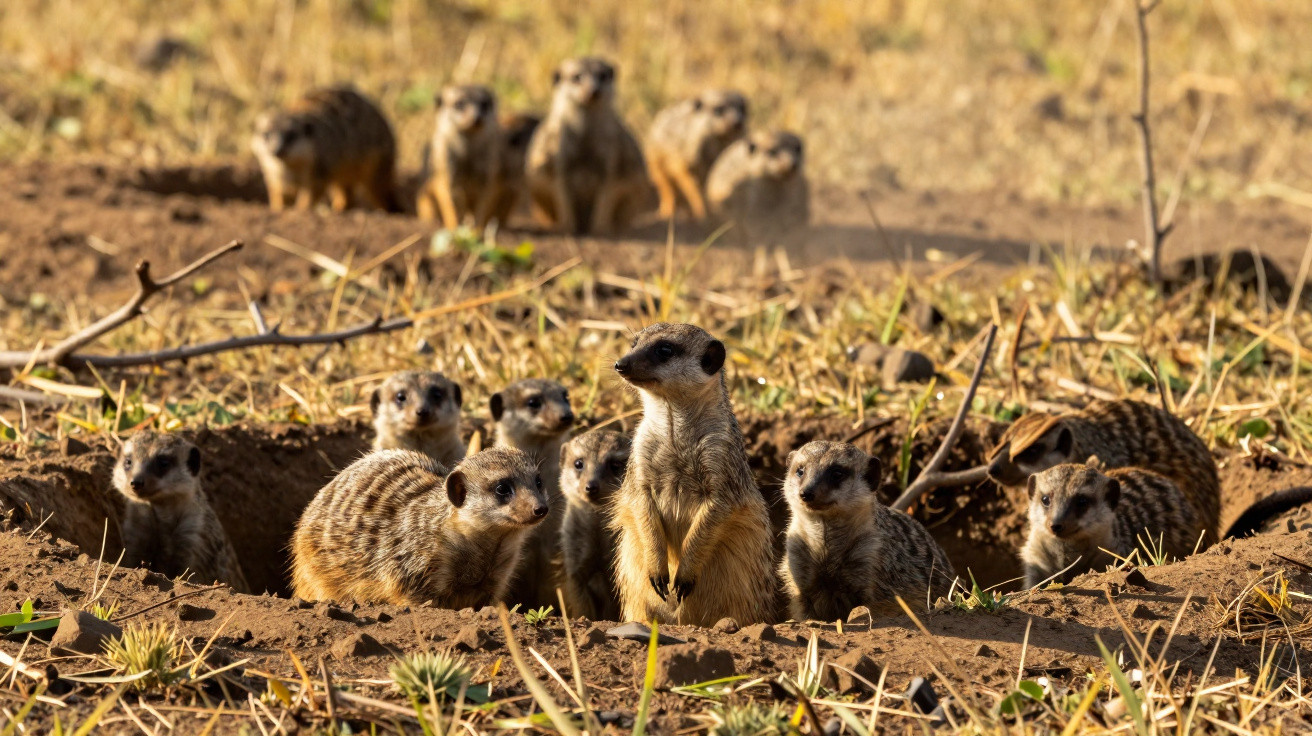
Conflict seldom occurs without advance signs. Animals living alongside competing groups can often detect the risk well before a confrontation takes place.
New findings reveal that dwarf mongooses behave in precisely this way.
In areas where an encounter appears probable, dwarf mongooses alter their movements, communication and territorial defence, even if no opponents are visible.
Researchers from the University of Bristol led the study, using a decade of detailed observations of wild groups in South Africa.
War starts before the fight
Scientists have previously used the term “landscape of fear” to describe how prey animals avoid predators. This research extends the concept to competition between members of the same species.
For mongoose groups, danger comes not just from hawks and snakes but also from neighbouring groups. These rivalries influence routine choices throughout their territories.
“Not only are the mongooses keeping track of where their enemies might be, but they’re factoring in the relative size of different groups. They can then tailor their pre-emptive behavior accordingly,” said Dr. Josh Arbon, who led the study.
This latter finding is central to the research. Previous studies generally considered only the location of danger, rather than the identity of the rival involved.
Africa’s smallest carnivore
Dwarf mongooses are Africa’s smallest carnivores. They form groups of five to 30, collectively defending a shared territory.
Conflicts between groups are frequent, and these encounters may result in injuries or, occasionally, death.
The researchers monitored 12 wild groups for approximately 10 years. Their records included more than 1,600 daily movement tracks, 16,000 guarding observations and 2,000 returns to sleeping burrows.
Importantly, the team examined peaceful periods instead of ongoing confrontations. Nearly every data point was collected on days when no encounter with a rival occurred.
Mongooses size up their rivals
Each group has several neighbouring groups at any one time, including some that are bigger, smaller or similarly sized.
Larger groups generally prevail in contests and therefore present the greatest physical threat. Similarly sized groups pose another kind of risk, however, as contests against them are more likely to last longer and intensify.
The mongooses appear able to distinguish between these risks. After entering a neighbour’s home range, a group adjusted its subsequent behaviour according to that neighbour’s relative size.
Louder calls for bigger rivals
Mongooses rotate sentinel duties, with an individual climbing to an elevated position to look out for danger. Sentinels commonly signal their presence with a quiet surveillance call.
These calls became more common when the neighbouring rival group was larger. For every doubling in relative group size, the likelihood of a call rose by about eight percent.
“We know that battles between groups can be very dangerous for participants. What we’ve shown now is that there are constant behavioral changes to mitigate these risks and enhance the likelihood of future contest success,” said Professor Andrew Radford, who supervised the project.
More effective communication helps maintain coordination across the group. Once a reliable sentinel has called, it also allows foraging mongooses to reduce their own vigilance.
Mongooses sleep away from rivals
Sleeping locations revealed a contrasting pattern. In this case, the most pronounced response was directed towards rivals of a similar size.
Groups were least inclined to sleep within the range of a similarly sized neighbour. About a quarter of all clashes occur at burrows, where getting away can be difficult.
Choosing safer ground for the night appears to be practical risk management. The potential cost of a burrow ambush is simply too great when facing a formidable competitor.
The team also examined the long-held belief that territory boundaries are invariably more dangerous than central areas. Their results were less straightforward.
When sleeping close to a boundary, groups did return to their burrows later. Yet sentinels were actually less watchful at the edges, contrary to what a simple threat-based explanation would suggest.
Feeding opportunities, scent-marking responsibilities and exposure all complicate what a territorial boundary represents. Location alone is therefore an unreliable indicator of genuine risk.
How small mongooses survive rivals
This research was part of the long-running Dwarf Mongoose Research Project, established by Dr. Julie Kern and Dr. Amy Morris-Drake. Long-term, careful observation enabled the team to identify these subtle behavioural decisions.
“The dwarf mongooses are an ideal model species. Both because their lives are strongly affected by intergroup conflict and because we could observe them so closely in natural conditions,” said Dr. Kern.
“Conflict between groups is rife throughout the natural world. We have shown that animals are continuously making decisions in a landscape of conflict, not just when they actually encounter rivals,” added Dr. Morris-Drake.
Dr. Arbon said the findings offer insight into how smaller groups can survive, and even prosper, among stronger enemies by moving strategically through space and communicating about possible threats.













Comments
No comments yet. Be the first to comment!
Leave a Comment