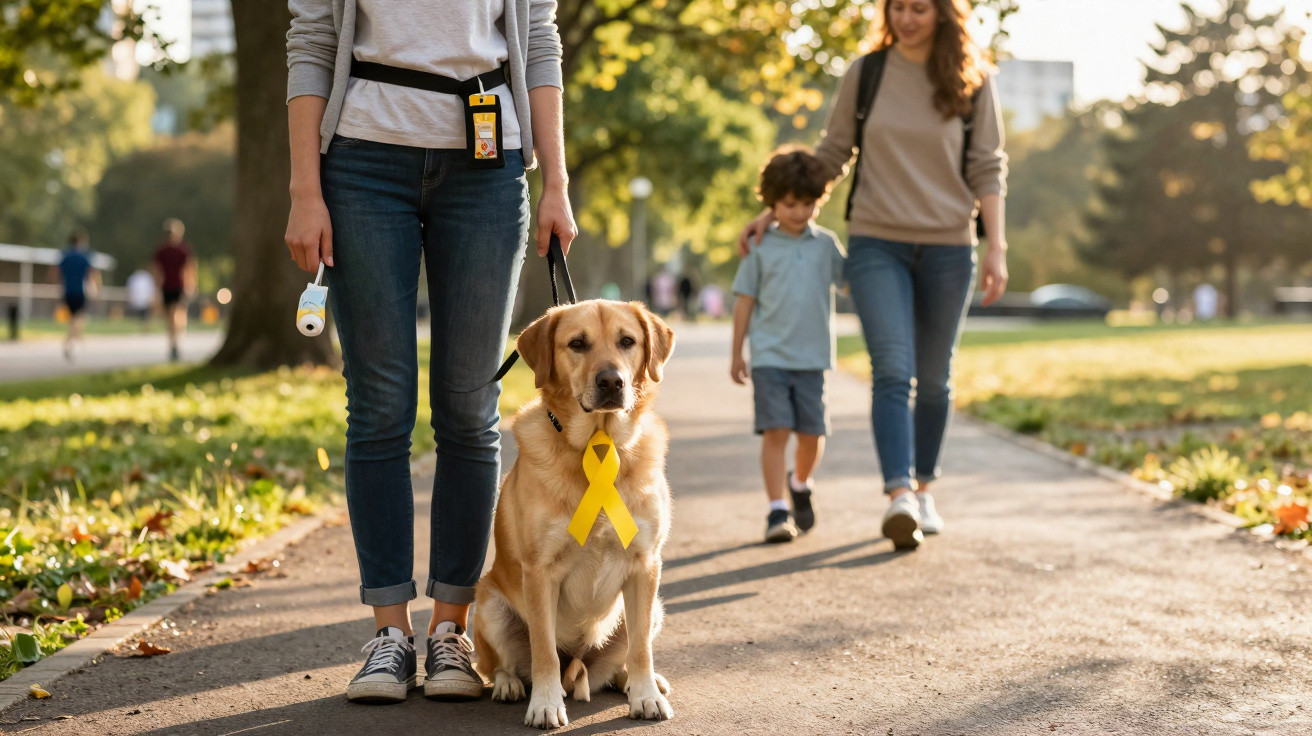
Between winter coats, paw boots and reflective collars, a yellow ribbon on a lead can initially look like just another accessory. Many people smile, bend down and want to stroke the dog on impulse. Yet this often puts both owner and animal in an awkward situation: the yellow ribbon is not a decorative gimmick, but a clear warning signal.
What the yellow ribbon really means
A yellow ribbon – sometimes a yellow cloth, yellow knot or yellow tag – carries one simple message internationally: This dog needs space.
Anyone who sees a dog with a yellow ribbon should keep their distance, avoid speaking to it and not seek physical contact – not even “just for a moment”.
The principle is straightforward: a clearly visible colour signal can prevent stress, misunderstandings and dangerous situations before they arise. It is effectively a “please keep your distance” sign for dogs.
Typical meanings of the yellow ribbon include:
- The dog does not cope well with direct contact from unfamiliar people or dogs.
- The dog is training and needs to remain focused.
- The dog is ill, injured or has recently had an operation.
- The dog becomes overwhelmed easily and reacts with stress.
Importantly, a yellow ribbon does not automatically mean that a dog is “nasty”. It simply means: Please leave us alone.
Why a dog needs space – common reasons
People often treat dogs as though they were living cuddly toys. In doing so, they may forget that every animal can have its own history, pain and fears. A yellow ribbon may be used for many different reasons.
Health issues and pain
A dog with arthritis, joint problems or a recent scar can appear completely normal from the outside. If someone touches a sensitive area, or another dog barges into it, it may snap from pain or react in panic.
The yellow ribbon communicates: Please do not bump into me, play boisterously or touch me. This allows the owner to protect their dog from further pain – and other people from a defensive response.
Fear, difficult experiences and “reactive” dogs
Some dogs have had negative experiences in the past or were never properly socialised. They can become stressed simply when an unfamiliar dog runs straight towards them or a child excitedly rushes up to them.
To inexperienced observers, these dogs can seem “moody” or “unnecessarily aggressive”. In reality, they are usually overwhelmed and merely trying to create distance. The yellow ribbon helps ensure they are not pushed to that point in the first place.
Dogs in training or behavioural therapy
Many owners work specifically with trainers on issues such as lead aggression, insecurity or being highly distractible. Any uninvited physical contact – a stranger’s hand on the dog’s head or a dog suddenly appearing nearby – can completely disrupt that training.
A yellow ribbon often means: focused, demanding work is taking place here. Every interruption sets both person and dog back.
Bitches in season and hormonal disruption
Some owners also use a yellow ribbon to insist on space when their bitch is in season. A “lovestruck” male dog on an extendable lead that suddenly charges over causes more than just disruption; it may also result in unwanted puppies.
How to behave when you see a yellow ribbon
The good news is that once you understand the signal, you immediately know what to do. No grand gestures are required, only a little consideration.
- Continue in your direction or move slightly aside
Walk on calmly instead of heading directly towards the dog. If the pavement is narrow, make a small detour where possible. - Do not stare
Staring can unsettle dogs. Briefly look away or keep your gaze casually on your surroundings rather than looking directly into the animal’s eyes. - Do not talk to or entice the dog
No “Hello, sweetie”, whistling or coaxing. It may seem friendly to us, but for many dogs it is stressful. - Do not hold out your hand
Do not stroke or tap the dog, and do not assume “he can sniff me first”. Keep the distance intact. - Keep your own dog close
Shorten the lead, bring your dog to your side and do not allow spontaneous nose-to-nose contact.
This behaviour may seem distant, but it is a form of respect. It tells the owner: “I see your signal and I will be considerate.”
Where the yellow ribbon signal came from
The idea of a standardised colour code emerged in Scandinavia more than ten years ago and became known in many countries through initiatives such as the “Yellow Dog Project”. Its aim was a simple, quickly understood signal that works regardless of language or culture.
In some countries, yellow markings on dog leads are now widespread, while elsewhere the system is only gradually becoming better known. In densely populated cities, parks full of dogs and narrow walking routes in particular, such a signal can stop conflicts from arising at all.
Why many people misunderstand the yellow ribbon
Many passers-by assume the ribbon is a fashionable detail or a cute accessory. That is hardly surprising: pet shops display colourful leads and collars in every shade, while social media is filled with photos of beautifully styled dogs.
When awareness is lacking, good intentions and ignorance can quickly form a dangerous combination:
- People bend over the dog without asking.
- Children happily run straight towards the dog.
- Owners of off-lead dogs merely call, “He won’t do anything” – while still allowing their dog to approach.
Most incidents involving dogs on leads happen not because dogs are “nasty”, but because people ignore signals or do not recognise them.
What owners can do themselves
Anyone with a dog that needs space can use the yellow ribbon deliberately. It is also sensible to communicate openly, especially in places with many passers-by.
Useful measures for owners include:
- Attach a clearly visible yellow ribbon or cloth to the lead or collar.
- If someone asks curiously, explain briefly and politely: “He simply needs space; otherwise he feels uncomfortable.”
- Do not apologise; confidently stand up for the fact that the dog needs protection and calm.
- If children are nearby, state clearly: “Please do not touch him; he does not like it.”
The more people understand the principle, the better the system works in everyday life.
Why keeping your distance is often better welfare than stroking
Many dog lovers believe that the more affection they show a dog, the better. But what feels like affection to us can feel intrusive to some dogs. A stranger bending over them can feel like an attack from above, even if their hand is gentle.
Children in particular are often taught: “Dogs are kind.” A more appropriate message would be: “Always ask the owner – and sometimes looking away is what is best for the dog.”
Respecting the yellow ribbon does not only protect sensitive animals. It also reduces the risk of bites, unwanted dog encounters and awkward arguments between owners. Dogs and people can complete their walk without constantly having to explain themselves.
Practical everyday examples
Typical situations in which the yellow ribbon is enormously helpful include:
- An older dog with hip problems that feels pain when knocked.
- A rescue animal that has only recently joined the family and is still frightened of strangers.
- A young dog learning to walk properly on a lead, which becomes completely overexcited again with every interaction.
- A bitch shortly after an operation that should move as little as possible.
In every one of these cases, “just a quick stroke” might be a pleasant moment for the person – but an imposition for the dog.
Conclusion without a closing formula: distance as a sign of consideration
Loving dogs does not mean having to touch them constantly. Sometimes genuine care for animals is shown precisely by leaving a dog alone. The yellow ribbon makes that request visible – quietly, but very clearly.
The most important rule is therefore this: if you see a yellow ribbon on a lead or collar, keep your hands in your pockets, your gaze relaxed and your own dog close to you. That is all it takes to make walks far less stressful for many dog-and-owner teams.













Comments
No comments yet. Be the first to comment!
Leave a Comment