Not so long ago, geneticists believed they had resolved the origin of domesticated horses with one defining date. Around 2200 BCE, a single even-tempered lineage spread throughout the ancient world. That, the accepted view held, was the moment horses transformed history.
New research challenges that conclusion. Bronze Age herders on the steppe were already riding, milking and systematically managing horses centuries before 2200 BCE.
According to the new analysis, that later date identifies the point at which one lineage prevailed and spread worldwide, rather than the beginning of the story.
A longer beginning
Volker Heyd, a professor of archaeology at the University of Helsinki, has devoted years to investigating this question.
Working with David Anthony of Hartwick College and Martin Trautmann at Helsinki, he assembled the argument through ancient DNA analysis, human skeletal remains and decades of fieldwork.
Recent genetic studies had dated horse domestication to about 2200 to 2100 BCE, when one horse lineage developed more placid temperaments and sturdier backs before spreading across Eurasia.
Under that interpretation, everything earlier was considered something different.
“Horses were already being used in sophisticated, widespread ways before we could pin down full domestication. That gap reshapes how we understand human history,” said Heyd, co-lead author of the research.
Horse domestication at 4000 BCE
The team’s most notable proposal is that humans were already managing three genetically distinct horse populations by around 4000 BCE.
Previous research had identified two of these lineages. This study puts forward the third for the first time.
They each occupied a separate area, extending from western Siberia to central Europe. Because the animals appeared sufficiently alike, herders were probably unaware that they were handling three distinct populations.
The more accurate account, it appears, is not of one pioneering population radiating outwards, but of several regional experiments occurring simultaneously, with horses tamed repeatedly across different grassland regions.
Milking before mounting
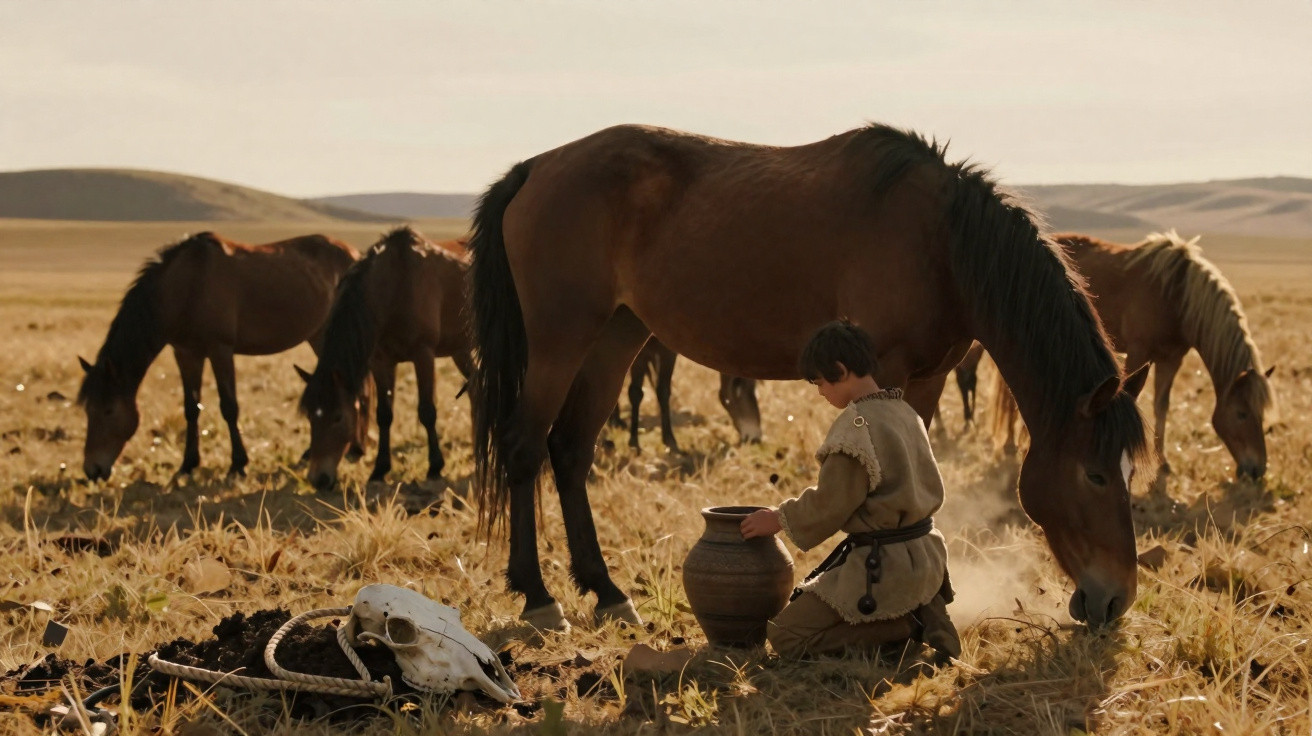
Some of the oldest indications of horse use are unrelated to riding. By around 3500 BCE, people on the Eurasian steppe were consuming horse milk. Evidence has been found baked into pottery, while further traces were discovered on the teeth of buried herders.
Milking requires control. Mares must be kept settled, foals separated from adults, and a small herd managed so it does not disperse. This practice probably preceded anyone riding a horse.
A separate 2023 study identified skeletal wear in Yamnaya men, including painful hips and distinctive spinal strain, that was consistent with spending substantial time on horseback.
Riding was therefore almost certainly established when Yamnaya culture began to expand. It was labour, not cavalry.
Yamnaya in the saddle
The Yamnaya were Bronze Age people who inhabited the lands north of the Black Sea from roughly 3200 to 2600 BCE. As herders and constructors of large kurgan burial mounds, they travelled quickly and over considerable distances.
Over only a few generations, Yamnaya groups expanded west into Hungary and eastwards towards Mongolia. Their DNA remains detectable in present-day Europeans. The enduring question has been how they travelled so far.
The new review maintains that horseback travel was part of the answer. Their horses, however, were unlike the manageable animals familiar to modern riders.
Before the emergence of those calming characteristics, Yamnaya horses were probably nervous and difficult to control. They were suitable for herding, but less effective in combat.
The breeding bottleneck
Around 2200 BCE, the picture changed dramatically. Horse populations declined sharply, while one lineage survived with traits associated with stronger backs and calmer temperaments.
These horses spread rapidly. In just a few centuries, this single bloodline had displaced the older regional populations in nearly every area.
The other groups either declined or disappeared altogether, while the genetic variety once present across Eurasia was reduced to a single line.
All domesticated horses living today descend from that restricted period. Even the supposedly wild Przewalski’s horse, on closer examination, descends from one of the earlier domesticated lineages.
This means no genuinely wild horses remain anywhere on Earth.
Words on the move
Movement on such a scale transported more than people: it also carried languages. The spread of Proto-Indo-European, the ancestor of English, Hindi, Russian, Greek and dozens of other languages, closely follows Yamnaya expansion and the appearance of wheeled wagons and riders.
A rider on horseback could travel in hours a distance that would take a wagon days. This altered how far individuals could journey, whom they could trade with and which settlements remained connected. Language moved with the riders.
Humans and domesticated horses
The new review establishes that the genetic event of 2200 BCE did not mark the beginning of domestication. Instead, it represented the conclusion of a long, regionally diverse process that had been in progress for at least 1,000 years.
That difference places horse riding in the Yamnaya period and earlier. The migrations, linguistic shifts and disruptions of roughly 3500 to 2000 BCE unfolded, at least partly, on horseback.
“The role of horses in major historical developments is almost too vast to measure, hence the saying that the world was conquered on horseback,” Heyd said. The new paper argues that the first thing conquered was distance.

















Comments
No comments yet. Be the first to comment!
Leave a Comment