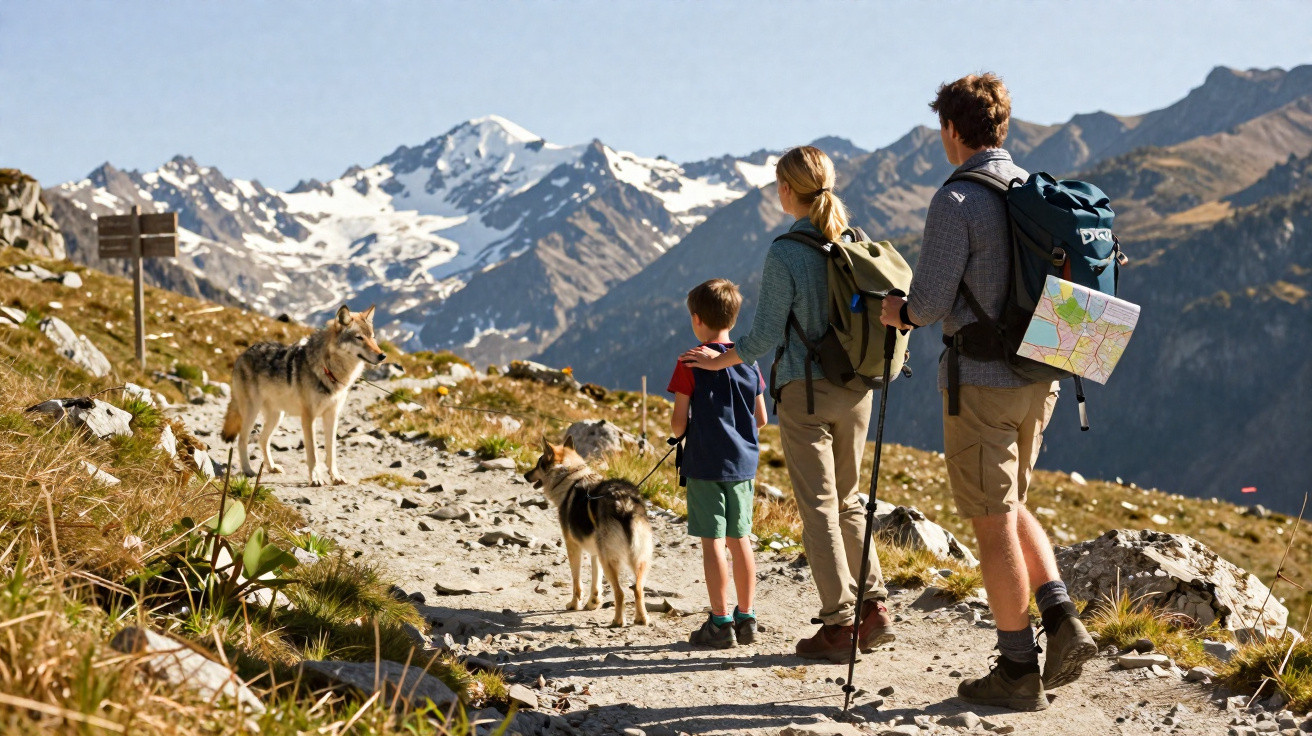
A grey shape on a mountain path, a brief glance, and your pulse races – in that very moment, a few seconds can determine whether the situation remains calm or escalates.
More and more wolves are once again roaming the Alps and other mountain ranges across German-speaking Europe. Frequent hikers may carry fears shaped by fairy tales, social media and alarming videos. What matters is not whether you encounter a wolf, but how you react in that instant – because an apparently logical reflex can make everything worse.
Wolves are back – but they are not monsters from a children’s story
Since the 1990s, wolves have re-established themselves in many parts of Europe. Sightings are also becoming more common in Germany, Austria and Switzerland, particularly in woodland and mountainous areas. The animals follow old migration corridors and adapt remarkably well to modern landscapes.
Even so, an encounter on a mountain path remains unusual. In most cases, the wolf notices a person first, turns away and disappears silently. Anyone who does see one will often only glimpse a distant silhouette, gone again within seconds.
“Wolves avoid people. By far the animal’s most common response is to keep its distance and retreat.”
The truly tense situation begins when a wolf does not immediately leave. It may stand still out of curiosity, cross the path slowly, or watch a herd from some distance away. These are precisely the moments when it becomes clear whether a person projects calm or panic.
The most dangerous reflex: running away
Many people imagine that, in a serious situation, they would simply run. It feels like the instinctive choice: get out of the danger zone, create distance and take no chances. To a wolf, however, that response can mean something quite different.
Deliberately running away can trigger its prey-chasing behaviour. In nature, prey animals flee – and a creature in flight can activate a hunting instinct, even if the wolf had not previously considered attacking.
“Anyone who runs away from a wolf in panic is more likely to appear, in its eyes, as potential prey than as a serious counterpart.”
The key point is that wolves are considerably faster and have greater endurance than people. Attempting to sprint away not only means losing control of the situation, but also increases stress in both your body and the animal. The best approach is therefore to stop, breathe and act deliberately.
How to respond properly to a wolf encounter in the mountains
Wildlife biologists and mountain rescue experts recommend a clear procedure that is easy to remember. It may sound straightforward, but putting it into practice requires a degree of self-control.
Stay calm and hold your position
- Do not run: Remain where you are, even if the urge to sprint is strong.
- Stay upright: Stand tall; do not crouch down or sit down.
- Maintain eye contact, but do not stare: Keep the wolf in view without fixing it with an aggressive stare.
- Breathe steadily: Taking several deep breaths in and out can help contain panic.
Speak in a firm, ordinary voice. Short, clear phrases are enough: the wolf recognises that you are a confident, large being rather than prey. Shouting or hysterical screaming achieves little and merely transfers stress to everyone involved.
Step back slowly without turning your back
If the wolf remains where it is or watches you for longer, take a few slow steps backwards. Do not turn around while doing so. This careful retreat communicates that you are not seeking conflict, while still wanting distance.
Always make sure you have secure footing. Avoid scree slopes and steep banks. In practice, the danger of falling is often greater than the risk posed by the wolf itself.
Keep the group together and protect children and dogs
When travelling in a group, everyone should move close together. People appear larger and more assured as a unit. Children should stand in the middle of the group or behind its calmest person.
“Never allow dogs to run freely towards a wolf – they can put the animal on the defensive and make the situation unpredictable.”
If you are out with a dog, put it on a lead immediately and keep it close to your body. However difficult it may be, do not say, “Run, chase it away.” A dog that confronts or barks at the wolf may be injured or push the animal into a fighting response.
Common mistakes that make an encounter more dangerous
Besides running away, other behaviours can turn a harmless moment into a stressful situation.
| Mistake | Why it is a problem |
|---|---|
| Moving too close for photos or videos | The wolf may feel pressured and could defend itself. |
| Following the wolf when it retreats | This breaches its flight distance, and it may learn not to avoid people. |
| Feeding it or throwing food towards it | This habituates the animal to people and increases conflicts with alpine pastures and villages. |
| Shouting, waving wildly or running away in panic | This raises stress levels and may trigger a flight or pursuit response. |
All of these mistakes have one thing in common: they alter the relationship between people and wolves. A shy, cautious wild animal can become either an inquisitive, habituated animal or a pressured animal with a defensive instinct – neither is something you want to encounter in the mountains.
Why wolves frighten us so much
The fear runs deep. From childhood, people hear stories of the “big bad wolf”, of cunning predators in the forest. Images of bloody fangs and animals tearing at prey become ingrained, while hardly anyone ever has a real encounter.
Viral clips on social media add to this, often filmed in entirely different countries or in enclosures. Such impressions can quickly overshadow sober facts: in Europe, wolves attack people extremely rarely. Their conflict is primarily with grazing livestock, not walkers.
“Anyone who understands before a walk that wolves are shy wild animals rather than figures from horror stories will react more confidently if the situation arises.”
A realistic understanding of the animals’ behaviour helps keep personal panic under control. Those who know that a wolf generally prefers distance are more likely to feel respect than sheer terror during an encounter.
How to prepare before setting off on a walk
Good preparation starts not on the trail, but at home, when checking a computer or looking at a walking map.
- Find out whether wolves have recently been recorded in the area.
- Read advice from national parks or Alpine associations about dealing with wild animals.
- Calmly explain in advance to children what they should and should not do.
- Keep dogs on a lead near grazing land and woodland – not only once a wolf is standing in front of you.
Many mountain hut wardens and mountain guides now have their own experience or official information leaflets. Asking them for advice means you can set out better prepared and with a clear idea of what to do.
Wolves, livestock and the perspective of local people
For many mountain farmers, the wolf is less a mythical creature than a very practical problem: sheep killed by predators, unsettled herds and higher costs for protective measures. Walkers should be aware that careless behaviour around wolves – such as feeding them or attracting them for photographs – can make these conflicts even worse.
Respecting livestock herds, accepting livestock guardian dogs and keeping away from fenced-off grazing areas are now part of mountain etiquette. By not habituating wolves to people, walkers help ensure that they remain away from settlements and that encounters continue to take place at a distance.
Practical perspective: how risky is a wolf encounter really?
A sober look at the facts shows that the greater risk on a mountain walk almost always comes from sudden weather changes, falls or exhaustion – not from a wolf. Dramatic attacks on people are exceptionally rare in Central Europe and are usually linked to sick animals or wolves that have been heavily fed by people.
Nevertheless, it is worthwhile having a clear strategy in mind. It provides reassurance and prevents thoughtless reactions. Knowing that running away is the worst reflex can help you control that first second of shock and take calm, sensible action.
Ultimately, a wolf remains what it is: a large, shy wild animal with an impressive presence. An encounter in the wild can be an intense experience – provided that people do not become fleeing prey, but act calmly, respectfully and thoughtfully.













Comments
No comments yet. Be the first to comment!
Leave a Comment