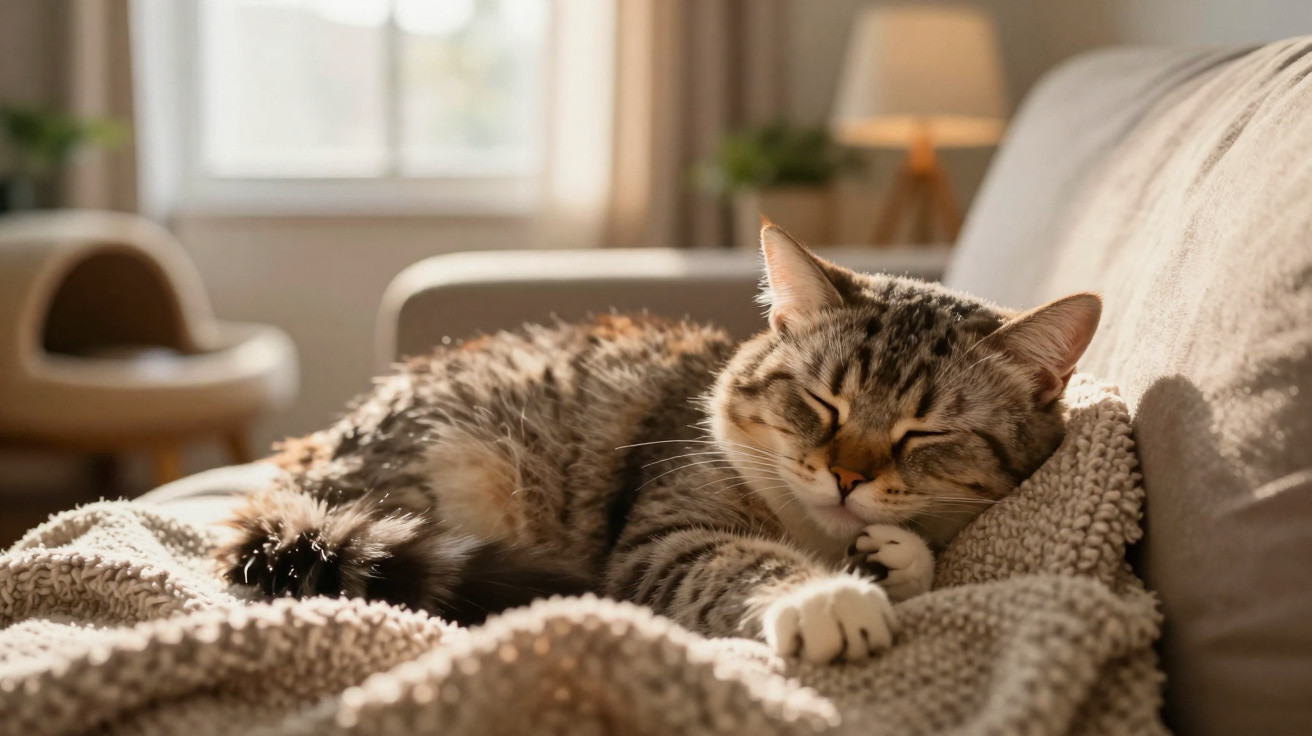
Your feline companion is curled up on the sofa, paws over its eyes – irresistibly sweet.
Yet there is more to this pose than simple cuteness.
Many owners see this sleeping position as nothing more than an ‘aww’ moment made for Instagram. In fact, it can reveal a surprising amount about a cat’s needs, instincts and even emotional state. Looking closely helps you understand what your four-legged friend truly needs to feel safe and comfortable.
Why cats cover their eyes while sleeping
A natural ‘sleep mask’ against artificial light
Living-room lights, television screens and mobile phone displays mean our homes are rarely properly dark, even in the evening. Cats are sensitive to this constant illumination. When they cover their eyes with their front paws while asleep, they are doing something entirely logical: creating their own natural screen from view.
By placing its paws over its eyes, a cat blocks out disruptive light and makes it easier to reach deep sleep.
A cat’s pupils work like high-performance sensors, adapted to twilight and night-time conditions. Even minor sources of brightness can interrupt the transition into deeper sleep stages. Covering its eyes helps the cat prevent precisely these disturbances. It is not merely adorable; it is also remarkably clever.
Deep sleep rather than constant dozing
Many people assume cats simply doze all day. Like us, however, they need periods of deep sleep and dream sleep, when both body and brain can genuinely recover. Bright or changing light can significantly disrupt these stages.
By shielding its eyes, a cat effectively creates its own ‘night mode’. This allows it to:
- drift into deep sleep more easily
- wake less often because of light stimuli
- maintain a stable sleep rhythm
- reduce stress hormones more effectively
If you often see your cat sleeping with a paw over its eyes, it is likely trying to create its own patch of darkness amid everyday light.
How paws help cats manage warmth
Protecting the sensitive cat nose
Cats have dense fur, but one part of the body remains almost unprotected: the nose leather. This small area loses heat quickly, particularly when the surrounding air is cooler. By resting its paws over its face during sleep, a cat also warms this sensitive area.
Paw over the nose, tail tucked close to the body – this is how a cat limits heat loss and conserves energy.
This pattern is especially easy to notice in winter or in slightly draughty rooms. The cat forms a compact ball, with its paws and tail acting like an extra blanket. This technique is vital for survival in outdoor cats, while house cats retain the same instinct.
A cosy cocoon against stimuli and stress
Modern homes can be noisy and busy places for cats: voices, music, vacuum cleaners, playing children and constant movement. When a cat shields its face with its paws, it is not only protecting itself from light but, in a sense, from the outside world too.
This position creates a small private retreat. For the animal, seeing less also means there is less to monitor and fewer stimuli to process. Its nervous system can finally wind down.
Typical signs of this ‘cocoon mode’ include:
- a tight, rounded sleeping position
- a tail wrapped around the body
- ears turned more to the side or backwards
- little response to quiet sounds
In this state, the body can process stress more effectively, heart rate and breathing become calmer, and the cat restores its energy.
What this cat sleeping pose reveals about trust and security
When a cat willingly gives up ‘guard duty’
Cats are naturally alert animals. Even when asleep, they often remain partly aware of their surroundings and react quickly to sounds. If a cat voluntarily covers its eyes, it sends a strong message: it feels sufficiently secure in its territory to stop monitoring everything constantly.
A cat that sleeps with its eyes covered is saying: ‘I feel so safe here that I do not need to keep watch.’
This pose often appears only after some time in former stray cats or animals adopted from rescue centres. Seeing it for the first time is, in essence, a quiet declaration of trust.
How owners should behave at this moment
The temptation can be strong: take a quick photograph, give the cat a brief stroke or perhaps gently lift its paw because its face looks so sweet. For the cat, though, this interrupts sleep at a time when it is most vulnerable.
Instead, it is better to follow a few simple guidelines:
- do not touch the cat when its paws are over its eyes
- avoid flash photography – ideally, take pictures only from a distance
- keep noise levels low near its sleeping area
- dim lamps or screens if the spot is very bright
Respecting this protected state will significantly strengthen trust and the bond with your cat over time.
What owners can do to improve a cat’s sleep
Provide quiet areas and regular sleeping places
Although cats enjoy changing locations now and then, they benefit from one or two clearly defined rest areas in the home. Raised spaces, soft baskets or enclosed beds protected from draughts are ideal.
Useful everyday measures include:
- do not place the sleeping spot directly beside a television, speaker or walkway
- avoid having a very bright lamp permanently lit nearby
- keep it warm but not overheated – cats generally prefer 20 to 24 degrees
- use heat-retaining fabrics such as blankets, cushions and felt caves
If your cat adopts the ‘paws over the eyes’ pose more frequently in these places, that is a positive sign: it accepts the area as a safe refuge.
When vets consider sleep problems a concern
Occasional changes of position, including during the night, are normal for cats. It may become concerning when sleeping habits change markedly: the animal seems persistently restless, struggles to fall asleep or repeatedly startles awake.
Warning signs may include:
- unusually frequent pacing during the night
- loud night-time meowing for no obvious reason
- noticeably short sleep phases followed by pronounced irritability
- other symptoms such as excessive grooming, loss of appetite or withdrawal
In such cases, it is worth examining the environment first: noise sources, new lights and altered routines. If the behaviour continues, a vet should assess whether pain, the thyroid or other illnesses may be involved.
How the behaviour can change over the years
Young whirlwinds, older sleep experts
Young cats sleep a great deal, but they often switch positions wildly and are easily distracted. The paws-over-the-eyes position usually appears only once they have found a clear favourite spot where they feel particularly safe.
In older animals, this pose often becomes more common. They feel the cold more quickly, respond more sensitively to light and noise, and instinctively use anything that makes sleeping more comfortable. Offering a senior tomcat or senior female cat softer, warmer places supports this natural process.
For owners, it is worthwhile to observe their own cat consciously in everyday life: how does its sleeping position change when visitors are present? When there is a storm outside? When the television is switched off? A ‘paw over the eyes’ may be just a small detail, but it reveals a great deal about a cat’s sense of security, perception of temperature and stress level.






Comments
No comments yet. Be the first to comment!
Leave a Comment