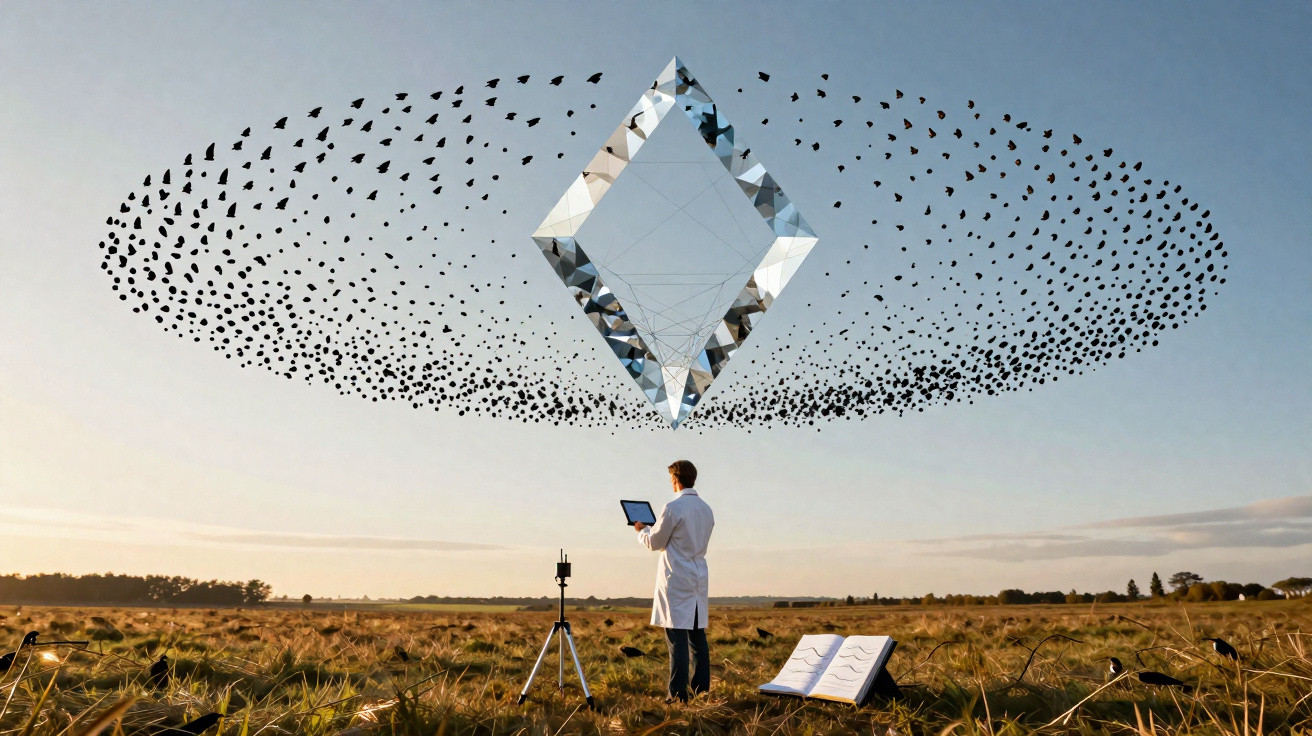
Watching a flock of starlings, it is tempting to think that every bird is merely following its nearest neighbour, copying each turn until the whole mass moves in unison.
For years, this nearest-neighbour view has shaped scientific explanations of bird flocks and fish schools.
Mathematicians have now examined not just the animals, but also the air and water they set in motion. In doing so, they identified a missing part of the explanation.
When arranged in a line, a flock stays together not so much like a crowd as like a solid material.
Flocks behave like crystals
The research was carried out at the Applied Mathematics Laboratory at New York University (NYU).
Christiana Mavroyiakoumou developed the model alongside laboratory director Leif Ristroph and undergraduate Jiajie Wu.
After studying birds and fish positioned one behind the other, the researchers found that the group behaves like a soft crystal – a material in which atoms occupy a regular, repeating arrangement.
In this comparison, every animal acts as an atom, maintaining equal spacing from those around it.
The team says the formation is held together not solely by vision or instinct, but by the moving air and water produced by each body.
These flows guide neighbouring animals into place, much as unseen bonds secure atoms within a lattice.
The force between neighbours
Each beating wing or moving tail produces a wake of swirling vortices that influences the animal behind.
Get too near and the flow drives you away; fall too far back and it draws you forwards.
This back-and-forth places each member at an ideal distance, about 1.2 times the wave created by a leader’s flapping.
If a follower is displaced, the flow acts like a spring and returns it to position.
Flying in line also offers a genuine benefit. Birds behind can gain lift from the bird in front.
One study of migrating ibis showed that they move into precisely the right position to make use of this rising air.
Testing the theory
To examine the idea, the researchers drew on a decade of laboratory experiments, including a mechanical version of a flock.
The apparatus featured 3D-printed plastic wings, driven by small motors and able to flap freely in a water tank.
Five flappers moved through the tank in single file, coming to rest wherever the currents directed them.
As predicted by the model, the flappers adopted evenly spaced positions. It recreated formation flight using little more than plastic wings and motors.
“Our findings offer a new way to understand how animal collectives coordinate movement and respond to their environment,” said Mavroyiakoumou.
The agreement between the machines and the mathematics indicated to the researchers that straightforward flow rules, rather than complicated decision-making, may account for the ordered columns seen in nature.
Ripples down the line
However, this neat arrangement has a drawback, which the team considers its most remarkable feature.
If one member of the line is disturbed, the disruption does not fade away. It instead moves along the formation and becomes larger as it travels.
The researchers describe these moving disruptions as flonons, named after the waves that pass through conventional crystals.
Previous flapping-wing experiments had already observed the oscillation intensifying towards the rear of a group, eventually causing the machines to collide.
Before this study, there was no model explaining why these waves grow in strength or how long a column could become before failing. The new mathematics provides answers to both questions.
Since each animal experiences the wake from the one in front but cannot exert a force back on it, even a slight wobble is transmitted forwards. It reinforces itself as it progresses through the group.
Why flocks stay small
This feedback creates a firm limit on the size of an orderly column. Applying the calculations to different body sizes and flapping speeds gives a group size of four to nine members. Beyond that, the growing waves lead to a collision.
The margin for remaining safe is slim. A bird or fish near the rear might have only two to five wingbeats to correct its path before crashing into the neighbour ahead. If it misses that moment, the formation breaks apart.
Yet this sensitivity brings an unusual advantage. The same elastic quality that can break up a column also enables it to detect the slightest disturbance.
Such responsiveness may allow a flock to react rapidly to a sudden wind gust or a nearby predator.
Fragility and responsiveness could therefore be two aspects of the same phenomenon.
What the work changes
Previously, researchers could explain how two birds settle into formation and observe waves disrupting a larger group.
Before this research, scientists could not completely account for the source of spacing within a column or for the reason such formations have a maximum size.
Engineers are seeking exactly this type of set of rules. Drone swarms and underwater robots could operate more closely together while avoiding the instability that ends in a pile-up.
The flow mechanisms that enable fish schools to reduce their effort, documented in a recent study, may also extract power from moving air and water.
What once appeared to be a remarkable example of animal cooperation increasingly looks like physics organising the formation itself.
Birds and fish must still detect changes and respond to them, but the crowd’s order is built into the flows themselves.












Comments
No comments yet. Be the first to comment!
Leave a Comment