Many owners assume their dog would make plenty of noise if something were wrong. Often, however, the reality is quite different. Dogs are highly skilled at concealing pain – not because they are exceptionally brave, but because an ancient instinct still operates deep within them. Anyone who truly wants to protect their dog needs to recognise these subtle signs before it is too late.
Why dogs hide their pain
The wolf’s legacy: weakness is dangerous
Even if your dog now sleeps on the sofa and eats premium food, the wolf remains in its genes. Within a pack, weakness brings danger. An injured or ill animal slows down the group, attracts predators and puts the hunt at risk. In the wild, animals that openly show pain can often pay for it with their lives.
For this very reason, many dogs suppress signs of suffering for as long as they can. They may appear “normal” and might even continue playing, despite already being in considerable pain. To us, this can look like unusual toughness. In reality, it is an age-old survival mechanism.
Anyone who waits for a dog to cry out in pain will usually act far too late.
Not heroism – an automatic response
Hiding pain has nothing to do with courage or loyalty towards you. Your dog does not consciously decide, “I’d rather not say anything.” Its body and behaviour automatically follow old patterns. This response is deeply ingrained, even if today the greatest “enemy” is merely the vacuum cleaner.
Owners often misread this: “He is not whimpering, so it cannot be that bad.” It is precisely this assumption that frequently delays help. Pain in dogs is far more subtle – showing itself in posture, breathing, appetite and social behaviour.
Seven quiet signs that your dog is suffering
1. Unusual panting and slight trembling
Panting after running in the park is perfectly normal. Panting while resting on the carpet, at moderate temperatures, is a warning sign. If your dog pants for an extended period without any obvious exertion, it may indicate pain, stress or internal discomfort.
Persistent, shallow panting is especially concerning when combined with tense abdominal muscles or a slightly tucked-up belly. You may also notice very slight muscle twitches around the flanks or hind legs. These so-called micro-tremors indicate that the body is working against an unseen strain.
2. Repeated licking of one particular area
Licking is part of normal grooming. However, if your dog repeatedly focuses on the same place – a joint, paw or flank – there is usually more behind it. Saliva feels soothing to them, much as we instinctively rub an area that hurts.
Excessive licking may point to:
- joint pain, such as osteoarthritis
- minor injuries or inflammation
- internal pain close to the area being licked
- nerve irritation
Over time, the spot may become bald, red or sore. At that stage, it is no longer simply a symptom but an additional problem in its own right.
3. Hesitation when lying down and getting up
A healthy dog will generally lower itself easily, turn around briefly and settle. A dog in pain assesses every movement. It may circle for a long time, search for “the one” position, stop several times while trying to lie down, or abandon the attempt altogether. You can sense its fear of the moment when pain “hits”.
Many owners also notice that their dog no longer jumps onto the sofa, suddenly prefers a blanket on the floor, or avoids smooth stair treads. This can sometimes seem like “stubbornness” or “old age”. More often, it is simply an attempt to avoid pain.
4. A changed sleeping position
Dogs have preferred ways of sleeping. If these suddenly change and remain different, it is worth taking a closer look. An animal that once slept curled up may now lie stretched out and stiff. Or a dog that usually dozed on its side may start curling into a tight ball to take pressure off certain areas.
Changes like these can suggest pain caused by pressure or movement. The dog is attempting not to load a painful area or to keep particular joints in a fixed position.
5. Withdrawal and less contact
Pain makes many dogs quieter. They seek less closeness, retreat to other rooms, respond more irritably to touch or invitations to play. A dog that is normally very affectionate may suddenly lie alone in the hallway rather than with the family in the living room.
It can easily look like “a bad mood”. In fact, the dog is protecting itself: it wants to avoid unexpected contact, have peace and manage the pain as best it can.
6. Difficulty with hard food
Trouble eating hard food is a particularly typical sign. If your dog suddenly becomes reluctant to chew bones, dry food or dental chews but continues eating soft food, this may indicate pain in the teeth, jaw or neck.
Many animals drop individual pieces, chew only on one side, or go to the bowl but then leave the food untouched. Not every loss of appetite is a stomach or bowel problem; sometimes chewing simply hurts.
7. Small breaks in everyday behaviour
Often, it is seemingly minor details that build an overall picture: the dog no longer jumps into the car, no longer runs to the door when the bell rings, barks less often or avoids particular movements while playing.
Pain in dogs is expressed through many tiny deviations from their own “normal state”.
Anyone who knows their dog well will notice: “Something is different.” That quiet feeling should be taken seriously.
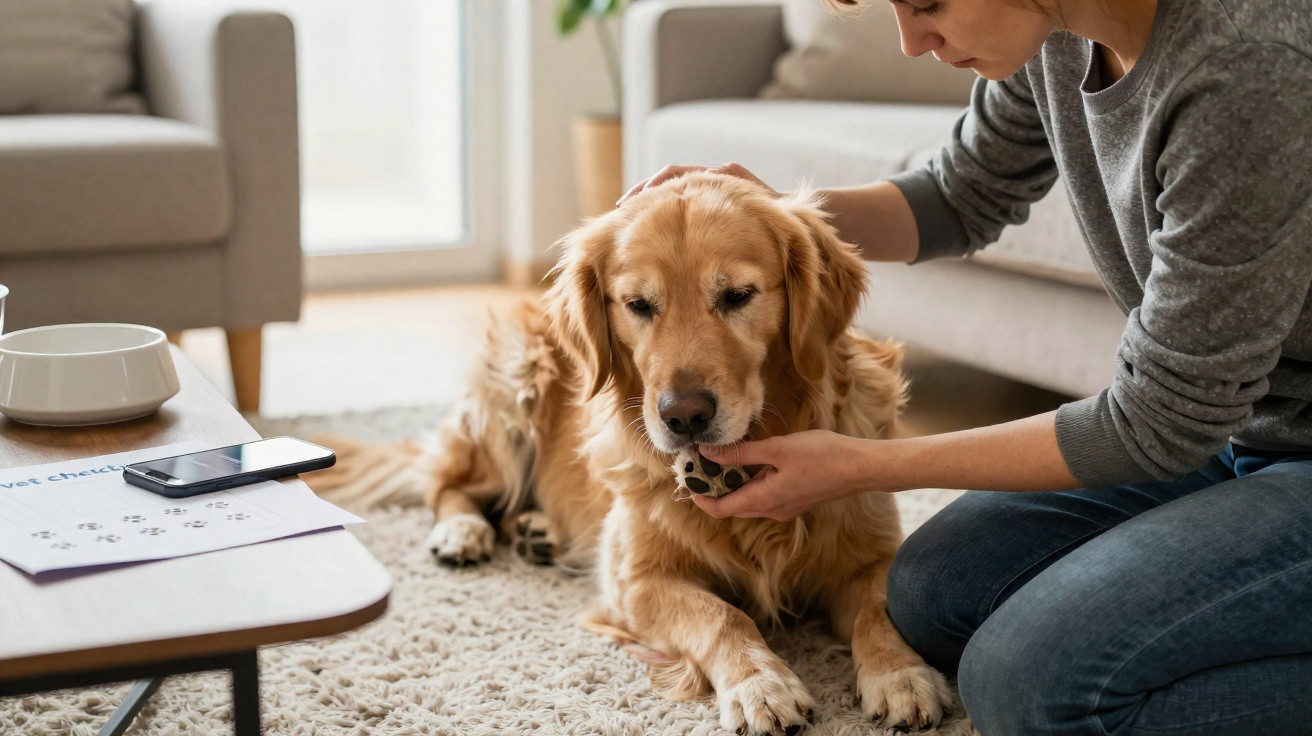
Using the veterinary checklist at home
The seven points at a glance
Many vets use scoring frameworks for chronic pain. A large proportion of the criteria can also be observed in everyday life. The following points provide a simple checklist:
- ongoing panting without physical exertion
- slight tremors around the flanks or hind legs
- intensive licking of one specific area of the body
- noticeable hesitation when lying down or getting up
- unfamiliar sleeping and resting positions
- withdrawal, less social contact and irritable reactions
- problems with hard food or sudden refusal to eat
If you notice several of these points at the same time, do not wait. A short video of the behaviour and a brief list of your observations can help the vet reach the cause much more quickly.
Observe rather than waiting for complaints
Dogs “speak” through subtle behavioural changes. Anyone waiting only for one loud symptom – whimpering, crying out or limping – may overlook weeks or months in which the animal has already been suffering. Love is shown through attentiveness, not through the number of treats bought.
One good approach is to set aside ten minutes every few weeks to watch your dog closely. How does it get up? How does it breathe when resting? How does it lie down? Is it eating as usual? These mini-checks create a routine, much like a brief body check for ourselves.
When it is urgent – and what owners can do
Warning signs requiring an immediate veterinary visit
Some signs must not be delayed. They include, for example:
- severe restlessness, alternating between lying down and jumping up
- intense panting despite a cool environment
- a hunched back and tucked-up abdomen
- refusing food for more than one day
- pale mucous membranes or severely reddened gums
- sudden severe limping or a complete refusal to move
As soon as one of these signs occurs, the dog should be taken to a veterinary practice or clinic. Pain is not merely unpleasant; it can cause lasting changes to circulation, organs and behaviour.
How to help your vet
The more accurately you observe, the better the vet can help. Useful information includes:
- when you first began noticing changes
- videos showing the gait, getting up and lying down
- details of which movements or touches cause problems
- information about food, activities and medication
Many types of pain can be relieved significantly with modern medicines and physiotherapy. Chronic complaints, such as those affecting older dogs with joint problems, are far more manageable today than they were a few years ago.
Greater understanding for the “quiet animal” beside you
The idea of the “tough dog” that simply takes everything in its stride remains widespread. Yet it means that many animals suffer unnecessarily for too long. Understanding the instinct from the wild behind this façade helps you see your four-legged companion differently.
Pain in dogs is often regarded purely as a symptom of old age. That is only partly true. A young dog can suffer from joint malformations, dental problems or internal illnesses just as much as a senior dog can. Particularly active dogs may conceal problems for a long time because adrenaline enables them to compensate.
It helps to discuss the issue within everyday family life. Children are often the first to notice when the dog no longer wants to play as it once did or avoids certain touches. Taking every observation seriously gives the animal the best chance of a life with less pain.
Ultimately, it is about one simple change in perspective: do not wait for your dog to raise a loud alarm, but learn to read the quiet signals it sends day after day – without saying a single word.








Comments
No comments yet. Be the first to comment!
Leave a Comment