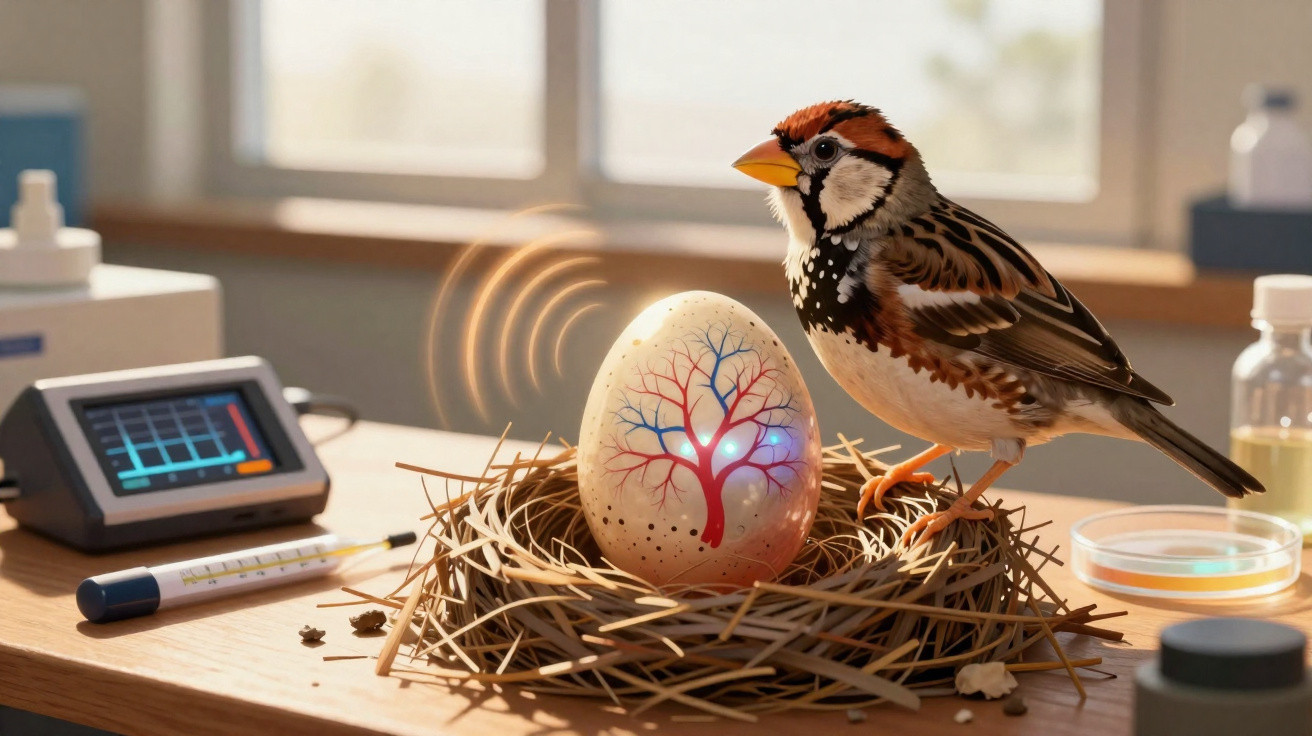
A zebra finch chick passes the last days of its development enclosed within an eggshell, unable to see the environment it is about to enter. That environment can be severe.
In Australia’s arid interior, a summer afternoon can make a nest almost furnace-like.
Before their young have encountered that heat, parent birds appear able to communicate a warning through the shell.
Zebra finch parents warn of heat
As temperatures rise, adult zebra finches pant and give a rapid, high-pitched vocalisation. Researchers refer to these as heat calls, which parents produce particularly often in the final days of incubation.
These calls appear to predict the warm conditions chicks will experience shortly after they hatch. Embryos exposed to them later become adults with greater heat tolerance, changed growth and a preference for warmer locations.
Until now, however, no study had demonstrated whether these warning calls directly alter the developing brain. This research aimed to investigate that question.
Recordings played inside the egg
To follow the route by which calls affect the developing brain, the researchers played recordings to embryos during the final period before hatching.
Mylene Mariette, who was then at Deakin University in Australia, conducted the playback experiment to replicate parents calling at the nest.
One group of eggs received heat calls mixed with normal contact calls. The control group heard normal calls alone.
The precise way embryos detect these signals remains unknown.
“How zebra finch embryos detect heat-calls has not been tested yet, but could possibly involve vibration sensing or other modes of detection, in addition to hearing,” said Mariette.
Shortly before hatching, the researchers took brain tissue samples and sent them to Queen Mary University of London (QMUL).
Katy Palios and the QMUL Genome Centre prepared the samples, while Prakrit Subba at Clemson University analysed thousands of genes to identify those whose activity had changed.
Hormones were not the answer
The team initially anticipated that hormone genes would play the central role.
They examined the hypothalamus, the brain area responsible for regulating temperature, growth and stress, making a hormonal response seem the most likely explanation.
However, that expectation proved incorrect. After accounting for the large number of genes tested, no hormone-related genes achieved statistical significance.
“This was initially disappointing,” said study co-author Julia George.
Blood vessels responded instead
Instead, the key result emerged in an unexpected place. Among 49 genes altered by exposure to heat calls, 48 showed reduced activity rather than increased activity.
Nearly all were involved in muscle contraction and the internal framework that gives cells their form. These genes help determine how blood vessels constrict and relax.
Further analysis linked the response to specific cell types. The affected genes were concentrated in the smooth muscle and lining cells of blood vessels, as well as cells surrounding the brain’s fluid-filled spaces.
Collectively, these cells form the blood-brain barrier, which controls what can pass from the bloodstream into brain tissue. They also regulate the amount of blood flowing through the hypothalamus at any given time.
Vascular cells represented under two percent of the tissue sampled by the team. Even so, their response was strongly visible in the results, indicating that the changes within these cells were substantial.
Flexible muscle cells in blood vessels
What, then, is the effect of reducing the activity of these genes? In a young embryo, muscle cells surrounding blood vessels initially remain flexible and focused on building tissue. Only later do they become the firm, contractile cells found in mature vessels.
Reducing contraction-gene activity seems to keep vessels in this earlier, more pliable condition.
Blood vessels that retain adaptability may be better able to cope with the abrupt changes in blood flow associated with extreme heat.
One gene, Tropomyosin 1, or TPM1, illustrated this change particularly clearly. Its activity declined, while the cells also shifted towards producing a different form of the protein it encodes.
In other animals, lower TPM1 levels are associated with the flexible blood-vessel state. Excessive levels have been connected with brain inflammation, meaning that reducing it could prevent a damaging response before heat exposure occurs.
Sound alone drove the change
The most notable aspect of the experiment is what the embryos did not experience. Mariette kept every egg at a constant 37.5°C throughout the study, meaning no chick was exposed to actual heat.
The observed brain changes were caused solely by the sound of the warning.
“Remarkably, the heat calls produced by the parents altered the development of their offspring,” said George.
“In the hypothalamus, heat calls seem to act mainly on blood vessels rather than altering the hormone-producing neurons.”
The brain’s blood supply is one of the first systems to break down during heat stroke. Adjusting it early in development could give a chick a real benefit during a heatwave.
Broader implications of the study
There is an important limitation at the heart of this strategy: a warning is useful only if it accurately reflects what follows.
If parents give heat calls when hot conditions do not arrive, or do not call before a cold spell, the apparent advantage could become a disadvantage.
George said that this match between warning and conditions could fail as climates change rapidly.
The findings may apply much more widely than to a single small Australian songbird. Prenatal heat affects blood-vessel function in cattle, while warming during embryonic development changes vascular genes in chickens and quail.
In developing chick eyes, light rather than sound produces comparable vascular changes.
Signals sensed from the outside world can, it appears, reach developing embryos and shape the blood vessels that will protect the brain for the rest of life.
















Comments
No comments yet. Be the first to comment!
Leave a Comment