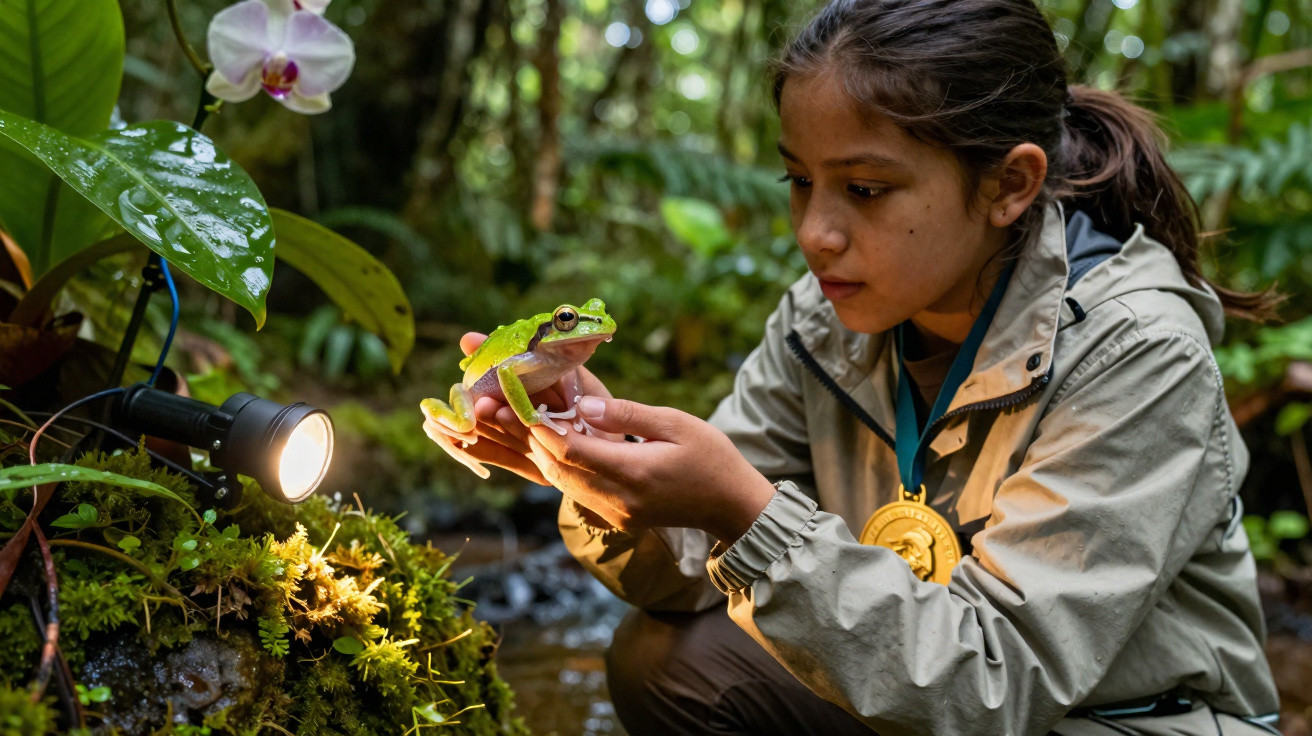
Researchers have discovered a new glassfrog species in Ecuador, naming it Nymphargus dajomesae in honour of Olympic champion Neisi Dajomes, the first Ecuadorian woman to claim Olympic gold.
The discovery draws attention to a mountainous area whose amphibian life is still largely undocumented, suggesting that considerably more biodiversity may remain concealed there.
Clues from a hidden plateau
The frogs were found on leaves above slow-moving blackwater streams in El Quimi, a nature reserve in the Cordillera del Cóndor of south-eastern Ecuador. Within this isolated forest environment, they stood out as distinct green frogs.
Mylena Masache-Sarango of the Pontifical Catholic University of Ecuador (PUCE) examined specimens from the reserve and recorded characteristics that distinguished them from every previously known species.
Detailed comparisons of their skin texture and internal membranes established that this population is a separate lineage, rather than a variant of an existing species.
Confirming the new species also increases the possibility that its surrounding habitat contains numerous other species still awaiting formal recognition.
The meaning of Nymphargus dajomesae
Giving the frog the name Nymphargus dajomesae after Neisi Dajomes links an elusive forest species with one of Ecuador’s best-known sporting achievements.
“It is especially meaningful that this discovery is led by a young woman scientist and honours an Ecuadorian Olympic champion – this species becomes a symbol of how science and society can recognise and celebrate women shaping the future,” said Dr. Diego F. Cisneros-Heredia, zoologist at PUCE.
By associating the species with a national sporting figure, the scientists brought species naming to the attention of a wider public.
A distinct body
Most glassfrogs are small, tree-dwelling frogs from Central and South America, recognised for transparent undersides that expose some internal organs.
This species, by contrast, conceals several organs beneath vivid white tissue.
The reflective cells, known as iridophores, are minute structures that bounce light and cover the heart, oesophagus, stomach and kidneys.
Above its pale underside, the frog is uniformly green, with granular skin and yellow fingers that distinguish it from related species.
As many glassfrogs appear remarkably similar, these subtle physical traits can define the boundary between species.
Nymphargus dajomesae lineage
Genetic data positioned the newly identified frog within a phylogeny, or species family tree, close to an unnamed relative from south-western Ecuador.
The comparison indicated that the lineages began diverging about 4.5 million years ago, probably after mountain barriers divided their wet habitats.
A further nearby lineage may occur only about 45 kilometres away, but a low valley may have prevented movement between the populations.
This evolutionary timescale indicates that the frogs are not simply a local variation, but an evolutionary branch separated for a long period.
A reserve rich in discoveries
El Quimi has yielded more than one surprise: over 85% of amphibians recorded in the reserve have not yet been described.
During only 22 survey days, scientists had already described several frogs, a lizard and even plants from the plateau.
One amphibian community on the high plateau seemed almost entirely new, whereas the neighbouring lower valleys contained known species.
This contrast indicates that the cold, isolated uplands may be particularly effective at concealing lineages in plain sight.
Nocturnal frog behaviour
The frogs are mostly active at night, perching on leaves 0.6 to 1.8 metres above streams.
One observed male produced a sharp, single click roughly every two seconds, probably enabling females to find him.
Several frogs called from bromeliads and damp leaves, keeping their breeding activity close to the narrow waterways beneath them.
These behaviours make stream condition vital, since polluted water or cleared forest could simultaneously disrupt shelter, mating and eggs.
Threats nearby
At present, the frog is classified as Data Deficient, a category applied when evidence is insufficient to determine extinction risk, under conservation criteria.
Its sole known location is about 4.8 kilometres from farmland and 6.4 kilometres from a large mine.
In other parts of the range, large-scale mining has already been associated with devastating impacts on about 20 amphibian species.
A species recorded at only one site can vanish rapidly, particularly when further population information is unavailable.
Identifying species accurately
Distinguishing these frogs is challenging because many species share green colouring and a leaf-dwelling lifestyle.
At PUCE, museum collections can preserve this uncertainty for years, especially where populations from distant areas display nearly identical colours.
In resolving this case, the authors also clarified the position of another Ecuadorian glassfrog whose relationship had remained uncertain.
Correct classification matters because conservation strategies may fail if separate species are treated as one.
What comes next for Nymphargus dajomesae
Scientists now regard south-eastern Ecuador and neighbouring north-eastern Peru as prime territory for further discoveries, rather than a completed inventory.
High plateaus above roughly 1,800 metres (5,900 feet) were particularly notable, as unnamed species besides Nymphargus dajomesae were more concentrated there than in lower valleys.
Surveys spanning the border could establish whether El Quimi is exceptional or forms part of a far larger hidden network.
Until that research is carried out, each new record from the Cordillera del Cóndor, along Ecuador’s border with Peru, reshapes the map more than anticipated.
One frog, one plateau and the name of one athlete now draw attention to a border region where science is still catching up.
Protecting these upland forests while surveys proceed may determine whether future discoveries enter scientific records or are known only through their loss.







Comments
No comments yet. Be the first to comment!
Leave a Comment