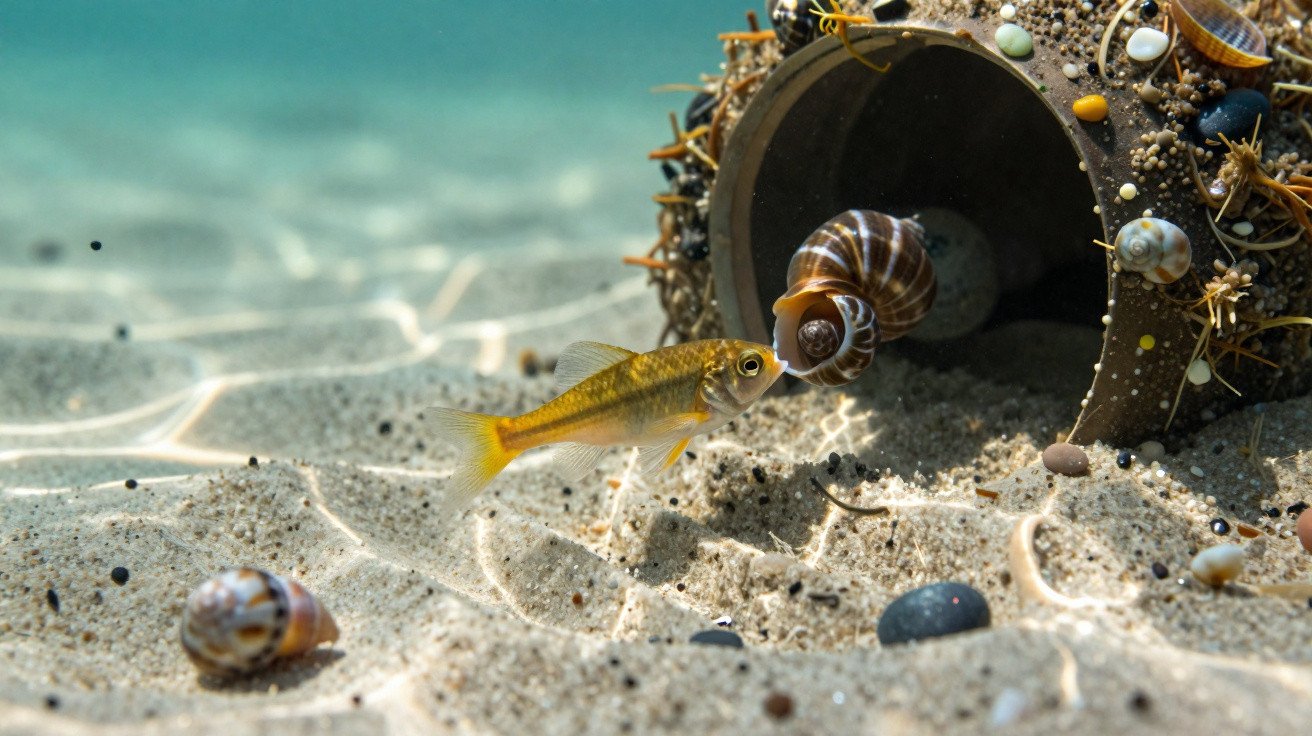
Some fish make nests the difficult way: they take over an empty snail shell, bury it beneath sand and settle inside. For a small species from East Africa, this is everyday behaviour.
Aquarium manuals have described the process for decades. Put a shell into a tank and the fish will cover it with sand within hours. Yet nobody had documented what its very first attempt looks like.
Scientists bred these fish from birth without providing any shells. They then recorded each fish encountering a shell for the first time as an adult. The fish understood the required actions, although carrying them out successfully was a different challenge.
How the nests are built
The species is the cichlid Lamprologus ocellatus, which lives in Lake Tanganyika in East Africa. In its natural habitat, it takes possession of a vacant snail shell, using it both for protection and for breeding its offspring.
Correct placement is crucial. With nothing but its fins and mouth, the fish excavates a hollow, manoeuvres the shell point-first into the sand, then throws sand across its surface until just the entrance remains visible.
Swantje Grätsch, Ph.D., headed the research team at the Max Planck Institute for Biological Intelligence (MPI).
The question was whether this ability was inherited or acquired. To investigate, the researchers gave every fish the same 3D-printed shell.
Born knowing the steps
To examine instinct, the team kept fish in shell-free tanks from the day they were born. The animals had never encountered the object they are adapted to use. They were introduced to a shell only once they had reached adulthood.
Nevertheless, they began building. Fish with no previous experience followed the same routine as experienced animals: digging, turning the shell into position and burying it. That sequence was present from the outset.
This suggests that the behaviour is built in. The underlying actions are therefore innate, as biologists had long believed of nest-building. However, the notable result emerged when those fish attempted the task again.
Practice pays off
Their initial efforts were untidy. Fish without experience needed about 12 hours to complete a nest, whereas practiced builders finished the same work in around three hours.
Understanding the process did not mean they could perform it well. Still, that awkwardness soon disappeared. After two further building sessions, spaced roughly ten days apart, the fish became markedly faster.
By their third nest, they were finishing in about four and a half hours. Instinct provided the plan, while repetition developed the ability. No previous study had mapped such a clear learning curve in a fish.
The distinction between inborn actions and acquired proficiency lies at the centre of the discovery. This behaviour is not simply an unchanging programme repeated over and over.
Instead, the fish improves at a practical task much as a person refines a manual skill. Comparable learning has been observed in studies of nest-building birds, which were also long regarded as acting solely on instinct.
A memory that lasts
The team also asked whether the improvement might be short-lived and disappear without continued practice. They tested this by withholding shells from the fish for an entire year after the third session.
When the animals were eventually presented with another shell, they built like experienced designers. There was no sluggish, uncertain beginning and no relapse into the 12-hour effort. The knowledge gained a year earlier remained intact.
For a small fish, retaining an unrehearsed skill for a year is a considerable length of time. Such lasting memory indicates something beyond a reflex that merely became more effective through repetition.
When the shell flips
The researchers devised one final, ingenious test. Snail shells almost always coil in the same direction, so a fish that turns a shell clockwise can normally rely on that arrangement.
The team therefore provided shells that coiled in the opposite direction, a form that is exceptionally rare in the natural world. The fish adapted: once they had worked out the difference, they reversed their movement and turned the shells anticlockwise.
These fish were not restricted to a single predetermined movement. They could assess the object before them and alter their approach. That adaptability distinguishes a builder capable of thought from a wind-up toy.
“For a long time, it was assumed that nest building consisted of purely innate behavioral patterns. But studies in birds and our own research show that cognitive abilities such as learning, remembering, and adapting also play important roles,” said Grätsch.
What the brain showed
The behaviour indicated learning and memory, and brain activity supported that conclusion. While the fish built their nests, a region comparable with the hippocampus became active. In mammals, this structure is involved in memory and spatial navigation.
A fish shifting sand may therefore be using circuitry similar to that which humans rely on to navigate. Extensive research has associated this area with such abilities. In this case, nest-building appears to involve more than a simple reflex.
Grätsch remains cautious about the finding. Activity in that brain region does not reveal precisely how the brain controls the behaviour. She describes the research as an early view of a process that is more complicated than previously thought.
Why this matters
The findings revise a longstanding assumption. Nest-building in this fish involves neither instinct alone nor learning alone, but a combination of both. An innate series of actions comes first, followed by skill that is gained and retained for a year.
The core behaviour arises naturally, yet performance improves through practice. This combination offers researchers a new opportunity to observe instinct and learning operating within one behaviour. The 3D-printed shell method makes experiments possible that could not be conducted in the wild.
The implications also extend to the brain. A hippocampus-like area has now been connected with a genuine, visible behaviour in a fish. Scientists can begin to track how this ancient circuitry converts an aim into a completed nest.
It also prompts a wider question: how much of what we label instinct is in fact influenced by learning?














Comments
No comments yet. Be the first to comment!
Leave a Comment