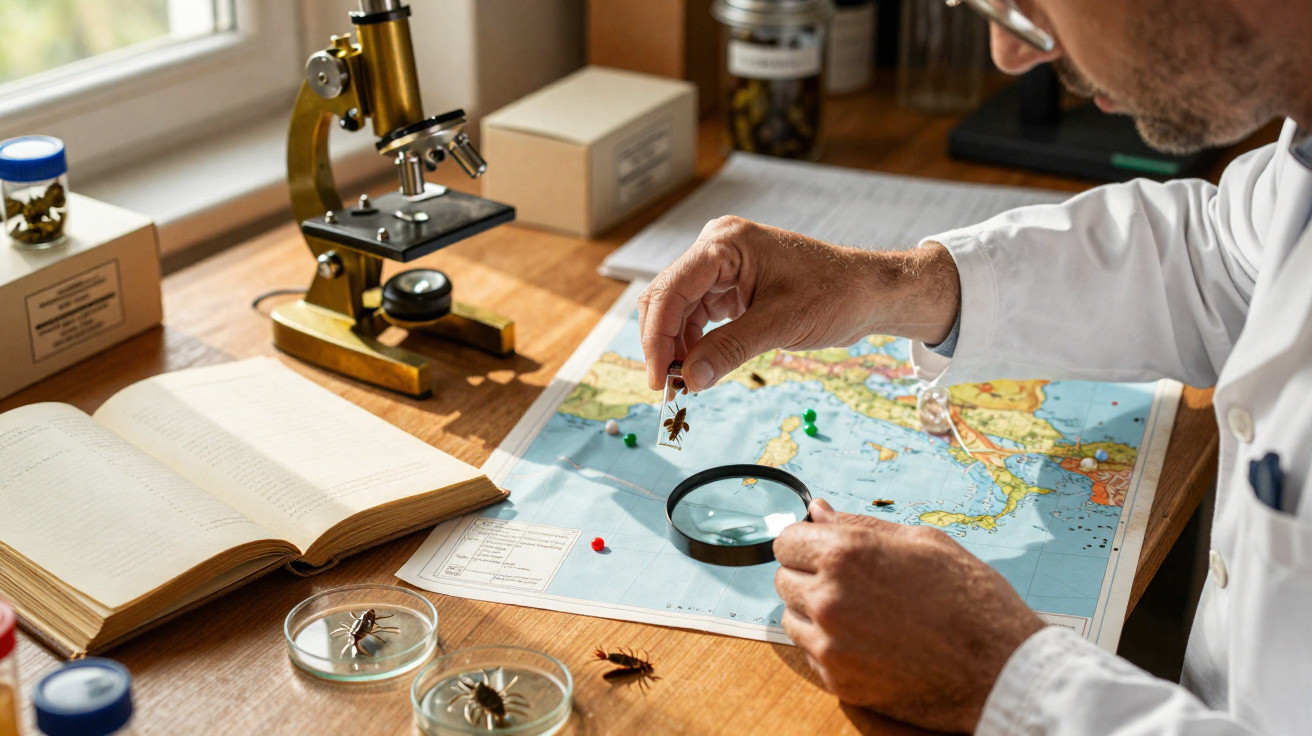
Italian researchers have collected animals from the country’s coastal waters since the early 1980s. Survey teams made regular trips, completed field notes and submitted records.
Yet those records were never brought together. Stored for four decades in agency documents and university archives, they remained disconnected and unpublished until a research team combined them. The result revealed more than 300 species.
Amphipods from archives
The animals in question are amphipods: shrimp-like crustaceans that generally measure less than a quarter of an inch (0.6 centimetres) in length.
Researchers compiled more than 4,300 amphipod records collected in Italian waters from the early 1980s to 2025.
Prof. Sabrina Lo Brutto, a marine zoologist at the University of Palermo, coordinated the project through Italy’s National Biodiversity Future Center. Her team gathered amphipod records that had remained unused in the files of universities, agencies and research institutes.
None of these records had previously been published. The most recent national checklist of Mediterranean crustaceans was produced in 2010, leaving fifteen years without an update. As a result, uncertainty over the true distribution of species continued to grow.
Tiny ocean recyclers
Despite their size, amphipods perform important roles in marine ecosystems. They break down dead organic matter, recycle nutrients and provide food for fish, birds and marine mammals, as outlined in a recent overview of their predators.
They are also used as bioindicators. Since they respond quickly to pollution and other pressures, a sudden decline in particular amphipods can warn of water-quality problems before larger species display the effects.
That work relies on knowing where each species occurs. When distribution data are incomplete, a single mistaken identification can affect subsequent research, with one incorrectly named amphipod repeated across a dozen papers.
Decades of data
Records accumulated slowly for much of the four-decade period. Sampling levels remained low from 1980 through the early 2000s, before rising steeply after 2014 and reaching a peak around 2021.
The increase reflects a policy shift rather than a biological change. A European requirement for countries to assess marine health led to much more frequent sampling, as amphipods are routinely used for this form of monitoring.
These newer surveys also exposed the scale of older information that had never been formally reported. While scientific research progressed, valuable records remained in archives.
Three seas surveyed
Italy is bordered by three marine areas: the Adriatic Sea to the east, the Tyrrhenian Sea to the west and the Ionian Sea to the south. Their records were not distributed evenly.
The Adriatic accounted for by far the largest number of records, nearly half of the total, largely because it has been extensively sampled for more than a century. The Tyrrhenian ranked second by the number of records.
However, the ranking changes when distinct species are counted. The Tyrrhenian contained the greatest diversity by a substantial margin, with 258 species in total, despite receiving fewer samples than the Adriatic.
It remains unclear whether the Tyrrhenian is genuinely more diverse. Its varied seabed and range of depths may support more species, although the total might instead reflect the areas where divers sampled most intensively.
Newcomers arrive quietly
Eleven species were not native to the Mediterranean. They seem to have come from other oceans, probably through ship hulls or shellfish imports, and most were found in ports, marinas and fish farms.
Their concentrations appeared in the busy, built-up locations that might be expected. The Venice Lagoon, long Italy’s principal entry point for marine newcomers, appeared once more, while a broader study of Mediterranean marinas found the same pattern.
Several of these introduced species are expanding their ranges. The skeleton shrimp Caprella scaura was formerly known only from the northern Adriatic. It now occurs along the full Italian coastline, whereas others have remained where they initially arrived.
Amphipods in old data
A defining feature of the project is the destination of its data. Rather than remaining within a single laboratory, the full dataset was placed on a global biodiversity platform, where anyone can download, search and use it.
Even the earliest samples contained unexpected findings. The open-water amphipod Vibilia gibbosa appeared in records from the port of Naples, representing a first for Italy. Laticorophium baconi was likewise recorded for the first time in the port of Palermo.
These records had been in storage throughout that period, with their value inaccessible until they were linked together.
Making them available enables other researchers to reassess earlier identifications and monitor shifting species ranges.
What this changes
For the first time since 2010, Italy has an up-to-date, openly accessible inventory of its marine amphipods, assembled without undertaking a single additional collecting trip.
The total of 302 species provides a baseline for a European initiative to safeguard nearly a third of the sea by 2030.
Reliable maps showing where species occur underpin conservation, whether the purpose is to identify declines or protect habitats. “Understanding where species live is the foundation of conservation,” said Lo Brutto.
The broader message extends beyond this single crustacean group. Unpublished records spanning decades exist for many other species and regions, and the project offers a model for recovering them.
“This is not the end of the story; it’s a starting point,” said Lo Brutto.









Comments
No comments yet. Be the first to comment!
Leave a Comment