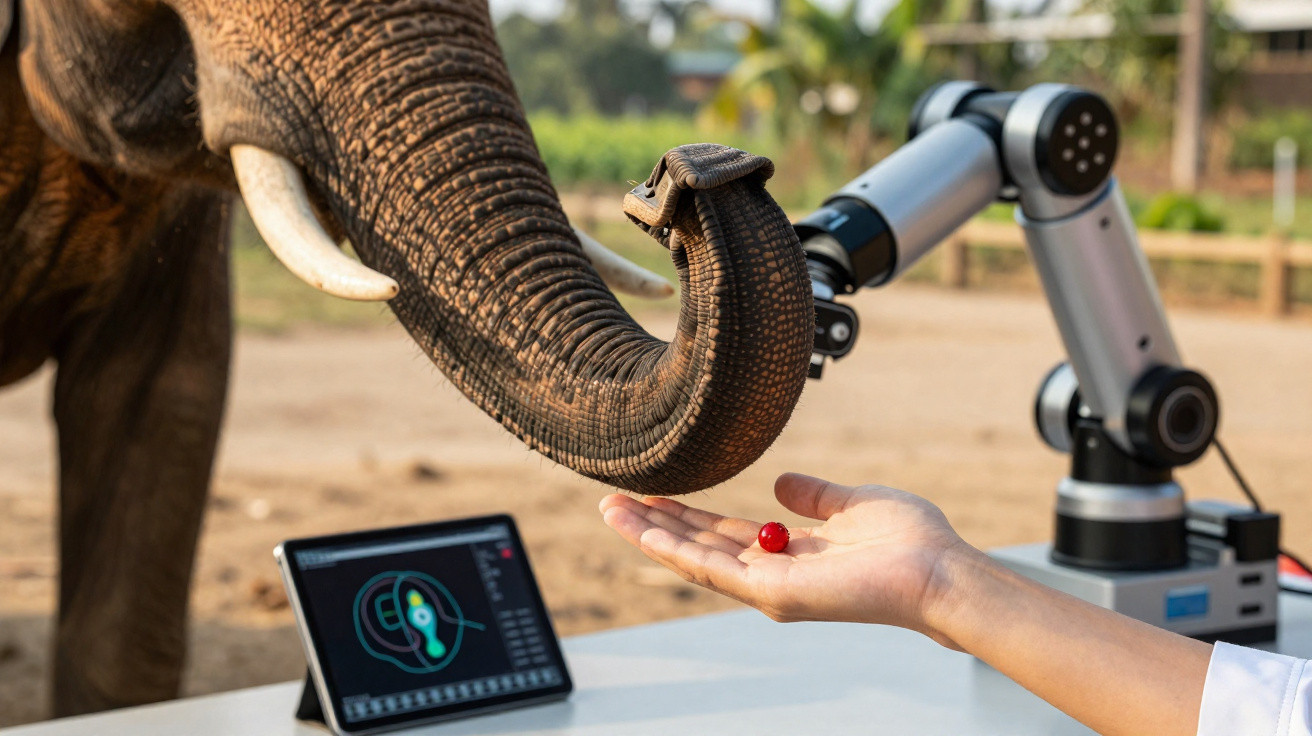
An elephant’s trunk ranks among nature’s most adaptable tools. It can pull a fallen tree trunk, remove leaves from a branch or carefully peel a banana without damaging the fruit.
For years, scientists have investigated the muscles behind these abilities, showing how a structure without bones can combine exceptional power with extraordinary precision.
A new study has uncovered another part of the answer.
The researchers discovered that trunk skin consists of two separate regions, each adapted to a particular role: one for protection and the other for touch.
The elephant trunk’s two roles
The trunk has to meet two conflicting demands. It needs enough toughness to push aside branches and carry heavy loads, while also being delicate enough to pick up fragile objects without crushing them.
Lucia Beccai, a robotics scientist at the Italian Institute of Technology (IIT) in Genoa, Italy, set out to establish how a single skin could achieve both tasks.
Her team examined the trunk of an Asian elephant (Elephas maximus) that died of natural causes at a Swiss zoo in 2020.
To chart the skin, the scientists measured the stiffness of dozens of samples taken along the trunk and inspected the tissue through microscopes. Their findings revealed two distinct sections.
Protection where it is needed
Previous research had documented the deep folds on the upper side of the trunk and the finer wrinkles underneath. However, that work described the surface rather than explaining how these features affect the skin’s function.
The upper skin is the more robust of the two. It is over three times stiffer than the underside, resisting deformation before yielding. It is also thicker and more textured.
This upper surface is the part of the trunk that encounters the outside world, rubbing against tree bark and uneven ground.
Its rigid outer layer absorbs impacts and distributes force, serving as a shield for the softer tissue below.
Adapted for delicate gripping
On the underside, the skin has a very different character. It is considerably softer and more flexible. When the trunk grasps an object, this surface moulds around it, increasing contact to create a more secure hold.
Elephants rely on this side of the trunk for their most precise tasks.
One study found that elephants can peel bananas with the tip of the trunk and lift small objects with remarkable gentleness.
Yet softness by itself does not account for the trunk’s highly developed sense of touch.
The key discovery was located directly beneath the underside skin, in a layer the researchers had not expected to provide the explanation.
Hidden features that boost touch
Rows of dome-like structures known as dermal papillae sit just below the underside skin. These small tissue mounds rise towards the surface.
They are almost absent from the upper skin, but on the underside they are both large and closely packed.
When the team modelled the way these bumps react to touch, the simulations suggested an important function.
Each dome collects pressure distributed over the skin’s surface and concentrates it at a small point at its base.
That point is precisely where the nerve endings that detect touch are located. A light brush at the surface, channelled downwards, could therefore reach those nerves as a strong and distinct signal.
The model is a prediction rather than a reading taken from a living trunk. Even so, it provides the first physical explanation for the trunk’s refined touch sensitivity.
A more intelligent way to sense touch
The ingenuity lies in how touch is enhanced: not through improved nerves, but through skin that alters its own structure to give ordinary nerves a stronger signal.
Elephants are not alone in using this approach. As separate research into skin mechanics has shown, human fingertips use a comparable arrangement of minute ridges and bumps to increase sensitivity.
More than a century ago, anatomists proposed that trunk skin contributed to its sense of touch, but they were unable to demonstrate the mechanism.
This research supplies a plausible explanation, linking the elephant trunk’s celebrated tactile ability to a feature of its skin.
Building better robots
The results provide engineers with a design principle they could replicate. Machines that need to grasp and sense face the same problem as an elephant trunk: creating a surface that is simultaneously resilient and sensitive. This has long challenged soft robotics.
One implication is that grippers should not be made from only one material.
A robotic hand could have a hard, abrasion-resistant skin in areas that contact rough surfaces, alongside a soft, gripping surface for handling fragile items, with both incorporated into one printed component.
The second lesson is to engineer the area surrounding a sensor rather than merely placing one inside a device.
By shaping dome-like features above a touch sensor, engineers could strengthen a weak signal while leaving the delicate component safely protected below the surface.
Further elephants to examine
At present, the research is based on one trunk from a single animal, which the team regards as an in-depth case study rather than a definitive conclusion.
Studying additional trunks, including those of African elephants as well as Asian elephants, would reveal how broadly this pattern applies.
The study does show clearly that an elephant trunk’s power and delicacy stem from a single skin divided into a hard, protective upper side and a soft, sensitive underside.
The bumps beneath the surface help account for its precise sense of touch, which had long been suspected but had never been demonstrated.
The broader benefit concerns what engineers may now create. A trunk-inspired gripper could shield its sensors while still recognising a light touch, making it suitable for robots handling delicate products or operating close to the human body.












Comments
No comments yet. Be the first to comment!
Leave a Comment