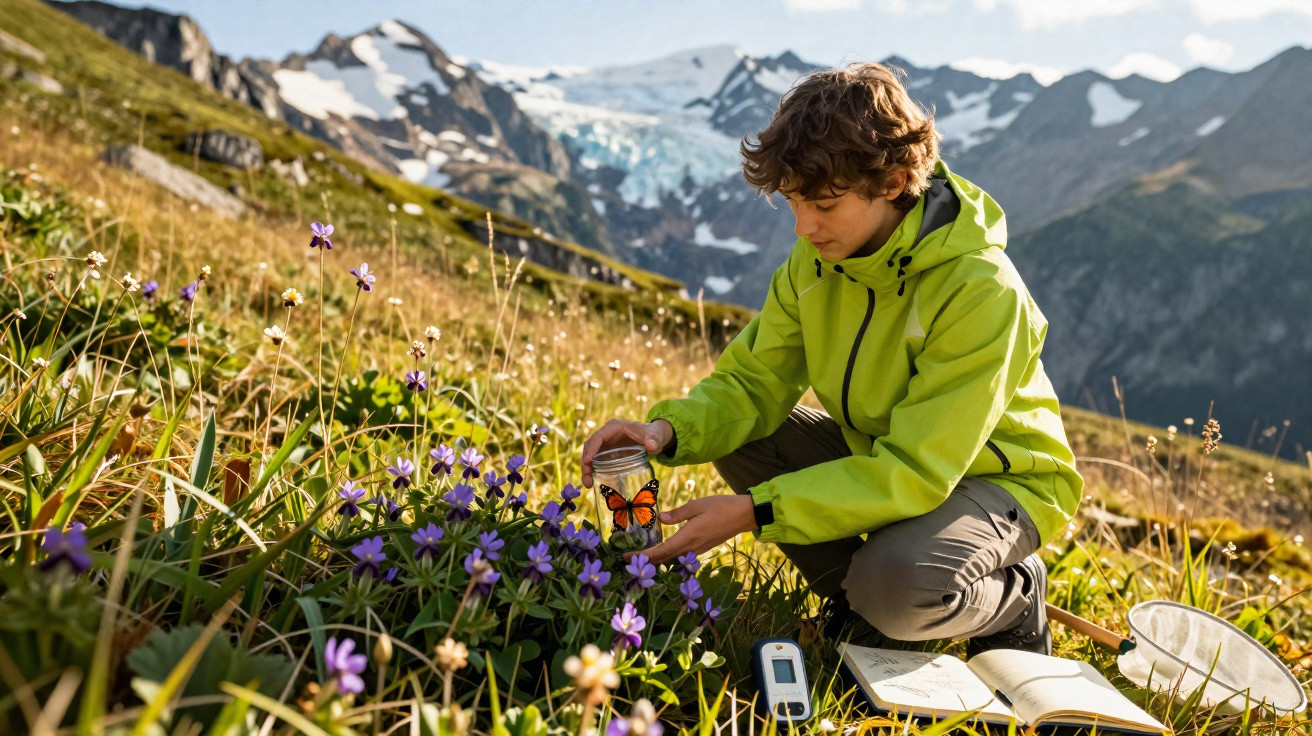
Butterflies in the Swiss Alps are climbing the mountains at almost precisely the rate expected from the speed at which the region is warming.
At first glance, this appears to be a neat and reassuring climate narrative. Yet the new research behind it reveals a more complicated, and more compelling, reality.
Rather than temperature, habitat appears to be the key factor determining where different butterfly species occur.
The research was carried out by scientists from the University of Würzburg, the University of Lausanne, Hintermann and Weber AG, and the Bavarian Forest National Park.
Using a recent butterfly survey from the Swiss National Park, the researchers discovered that habitat type accounted for nearly half of the variation in butterfly communities.
Elevation by itself had very little explanatory power.
An unusual butterfly
Korbinian Schrauth, the lead researcher at the University of Würzburg, explained what first prompted the team to investigate the issue.
“The common assumption is that temperature adaptation is the main driving force behind the elevational distribution of butterflies in the Alps,” he said.
“But there are a few cases that appear to be contradictory to this assumption.”
His preferred example is striking once imagined: the Peak White, a butterfly adapted to the cold of high alpine areas, living successfully on gravel banks in the lowlands.
Its host plant, itself a high-alpine species, had apparently been carried downhill in alluvial deposits from higher on the mountain.
The butterfly appeared wherever the host plant became established.
“This and similar examples led us to suspect that the elevational distribution of alpine butterflies might be rather driven by available habitats than by temperatures,” Schrauth said.
The Swiss Alps butterfly findings were unexpected
When the researchers analysed the data, the difference between habitat and elevation as explanations was even greater than the team had anticipated.
“At first we were surprised that the amount of variance explained by elevation on its own was that small, but in the end, it fits quite well with our initial considerations and makes perfect sense given the knowledge of the complex ecology of butterflies,” Schrauth said.
Put simply, a site's elevation reveals remarkably little about the butterfly species likely to be found there. The type of habitat available is much more informative.
The result has important implications for conservation planning, because safeguarding suitable habitat types may be far more valuable than protecting land solely according to elevation.
Warming changes communities unevenly
Over a period of around twenty years, the scientists found that butterfly communities throughout the park had become clearly more adapted to warmer conditions overall.
However, the change was not uniform across the mountainside. It was weakest at the highest elevations, where cold-adapted alpine species still persist and appear less affected by warming than species in lower areas.
Since 2004, the mean uphill movement of butterfly ranges has closely matched the shift predicted from local warming patterns alone.
Together, these results indicate that butterfly populations overall have so far been able to keep up with climate change, rather than lagging behind it.
Specialists face a greater cost
This apparent success is not shared by every species. Butterflies dependent on a limited range of habitat types moved uphill much more strongly than generalists, which can survive in a broad variety of places.
This pattern indicates that alpine specialists are facing the strongest pressure.
Timing is one reason this creates risk. Plant communities do not necessarily shift at the same rate as temperatures, and a specialist butterfly reliant on a particular host plant needs more than suitably warming air.
Its host plant must also be present. When a butterfly and its host plant move uphill at different speeds, their relationship can break down entirely, regardless of how successfully the butterfly itself handles higher temperatures.
What protects alpine butterflies
The conservation message is relatively clear, if somewhat unexpected.
“One of the implications of our study is that, besides reducing carbon emissions, the protection of alpine habitats is the most important measure for preserving the diversity of alpine butterflies,” Schrauth explained.
This represents a meaningful change in emphasis. Reducing emissions remains extremely important, but it cannot provide the complete solution alone.
The research indicates that habitat structure does most of the work in determining which species can persist, irrespective of how temperatures change.
What comes next
To follow how these changes develop, the study authors recommend repeating Swiss National Park surveys approximately every ten years.
Schrauth said that he would prefer surveys to be undertaken more frequently, candidly recognising the divide between ideal scientific monitoring and what can realistically receive long-term funding.
In any case, the research has already altered what initially seemed a straightforward story. It is less about butterflies escaping the heat than about whether the habitats beneath them can keep pace.















Comments
No comments yet. Be the first to comment!
Leave a Comment