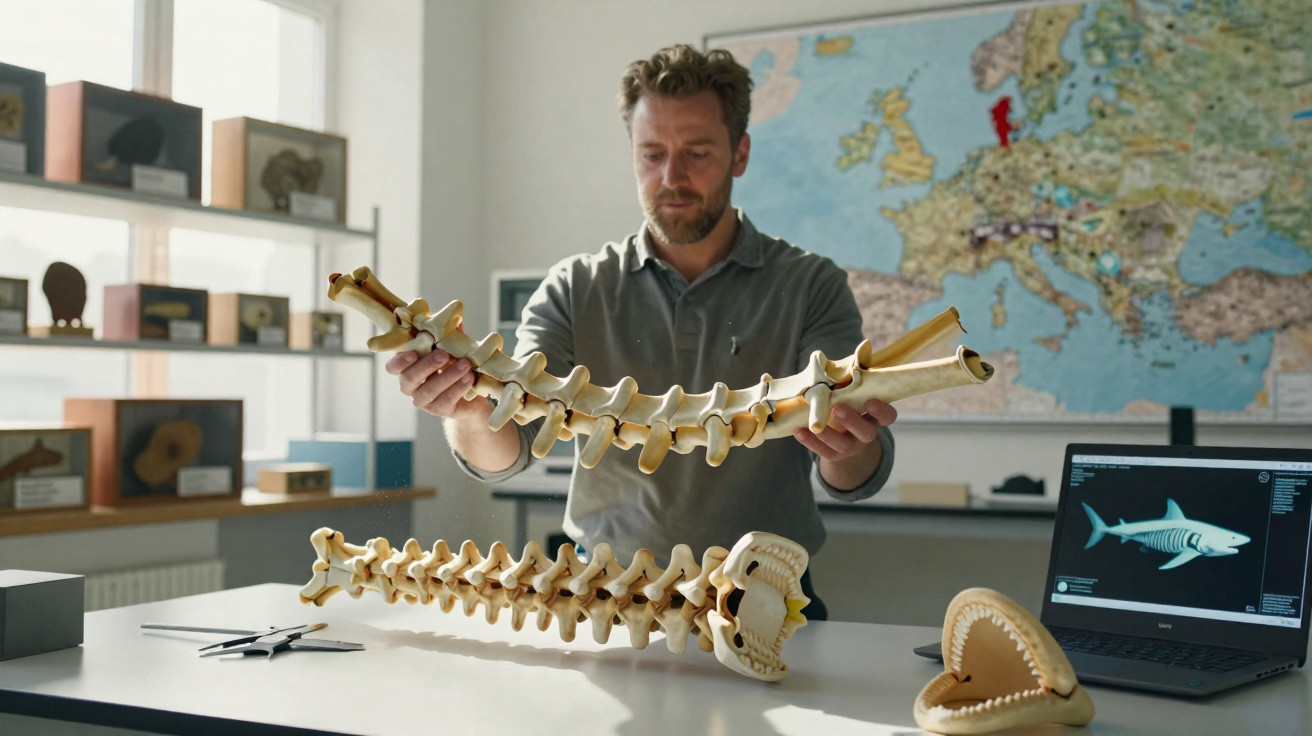
Few extinct animals inspire fascination quite like the megalodon, a shark of such immense size that it has become a cinematic monster. However, the evidence underpinning what is known about its dimensions is remarkably limited.
One important piece of evidence - a group of vertebrae - disappeared for many years. Scientists were left to examine only historic photographs until the original fossil was found once more.
How the fossil disappeared
The megalodon vertebrae were unearthed from a vast commercial clay pit in Gram, Denmark, in the late 1970s.
Scientists documented the fossils in the early 1980s and reported that the largest vertebra measured 23 centimetres (9 inches) in diameter.
The specimen was kept at Copenhagen's Geological Museum, which is now part of the Natural History Museum of Denmark. In 1989, after the description had been published, staff moved it from its original laboratory and it subsequently vanished from view.
Only the images published with the original research remained, leaving no means of verifying the diameter of the largest vertebra.
Missing megalodon vertebrae recovered
Decades afterwards, a vigilant museum employee discovered several unexplained boxes containing fossils stored within the collection. Inside were the long-lost megalodon vertebrae.
Shark skeletons almost never fossilise in the first place, making the recovery of these vertebrae especially worth celebrating.
“The sharks’ cartilaginous skeletons make their preservation potential generally very low except for their highly mineralized teeth,” said Trine Sørensen, a Natural History Conservator at the Museum of Southern Jutland, who prepared the specimen.
Megalodon vertebrae set records
A research group has since verified that the biggest megalodon vertebra is 23 centimetres (9 inches) across. This makes it the broadest shark vertebra ever discovered.
As far as the team is aware, it is also the largest vertebra from any fish in the whole fossil record. It came from Otodus megalodon, the megatooth shark that inhabited the seas approximately 15 to 3.6 million years ago.
“The rediscovery of the vertebrae was a true delight because they empirically confirm the maximum vertebral diameter of 23 centimeters reported in the literature,” said Kenshu Shimada, the study’s lead author and a paleobiology professor at DePaul University.
“The specimen not only represents the largest shark vertebrae known to date but also the largest fish vertebrae ever recorded to our knowledge.”
Why megalodon size matters
Confirming this measurement is significant, as no complete megalodon skeleton has ever been discovered.
Instead, scientists calculate the shark's body length from the isolated remains available to them. Before this study, the latest upper estimate placed megalodon at nearly 24.3 metres (80 feet) long, with a possible mass of about 94 tonnes.
That estimate was based on a relatively complete series of megalodon trunk vertebrae from Belgium. The largest vertebra in that specimen is only around 15.5 centimetres (6 inches) wide and is believed to have belonged to an animal approximately 16.4 metres (54 feet) in length.
Applying the same proportions to the Danish fossil vertebra, at 23 centimetres (9 inches), produces the estimate of roughly 24.3 metres (80 feet). Previously, however, that calculation had relied exclusively on photographs.
A basking shark in the stomach
The material surrounding the megalodon vertebrae yielded an unexpected discovery when they were first excavated from the Gram clay pit. The rock matrix also contained fragmented gill structures and tiny scales from another creature: a basking shark.
The researchers excluded the possibility that the large vertebrae came from the basking shark. In proportion, basking shark vertebrae are far longer than they are wide, unlike the short, broad bones of megalodon.
Why, then, had remains of both animals become embedded in the same rock?
“This led us to interpret the basking shark elements to represent the stomach contents of the megalodon, which is the first documentation for the megalodon fossil record,” stated Mikael Siversson, a paleontologist at the Western Australian Museum in Welshpool.
Ageing megalodon vertebrae
The vertebrae provide a record of passing time as well. Sharks form incremental growth bands, thought to develop annually, much like rings in a tree.
The team examined these bands with micro-CT scanning, a non-destructive X-ray technique. The resulting scans indicated that the shark was at least 64 years old when it died.
A growth model based on the bands extended its potential lifespan to nearly 96 years. Producing the scans took the imaging technique close to its practical limits.
“Scanning the large, low-contrast vertebrae fossils surrounded by clay at ultra-high resolution was a real technical challenge, which resulted in generating more than 100 GB worth of images,” noted Henrik Lauridsen of Aarhus University, who performed the scanning.
Largest size estimate
The updated growth model indicated that this particular animal might have grown somewhat bigger. The researchers are cautious about that implication.
Their assessment depends on fragmentary remains and a number of substantial assumptions. If it was born at around 3.6 metres (12 feet), the shark could theoretically have reached nearly 28 metres (92 feet), although the authors emphasise the uncertainty behind figures of this kind.
“Although our growth model suggests that megalodon could have theoretically grown even slightly larger, the length of 80 feet is currently the largest possible scientifically justifiable estimate for O. megalodon,” said Shimada.
Why the Danish site matters
An animal's body size influences almost every aspect of its life. For an apex predator such as megalodon, it also affects the wider ecosystem.
“The giant megalodon vertebrae are of great importance because size matters when it comes to understanding the biology, ecological impact, and geographic distribution pattern of this extinct giant predator,” said Mette Elstrup, who heads the Natural History section of the museum.
“The Gram claypit site also represents the scientifically verifiable latitudinally highest megalodon locality in the world, which does not contradict the previous observation that larger megalodon remains are more common in ‘cooler’ regions relative to ‘warmer’ regions.”
A full skeleton would resolve the debate over its size conclusively. Unless one is found, these rediscovered vertebrae remain the most reliable anchor available to scientists.











Comments
No comments yet. Be the first to comment!
Leave a Comment