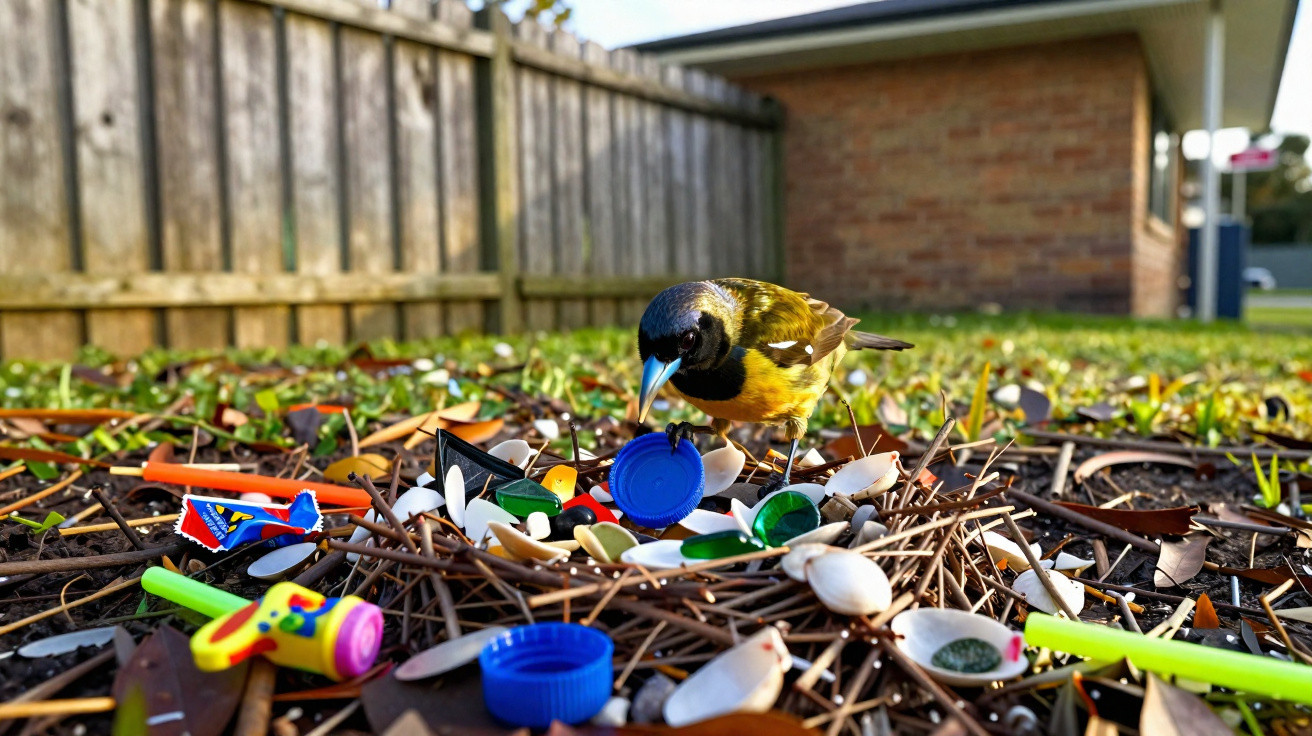
In a Townsville park in Australia, a male great bowerbird is hard at work preparing to court a mate. Rather than singing from a tree branch or displaying vivid feathers overhead, he takes a different approach.
He constructs a display site on the ground, carefully forming a tidy arrangement from sticks before adorning it with items gathered from the surrounding area.
While some of these objects originally came from trees and other plants, others are sourced from bins, verges, gardens and playgrounds.
Red wire fragments, green plastic, broken glass and pieces of metal have all become part of avian courtship.
Although these things might appear to us as rubbish, they could influence a female bowerbird's decision about whether a male is an appealing partner.
Bowerbird stages designed to attract mates
When great bowerbirds construct bowers, they are not making nests. A bower is neither a place for laying eggs nor raising young; instead, it is a courtship arena made by males to attract females.
Every male builds a stick-lined avenue and arranges colourful ornaments around it. Females come to examine the display and observe the male's performance. For this species, aesthetic choices are important.
“Bowers are built exclusively to attract a mate, and males choose decorations that contrast against their own plumage and the bower itself,” said Caitlin Evans, from the Centre for Ecology and Conservation at the University of Exeter.
“Once a female arrives and stands in the bower, males throw an object into their view and then display the plumage on the back of their head, then throw another object – and so on.”
Urban environments alter courtship
Evans and Laura Kelley, who is also based at the University of Exeter, set out to investigate how urban living affects this long-established courtship behaviour.
During the 2023 breeding season, the researchers examined 61 bowers in Queensland.
Some were located on a rural cattle station close to eucalypt woodland beside the Burdekin River. The remainder were in Townsville, where the birds share their environment with parks, gardens, roads and buildings.
The researchers recorded and analysed 3,782 decorations, revealing an unmistakable contrast between rural and urban bowers.
City bowers contain more decorations
Urban male bowerbirds used almost five times more decorations than males in rural areas. City bowers contained approximately 93 items on average, compared with fewer than 20 in rural bowers.
The urban ornaments were bigger as well as more varied in colour. Most had been made by people: almost 90 percent of objects in city bowers included materials such as plastic, wire, metal and glass.
By contrast, human-made items accounted for around 46 percent of decorations in rural bowers. “Our findings show that bowerbirds in a city use a wide range of items scavenged from humans,” Evans said.
“Glass, plastic and wire were common choices, but we also found items including a pair of handcuffs, medicine jars at bowers near a hospital, and fluorescent mouth guards from a site near an Australian Rules football ground.”
Decorations with striking colours
The research involved more than simply tallying items. Every decoration was photographed, then assessed using a visual model based on bowerbird vision.
That distinction is important because birds perceive their surroundings differently from humans. They are able to see ultraviolet light, which is invisible to us.
To bowerbirds, red decorations in urban bowers appeared particularly vivid. This is unsurprising, as red plastic and wire often feature intense manufactured colouring.
Green objects produced a contrasting result. Green rural decorations were more vibrant and saturated, likely because countryside locations provide fresher and more diverse plant materials than urban settings.
City habitats therefore offer certain new benefits, notably intensely red items, while reducing access to some naturally coloured materials, particularly bright greens.
“Our study did not assess whether females favor the more striking items collected in urban areas, but the males’ enthusiasm for gathering these items suggests this is likely,” she said.
Do great bowerbirds favour plastic?
A key question still needed answering: do urban birds select plastic and wire simply because they are readily available, or are bowerbirds genuinely attracted to these materials?
To find out, the researchers cleared decorations from bowers and put a mixed collection beside each site.
Each collection contained ten ornaments from urban bowers alongside ten from rural bowers. The team then observed which objects the males selected.
The result was unambiguous. Males chose urban decorations much more frequently, regardless of whether they lived in urban or rural areas.
Urban birds select human-made objects
Rural birds did not remain committed to leaves, seeds and twigs. Given the opportunity, they regularly selected objects made by people as well.
“Even in rural areas, birds find items made by humans,” Evans noted. “In this case, we think they raid the bins and garage of a farm – and also the bowers of other male bowerbirds.”
This indicates that the contrast between city and rural bowers largely reflects what is available to the birds, rather than a fundamental difference in their preferences.
For male bowerbirds, human rubbish could offer practical advantages. Plastic and metal endure far longer than berries or leaves.
An eye-catching object found once could remain useful for several years, potentially reducing the time and energy required to replace it.
However, these materials also present risks. String and wire can entangle birds, while swallowed plastic may injure animals. Because bowerbirds repeatedly handle many human-made objects, their exposure to such dangers may be substantial.
Human waste reshapes nature
The research illustrates how rapidly animal behaviour can adapt when people alter a landscape.
Great bowerbirds continue to build, decorate, perform and compete for female attention as they always have, but their choice of materials has shifted.
“Our study demonstrates that availability of human items – often glass and plastic – is affecting the behavior of bowerbirds,” said Dr. Laura Kelley, co-author of the study.
“We don’t yet know whether this has any negative or positive impact on them, but it’s a reminder of how human activity is changing the natural world in unanticipated ways.”







Comments
No comments yet. Be the first to comment!
Leave a Comment