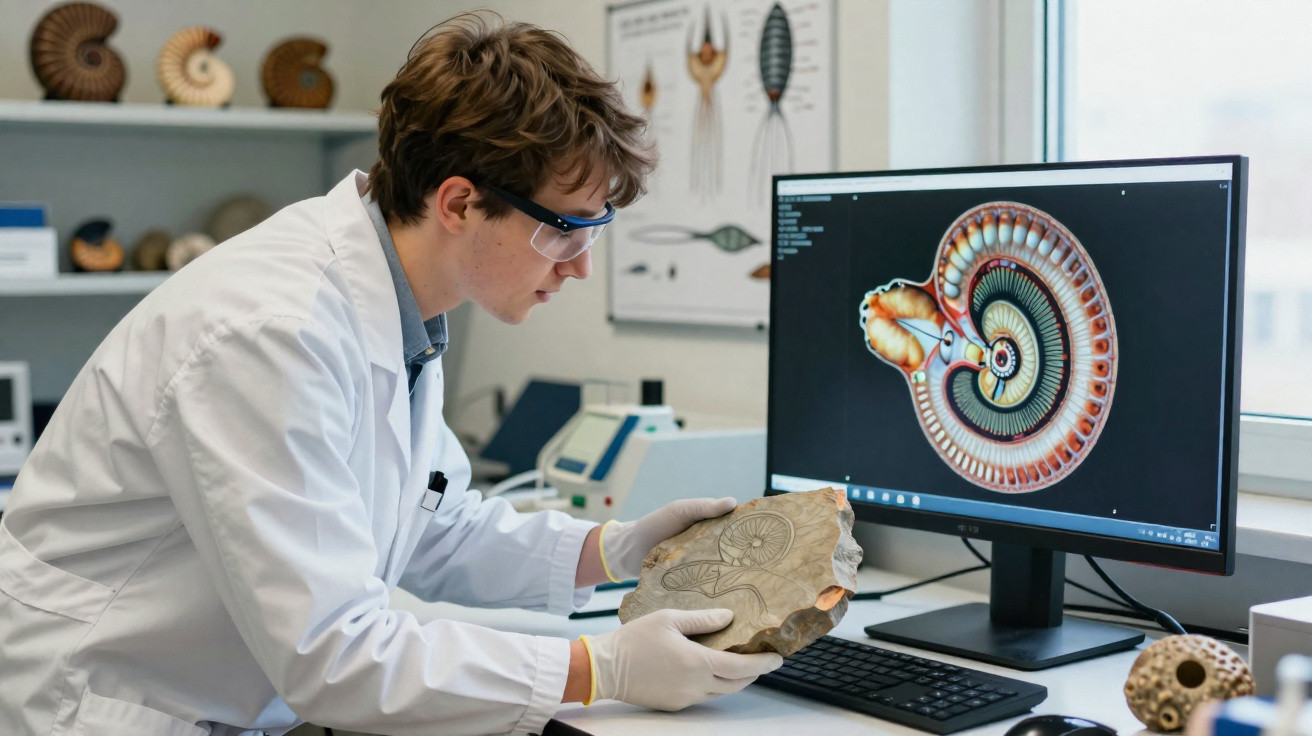
A fossil that played a crucial role in explaining octopus evolution has turned out to be an impostor.
The celebrated 300-million-year-old Pohlsepia mazonensis, discovered in 2000 and later recognised by the Guinness Book of World Records as the oldest known octopus species, has been reclassified as a nautiloid. These shelled cephalopods are closely related to the nautiluses found in the oceans today.
The finding means the cephalopod family tree will need to be redrawn. It pushes the record of nautiloid soft tissue back by around 220 million years, while bringing the earliest evidence of octopuses forward by around 150 million years.
"It turns out the world's most famous octopus fossil was never an octopus at all. It was a nautilus relative that had been decomposing for weeks before it became buried and later preserved in rock, and that decomposition is what made it look so convincingly octopus-like," says Thomas Clements, a palaeobiologist at the University of Reading in the UK.
"Scientists identified Pohlsepia as an octopus 25 years ago, but using modern techniques showed us what was beneath the surface of the rock, which finally cracked the case. We now have the oldest soft tissue evidence of a nautiloid ever found, and a much clearer picture of when octopuses actually first appeared on Earth."
Why Pohlsepia was identified as an octopus
Pohlsepia is known from just one fossil, found in the Mazon Creek Lagerstätte in Illinois. Its body had already decomposed badly when it was preserved in soft mud 300 million years ago, making the flattened remains difficult for palaeontologists to interpret.
Even so, they identified what seemed to be eight limbs, two eyes and an ink sac, features they said pointed to an octopodean identity. Other scientists questioned that finding over the following years, although no definitive research was published.
In the decades after Pohlsepia was first identified, technology emerged that enabled scientists to look inside fossils without destroying them. Clements and his team used advanced synchrotron imaging, which employs X-rays generated by particle accelerators to examine the interiors of dense objects.
This X-radiation is billions to trillions of times brighter than the X-rays produced by equipment found in a hospital. It can reveal high-resolution details that other imaging methods, including computed tomography, may miss.
Hidden teeth reveal the fossil's nautiloid identity
Using the technique to examine Pohlsepia, the researchers discovered an anatomical feature that had previously been invisible: a row of 11 tiny, tooth-like structures. They said these were probably a radula, a tongue-like ribbon covered in denticles that is found only in molluscs.
According to the researchers, the number and shape of the denticles were the decisive clues that Pohlsepia was not an octopus. Octopuses usually have only seven or nine elements in each radula row, whereas nautiloids have 13. The number in Pohlsepia falls between the two, but its shape settled the question: it more closely resembles that of nautiloids than octopuses.
The team also found little evidence that the feature previously identified as an ink sac really was one. There was no trace of the pigment melanosomes that should have been present alongside it.
A further surprise emerged when the researchers compared their results with other cephalopod fossils from the Mazon Creek Lagerstätte. The newly exposed radula matched that of Paleocadmus pohli, an ancient nautiloid already known from the site.
This indicates that Pohlsepia was never a separate species. Its unusual, decayed state of preservation made it hard to interpret, leading it to be mistakenly classified as distinct. Instead, it is a specimen of P. pohli that has now been returned to its proper classification.
What the discovery means for octopus evolution
The finding also changes our understanding of the octopus family tree. That is the beauty of science: in 2000, researchers did the best they could with the information available to them. New technology and techniques have now supplied evidence that can move us towards a better understanding of life on our planet.
"Sometimes, re-examining controversial fossils with new techniques reveals tiny clues that lead to really exciting discoveries," Clements says.
"It's amazing to think a row of tiny hidden teeth, hidden in the rock for 300 million years, have fundamentally changed what we know about when and how octopuses evolved."
Guinness World Records agrees with the finding.
"This is a fascinating discovery and congratulations to the University of Reading on their research," says Adam Millward, managing editor of Guinness World Records.
"We will be resting the original 'oldest octopus fossil' title and look forward to reviewing this new evidence."
The research was published in the Proceedings of the Royal Society B: Biological Sciences.











Comments
No comments yet. Be the first to comment!
Leave a Comment