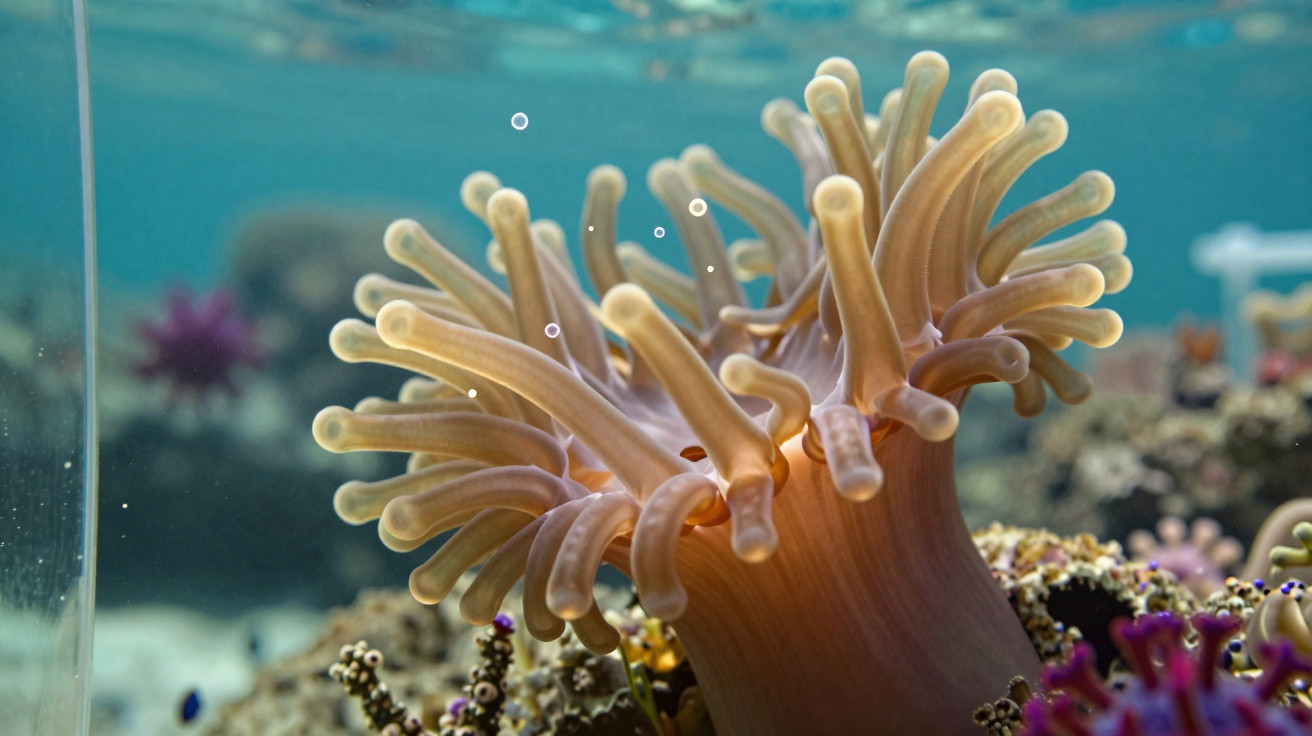
The human immune system depends on a protein that functions as an alarm, activating as soon as a virus enters the body. Scientists anticipated finding the same approach in the sea anemone, one of humanity’s most ancient animal relatives.
They found precisely the reverse.
A new study shows that sea anemones combat viruses with an almost identical protein that usually keeps their antiviral defences turned off.
This finding indicates that evolution produced two entirely different answers from strikingly similar molecular components, overturning a long-standing assumption about the evolution of immune systems.
The protein that flipped roles
Viruses exert pressure on all living organisms, and animals have developed methods to recognise and halt them over hundreds of millions of years.
In vertebrate animals, a large part of this protection depends on MAVS, a protein that acts as a molecular switch and raises the alarm when a cell detects a virus.
To establish how ancient that arrangement is, scientists studied the starlet sea anemone, Nematostella vectensis, a soft-bodied relative of corals and jellyfish. Its lineage diverged from ours over 600 million years ago. Despite its ancient origins, the animal’s genome contains a remarkably extensive collection of immune genes.
One such gene appeared to be a convincing human MAVS counterpart: it shares around a third of its sequence and lies immediately beside the anemone’s principal viral sensor.
The researchers, headed by Ph.D. candidate Ton Sharoni and Professor Yehu Moran from the Hebrew University of Jerusalem (HUJI), assumed it would function like MAVS.
Their results instead revealed an inversion. The protein does not initiate an immune response; under ordinary conditions, it suppresses one by quietly keeping a group of defence genes inactive. The team therefore called it CARDIB.
Removing the immune brake
Relying on a mechanism that restrains immunity may seem unusual. To investigate CARDIB’s function, the scientists used CRISPR gene editing to delete it from anemones. They then exposed the animals to a synthetic viral substitute and monitored their defences.
The anemones performed poorly. In the absence of CARDIB, viruses reproduced more readily, immune genes that ought to have activated remained silent, and the animals were largely unable to eliminate the infection.
“The results were completely counterintuitive. Although CARDIB acts as a brake on the immune system under normal conditions, that brake turns out to be essential for mounting an effective antiviral response,” said Sharoni.
Its operation relies on a partnership. In normal circumstances, CARDIB binds to the anemone’s viral sensor, RLRb, and together they form an off-switch; two independent laboratory tests confirmed this interaction.
When viral material overwhelms the cell, that hold apparently loosens, freeing the sensor and allowing the defence response to activate.
Viruses face another obstacle
This molecular building block occurs in other parts of the animal kingdom, although it does not always serve the same function.
In roundworms, a similar sensor uses it to turn immunity on – the opposite of its role in the anemone.
Deleting CARDIB also knocked out another antiviral defence. Healthy anemones partly resist infection through apoptosis, a controlled process of cell death that removes infected cells before viruses can spread.
The gene-edited animals, by contrast, were unable to activate this process when needed, leaving their cells in a persistently stressed condition.
Built from similar parts
CARDIB and MAVS are sufficiently alike to create a misleading impression.
When the team mapped both proteins onto the broader evolutionary tree of related immune molecules, the anemone protein did not fall within the human group. Instead, it occupied a separate branch.
This arrangement points to convergence, not common inheritance. Starting with a shared ancient toolkit, the two lineages appear to have independently produced similar-looking proteins before deploying them for opposing purposes.
The authors caution that structural similarity is an unreliable indicator of a gene’s actual role.
This laboratory had previously focused on the anemone’s defences. An earlier study by the group found that these animals identify invading viruses in much the same way as vertebrate animals, using sensors whose core function existed before their lineage split from ours.
Nature reveals the difference
Laboratories are orderly environments with few viruses. A gene may seem non-essential there yet be vital in the wild. The team therefore transferred both normal and edited anemones to outdoor tanks at a field site in South Carolina.
The tanks received untreated estuary water and were run alongside US collaborators at the University of North Carolina at Charlotte.
After four days, sequencing showed that every edited line carried more viruses than normal anemones. This included one gene that had seemed only moderately useful in laboratory experiments. Natural conditions had uncovered a contribution that the laboratory had obscured.
This rise reflects a recognised challenge in biology. Immune genes can remain unnoticed in simplified laboratory settings, only revealing their significance under natural exposure. Researchers have observed the effect in rewilded mice, and now in an animal far more ancient.
“This demonstrated that the pathway we discovered is not simply a laboratory phenomenon. It plays a crucial role in helping these animals cope with the viral challenges they face in nature,” said Moran.
Evolution’s alternative immune design
The research confirms that the antiviral system operating within human cells is not the only design animals have created.
Sea anemones protect themselves through a parallel arrangement, employing the same ancient logic but wiring it to curb immunity rather than trigger it. It is nevertheless equally crucial when a virus attacks.
For scientists at the bench, the most important message concerns a common research practice. Biologists often infer a gene’s function from its resemblance to a familiar human gene.
CARDIB demonstrates how seriously that shortcut can mislead researchers as they compare immune systems across increasingly distant branches of life.
The meaning extends beyond a single small animal.
“Humans and sea anemones both need protection from viruses, but this work shows that evolution can organize those defenses in fundamentally different ways,” said Moran.








Comments
No comments yet. Be the first to comment!
Leave a Comment