Conservation scientists have precise tools for recording what invasive species remove from an ecosystem.
They measure and map variables such as population numbers, extinction timelines and species ranges.
Far less attention has been paid to what individual animals experience in their interactions with other species.
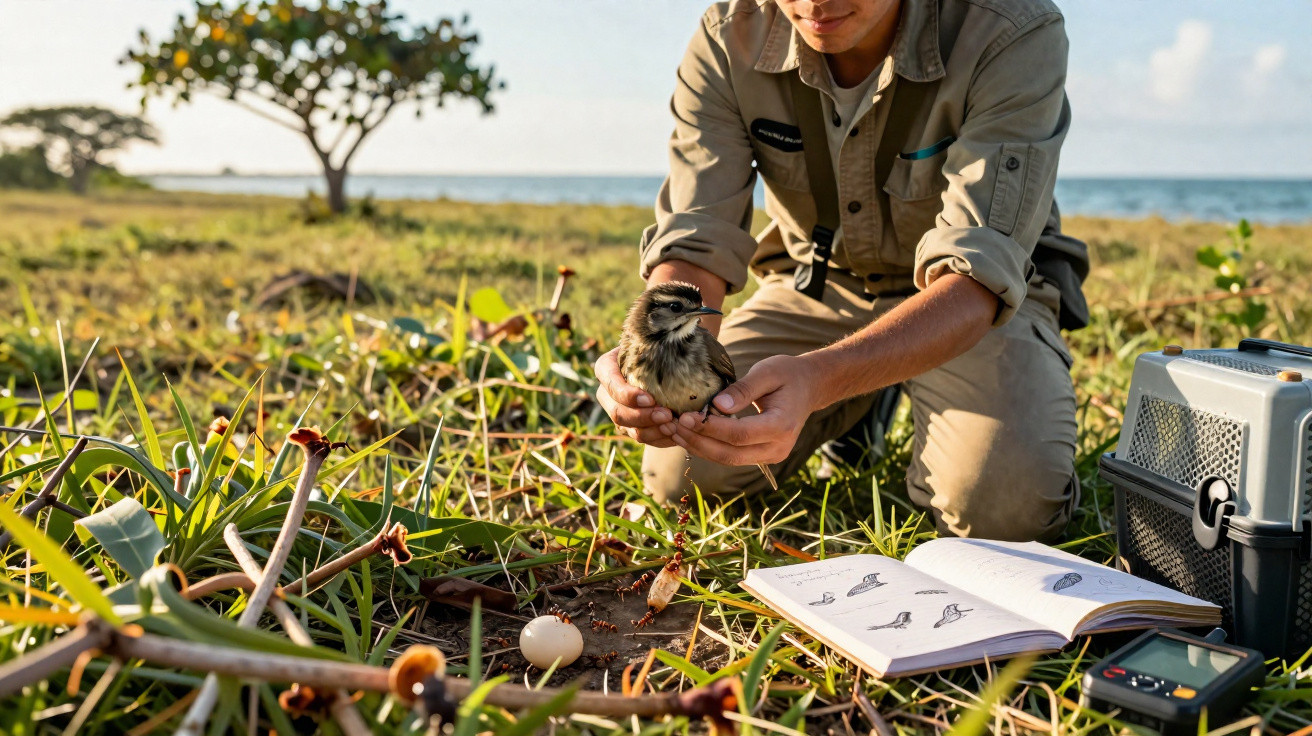
One example is a seabird losing its toes to fire ants and taking hours to die. A new study has created the first formal system for tracking incidents like this.
The hidden conservation costs of invasive species
The study was led by Dr Thomas Evans, a biologist at the Free University of Berlin (FU Berlin), and Professor Michael Mendl at the University of Bristol (Bristol).
Evans had spent years examining how introduced birds drive native species towards extinction.
While working with Mendl, whose research focuses on animal welfare science, he repeatedly noticed that the field stopped at population figures.
Individual animals being hunted, parasitised or deprived of food scarcely featured in the calculation.
Their response is a scoring framework named AWICIS: the Animal Welfare Impact Classification for Invasion Science.
It evaluates the extent to which an invasive species harms an individual animal’s physical and mental state.
That measure is separate from whether the species survives, because animal welfare and biodiversity are not the same thing.
Biological invasions can cause extinctions, but they also inflict severe suffering on individuals that population counts never reveal.
Measuring animal suffering
AWICIS divides welfare impacts into five severity tiers, ranging from negligible to severe.
Evidence must come from one of three sources: visible injuries, observable behaviour or physiological signs such as raised stress hormone levels.
An eye swollen shut qualifies, as does repetitive preening. A rise in cortisol on a blood test also counts, even if the animal appears uninjured externally.
The framework takes its structure from a tool designed to assess damage to biodiversity. While the older tool records extinction risk, AWICIS focuses on the individual animal researchers are observing.
Evans and Mendl applied it to two very different groups of invaders: introduced birds and introduced ants. Both have been the subject of research for decades.
The brutality of invasive ants
The results for ants were particularly stark. Approximately 92% of recorded welfare impacts associated with introduced ants fell into the highest severity categories.
The harm affected animals across six classes and 27 orders, including turtles, lizards, crabs, bats, fledgling seabirds, and even cats and dogs.
Fire ants emerged as the main cause of devastation, particularly red imported fire ants.
Yellow crazy ants also featured. On Christmas Island, they left native red crabs blind and maimed.
In Hawaiian colonies, wedge-tailed shearwaters lost toes, developed malformed bills and had their eyes partly closed by overgrown skin.
A fledgling bull-headed shrike attacked by yellow crazy ants on Minami-Daito Island suffered severe eye inflammation and died from its injuries several days later.
A slow, drawn-out death
Why is the harm so severe? The explanation lies in both body size and chemistry. An individual fire ant carries only a tiny dose of venom or acid, but ants arriving in large numbers can be immensely harmful.
It takes hundreds or thousands of stings, inflicted over hours, to kill a vertebrate.
Larger animals tend to take longer to die and are therefore assumed to suffer more.
Native predators also kill, but the length of the process distinguishes some introduced ants.
A review of the effects of red imported fire ants on humans found that their stings can cause anaphylactic shock and kill adults.
When thousands of stings are inflicted on a fledgling bird or a lizard, the outcome is similar.
Birds behave differently
Introduced birds presented a less severe picture. Only around 9% of their welfare impacts reached the more severe tiers, mostly through competition for food and nesting sites.
Islands without native birds of prey were the exception. When birds of prey are introduced to control rats, they hunt seabirds that never evolved to escape aerial predators. In those cases, the severity rises.
Missing physical clues
The authors highlighted one finding: only 2% of ant impacts and a small proportion of bird impacts included physiological evidence.
Stress hormones and other chemical signals, which can provide subtler indications of suffering, were almost entirely absent from the data.
Most welfare evidence consisted of visible injuries and observable behaviour, because field biologists were already collecting those observations. This works well when wounds are obvious.
Where suffering is less apparent, physiological data could fill gaps that might not be visible to the naked eye. A recent paper on the physiology of wild animal welfare has begun to make that argument.
An uneven global record
The findings are heavily weighted towards high-income regions, including North America, Europe and Australia, where most biodiversity research is published.
Welfare impacts in low-income regions are almost certainly underreported, and their absence from the dataset should not be taken as evidence that they do not occur.
The axis of conservation
Before this work, the field lacked a shared method for tracking what introduced species do to individuals.
Population decline and extinction could be recorded, but sustained physical or emotional harm could not.
In practical terms, this provides a second axis for conservation decisions. An ant species can pose a low extinction risk while still causing enormous suffering.
A 2023 study found that just 17 of more than 500 introduced ant species caused severe biodiversity damage. The new framework suggests that welfare damage may be much more widespread.
Evans is now calling on field researchers to gather welfare data alongside biodiversity surveys, particularly in lower-income regions where data are most limited.







Comments
No comments yet. Be the first to comment!
Leave a Comment