Modern birds owe much of their aerial agility to short, light tails. Yet scientists have long disputed precisely how this feature developed from the elongated, bony tails of their dinosaur ancestors.
A new study has resolved one of the central questions surrounding that shift, finding that early birds reduced their tail length before the remaining bones fused into the compact arrangement found in birds today.
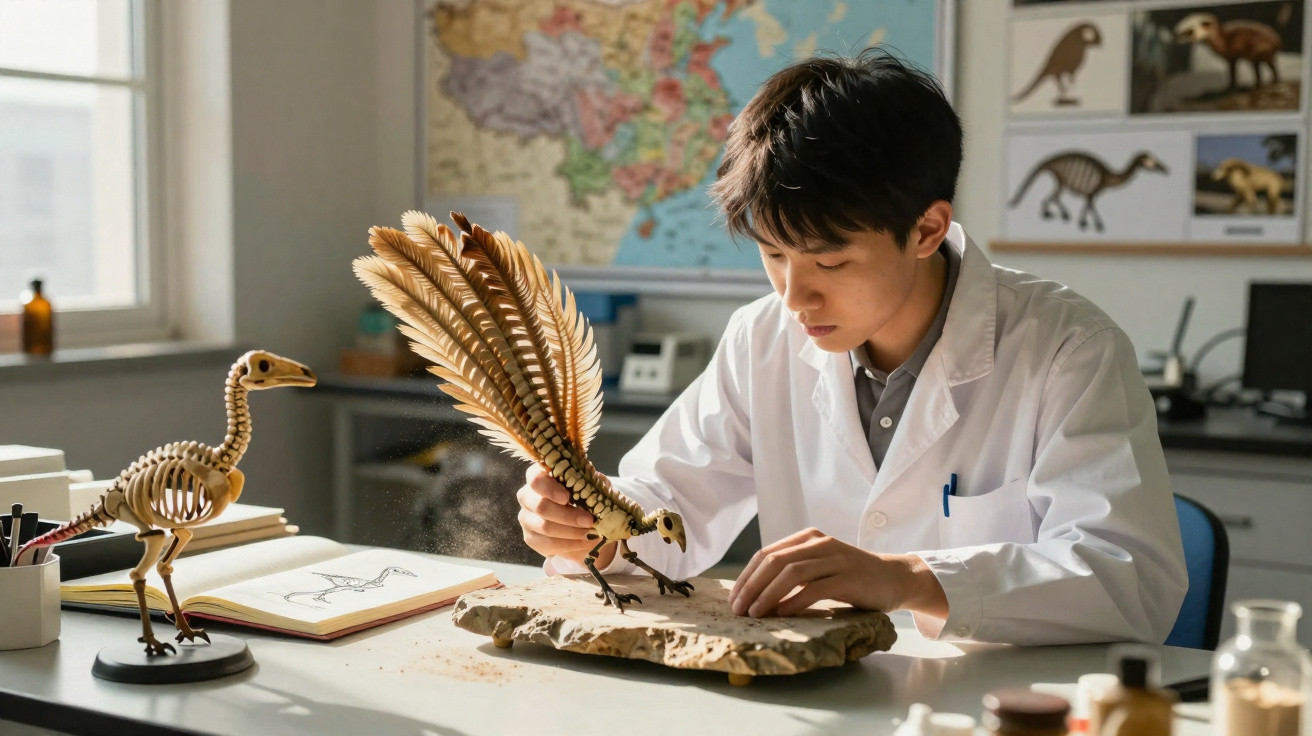
The findings come from a minute feathered dinosaur that lived in south-eastern China around 150 million years ago, providing an unusual view of an important stage in the evolution of flight.
Discovering Zhengheornis buyu
Min Wang, a palaeontologist at Beijing's Institute of Vertebrate Paleontology and Paleoanthropology (IVPP), headed the group that described the fossil.
The researchers called the animal Zhengheornis buyu, with the second element of its name taken from an ancient Chinese term meaning unexpected.
The only known specimen is divided between a rock slab and its corresponding counter-slab, with feathers still visible around its body. Much of its limb skeleton remains solely as moulds: empty impressions left when the original bone dissolved.
The rock comes from the very end of the Jurassic, approximately 150 million years ago. Fused bones in the hips and ankles indicate that the creature was close to its adult size, rather than being a juvenile.
Nevertheless, it was exceptionally small, weighing no more than roughly 170 g. This makes it the smallest early bird relative yet discovered without a fused tail, underscoring how diverse these animals had already become.
Birds, dinosaurs and tails
Its tail is the feature that distinguishes this animal. It contains only 15 short tail bones and finishes with a series of small, separate bones rather than a fused tip.
In modern birds, the final tail bones are united into a wedge-like structure known as the pygostyle: the bony projection supporting the fan of tail feathers. Zhengheornis lacked this feature. Instead, its tail narrowed into a chain of small, unfused bones.
Its tail length was also unusual. It measured only around two-thirds of the hind-leg length, whereas the tails of most long-tailed relatives extended beyond the leg. The bone count points to the same conclusion.
The morphological gap in early bird tails
Archaeopteryx, the celebrated early bird relative from Germany, possessed 23 to 24 tail bones, while certain close relatives had more than 30.
With just 15, Zhengheornis had already shed a substantial section of the ancestral dinosaur tail. Its last two tail bones were brief and box-shaped, in contrast to the long, splinter-like bones of related species.
The change involved more than simply removing bones from the tip. The first five tail bones have small sideways projections for muscle attachment, while those behind them diminish abruptly. As a result, the tail changes from robust to slender about one-third of the way along. The same structural transition occurs in the same position in Archaeopteryx.
Where early birds flourished
Zhengheornis is the fourth bird relative identified from the Zhenghe Fauna, a fossil-rich group of rocks in Fujian that has reshaped the early history of birds.
In a 2023 study, researchers named the long-legged predator Fujianvenator, which retained a complete dinosaur-like tail.
In the evolutionary tree assembled by Wang's team, Zhengheornis belongs among the earliest birds, positioned only one step beyond Archaeopteryx.
That position is significant. Fossils of long-tailed and short-tailed birds appear at nearly the same time, making the sequence of evolutionary changes difficult to establish.
The same rocks produced a bird with the reverse tail condition. Baminornis zhenghensis, described in a 2025 paper, already had a short tail ending in a fully developed pygostyle-the oldest such tail known.
Thus, two birds from the same location and period record two phases of the same transformation.
How modern bird tails developed
Taken together, the three birds show a distinct progression. The dinosaur tail initially became shorter and lost bones, as seen in Zhengheornis; only afterwards did the surviving terminal bones fuse into a pygostyle, as in Baminornis. Tail shortening occurred first, followed by fusion.
This sequence helps account for the refinement of flight. A long, bony tail is heavy and extends behind the hips, drawing the body's centre of balance backwards.
Reducing the tail probably shifted that balance point forwards. It may also have allowed the tail and hind legs to move more independently, a development associated with more stable flight.
Researchers can now investigate why the tail changed in the first place, and whether identical evolutionary pressures caused both its shortening and its fusion.
The Zhenghe rocks continue to yield early birds. Every newly recovered skeleton adds another part to the period when dinosaurs began to take to the air.













Comments
No comments yet. Be the first to comment!
Leave a Comment