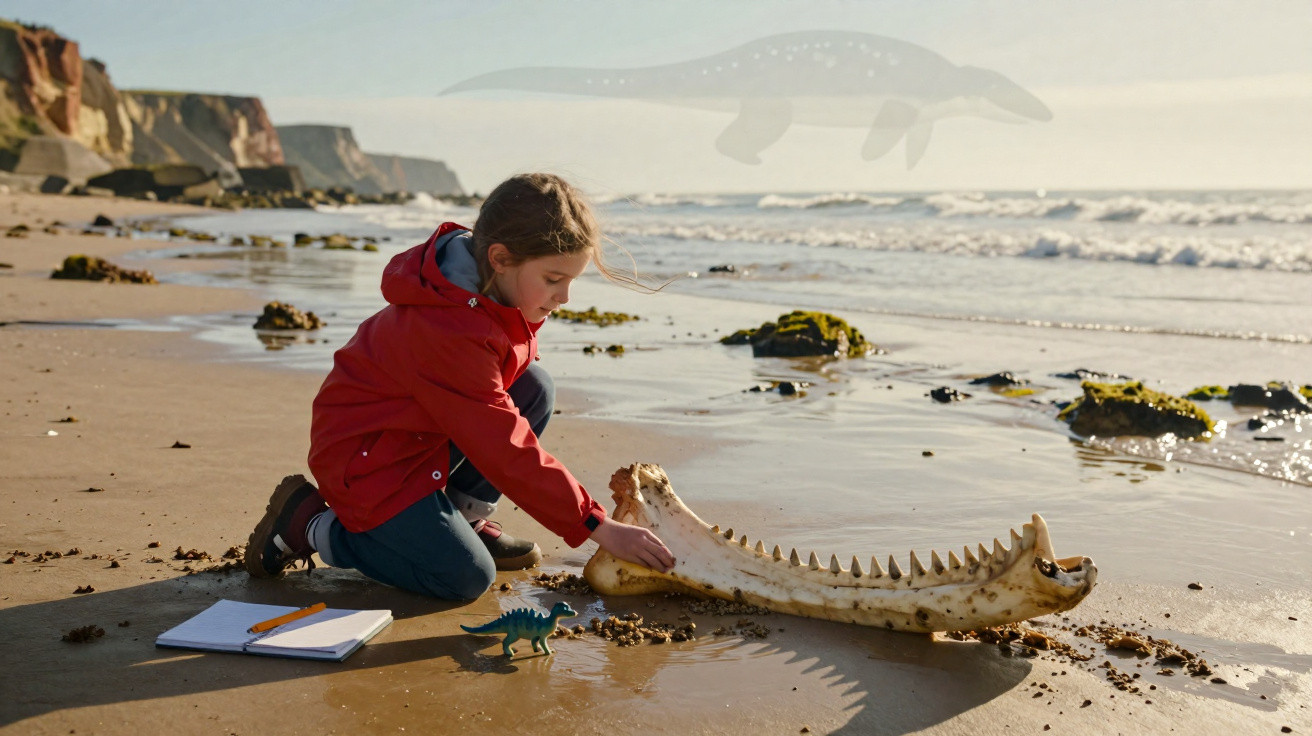
A walk along a familiar beach is hardly where anyone would expect to find a relic from the age of dinosaurs. Yet that is precisely what happened on England’s west coast.
Below Somerset’s eroding cliffs, a stretch of shoreline gave up a bone so enormous that it challenged assumptions about prehistoric marine reptiles.
The fossil was a lower jaw more than 2 metres long, pointing to a creature vastly larger than anything alive today. It dated from around 202 million years ago, during the turbulent closing chapter of the Triassic Period.
Much of present-day Britain then lay under a warm, shallow sea, where giant meat-eaters hunted. A mass extinction brought their reign to an end, leaving scattered bones as traces of their stories – until now.
Ruby and Ichthyotitan severnensis
In late May 2020, 11-year-old Ruby Reynolds and her father, Justin, went fossil-hunting on the mudflats at Blue Anchor.
Justin found a fragment of bone measuring about 10 centimetres, “bigger than any piece of bone I’d ever found before,” he recalls.
Further along the shore, Ruby uncovered a second piece twice as large. “It was just sort of lying there,” she says. “I was just happy, really.” Their excitement would soon spread well beyond the beach.
News of the find reached palaeontologist Dean Lomax, who holds positions at both the University of Bristol and the University of Manchester. He recognised similarities with another Somerset specimen, collected in 2016 by local fossil hunter Paul de la Salle.
That earlier jaw fragment, a bone known as a surangular, had been assembled from several pieces that, Lomax recalls, “fit together perfectly like an ancient prehistoric jigsaw puzzle.”
Ruby’s discovery was eventually named Ichthyotitan severnensis, literally meaning “giant fish lizard from the Severn.”
Ichthyotitan severnensis was a true giant
The worn edges of the first bone left scientists wanting further evidence. “It suggests that it was from something unusual and exceedingly large,” Lomax says.
He and his colleagues published a cautious description, although they could not establish the animal’s identity. “What we’d hoped for – we kept our fingers crossed – we hoped that maybe more specimens would come to light in the future,” he admits.
Ruby and Justin’s beach finds provided just that. They sent photographs by email – “Hey, Dr. Lomax – we think we’ve found another one of your giant ichthyosaur jawbones” – prompting the research team to hurry to Somerset.
“Of course, they were quite right,” Lomax says. “They correctly identified these sections of bone as belonging to an ichthyosaur.”
Further collecting trips yielded more fragments, leaving almost two-thirds of the jaw intact and in excellent condition.
Matching two enormous jawbones
The two Somerset jaws showed striking similarities when compared. They came from the same rock layer and shared unusual internal bone textures, leading the team to conclude that they represented a single new species.
In a paper published in PLOS ONE, the researchers suggested that the whole animal measured roughly 25 metres – “genuinely enormous, about the length of a blue whale,” Lomax says.
Size alone is not enough to secure a record, so the scientists also examined microscopic structures within the bone.
These corresponded to the unusual pattern found in other exceptionally large ichthyosaurs, prompting researchers to suggest that the reptiles grew differently from most of their scaly relatives.
It remains uncertain whether Ichthyotitan severnensis belonged to the shastasaur group, the clade responsible for giant Triassic animals around the world. A complete skeleton would be needed to settle the question.
Estimating Ichthyotitan’s size
The Somerset giant probably had a lighter, more streamlined body suited to travelling through the open ocean. Its jawbone alone was around a metre or more longer than an adult person.
If its proportions resembled those of relatives such as Shonisaurus, its skull could have exceeded 3 metres in length, while its paddle-shaped flippers may have stretched wider than a living-room sofa.
Reaching such dimensions suggests an ocean with plentiful food and no larger predators. Vast schools of squid-like cephalopods flourished in Triassic seas, providing a feast for hunters that ranged over long distances.
Stable-isotope evidence from other ichthyosaur bones points towards warm-blooded metabolisms. Combined with live birth and streamlined bodies, these may have allowed ichthyosaurs to occupy whale-like niches long before mammals entered the sea.
The remarkable Triassic world
The Triassic often receives less attention than the Jurassic, with its famous dinosaurs, but biomechanist Kelsey Stilson describes it as “a really weird time.”
The continents had only recently joined to form Pangaea, monsoon-driven climates shifted between drought and deluge, and early dinosaurs and mammals had only just appeared.
“There were things that we can’t even possibly imagine in the past,” Stilson adds. “But we can get little hints, and this is one little hint at this larger picture of evolution on Earth.”
That wider picture shows ichthyosaurs rising rapidly after the end-Permian mass extinction, then reaching their greatest sizes shortly before the next catastrophe.
“No marine reptile ever reached such gigantic sizes ever again,” Lomax notes. Ichthyosaurs of the later Jurassic and Cretaceous became smaller, perhaps displaced by changing oceans and the appearance of other reptilian predators, including pliosaurs and mosasaurs.
Whales followed Ichthyotitan severnensis
Around 94 million years ago, the last ichthyosaurs vanished, leaving their position at the top of marine food webs vacant.
The gap remained until hoofed mammals returned to the sea some 50 million years ago, putting whales on their own evolutionary path towards immense size.
This repeated pattern – large, fish-shaped predators evolving from land-dwelling ancestors – shows how similar ecological opportunities can produce recurring evolutionary solutions.
Today’s blue whales can grow beyond 30 metres and weigh around 163 tonnes, yet, in terms of length, they share the open ocean’s realm with Ichthyotitan in the fossil record.
Their stories demonstrate the ocean’s capacity to support giants when food is plentiful and competition limited.
What happens next?
Each winter, Somerset’s cliffs erode a little further. Storms batter the ancient mudstones, sometimes revealing new fossils overnight.
“This research has been ongoing for almost eight years. It is quite remarkable to think that gigantic, blue whale‑sized ichthyosaurs were swimming in the oceans around what was the UK during the Triassic Period,” Lomax concluded.
“These jawbones provide tantalizing evidence that perhaps one day a complete skull or skeleton of one of these giants might be found. You never know.”
Beachcombers such as Ruby and Justin now search those shores with fresh purpose. Their fortunate discovery is a reminder that scientific breakthroughs can lie in plain sight, awaiting curious eyes and persistence.
The sea claimed Ichthyotitan severnensis long before people walked in Europe, but its story shows that, even after millions of years, a coastal walk can rewrite natural history.
The full study was published in the journal PLOS ONE.









Comments
No comments yet. Be the first to comment!
Leave a Comment