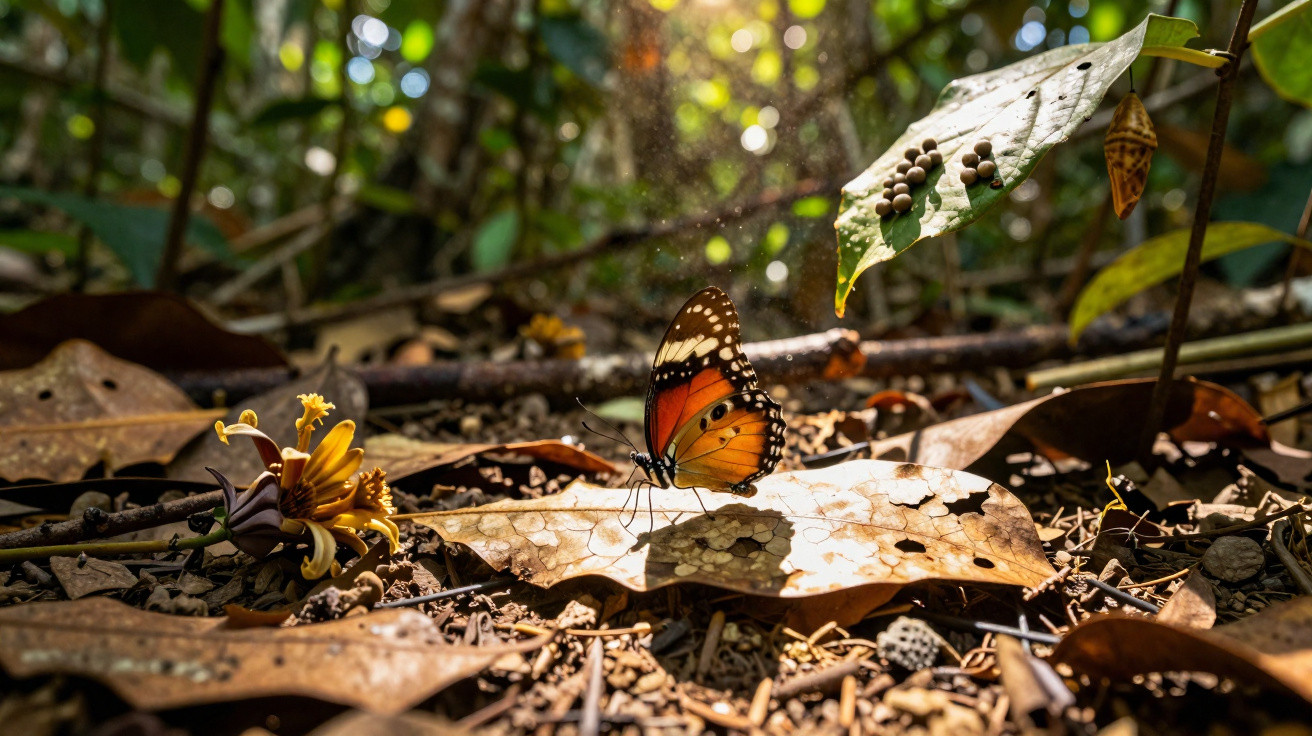
Deep in the south-western Amazon, changing rainfall marks the passing of the seasons. Between June and October, the forest grows drier and hotter.
To survive this period, some butterflies take an unusual step: they stop reproducing.
A new study has found that female butterflies in the Peruvian Amazon can suspend egg production throughout the dry season. Researchers refer to this as “reproductive pause diapause”.
The phenomenon is common among insects that experience cold winters, but little was known about it in tropical rainforests.
The research also revealed that closely related butterfly species can respond very differently to the same season.
Studying butterflies in the Amazon
Researchers spent four years studying butterflies at Finca Las Piedras in Peru. The team brought together scientists from the United Kingdom, Peru, Sweden and the United States.
They examined 599 female butterflies belonging to nine species, counting their eggs and checking whether they had mated.
The team also compared its findings with weather records collected at the site.
The study provided a detailed picture of how tropical butterflies respond to changes between seasons.
How dry seasons shape survival
Most research into diapause has concentrated on insects in colder parts of the world. There, winter typically forces insects to halt reproduction until spring.
In the tropics, seasons are shaped more by rainfall than by temperature. Dry spells can diminish food supplies, damage plants and make it harder for young insects to survive.
The study shows that tropical butterflies adopt different strategies to survive challenging seasons.
Butterflies respond in different ways
During the dry season, some butterfly species changed very little, while others cut back reproduction much more sharply.
“We were surprised to see so much variation in reproductive strategies across this group of butterflies, even within the same populations,” said lead author Marcus Hicks.
“In temperate butterflies you’d expect to see diapause in almost 100% of individuals in the winter.”
The results suggest that these reproductive strategies evolved many times among tropical butterflies.
Two species, two strategies
The clearest example came from two closely related species: Catonephele acontius and Catonephele numilia.
Both inhabit the same forests and use similar plants, yet their responses to the dry season differ.
Among C. acontius, the number of females without eggs rose sharply in the dry months. By contrast, C. numilia showed almost no seasonal change.
Females that continued laying eggs also produced fewer during the dry season, although the decline was much greater in C. acontius.
One species sharply slows its reproduction, whereas the other carries on with only minor changes.
Heat triggers diapause
The researchers compared butterfly reproduction against rainfall, daylight and temperature.
Maximum temperature showed the strongest link. When daytime temperatures rose, egg production fell and more butterflies entered diapause.
This finding surprised the researchers, since tropical seasons are generally associated more closely with rainfall.
Some butterflies continue reproducing
Even in the driest months, many female C. acontius continued to reproduce, though at lower levels.
This points to the butterflies spreading their risk: some keep laying eggs in case conditions improve, while others wait for better weather.
“One explanation could be that these butterflies are hedging their bets to help them navigate increasingly variable conditions in the tropics,” said Hicks.
“It may be helpful for them to ‘play both sides’, with some butterflies continuing to reproduce, and others taking a break during the dry season.”
Climate change could disrupt survival
The research comes at a significant time for the Amazon, as climate models forecast longer, hotter dry seasons in the future.
Scientists are concerned that rising temperatures could lead some butterfly species to pause reproduction for longer, making survival more difficult.
“To me, this study represents a vital step forward in our understanding of how Amazonian insects respond to seasonal environments,” noted Hicks.
“As the rapid impacts of anthropogenic climate change become more pronounced, we are likely to see severe changes to these seasonal patterns in the Amazon.”
Scientists concerned about climate shifts
Study co-author Jamal Kabir is a PhD student at the University of Nottingham.
“Understanding how tropical insects respond to changing seasonal conditions is becoming increasingly valuable as climate change alters rainfall and temperature patterns across the Amazon,” said Kabir.
For these Amazon butterflies, survival may hinge on knowing precisely when to stop and when to start again.












Comments
No comments yet. Be the first to comment!
Leave a Comment