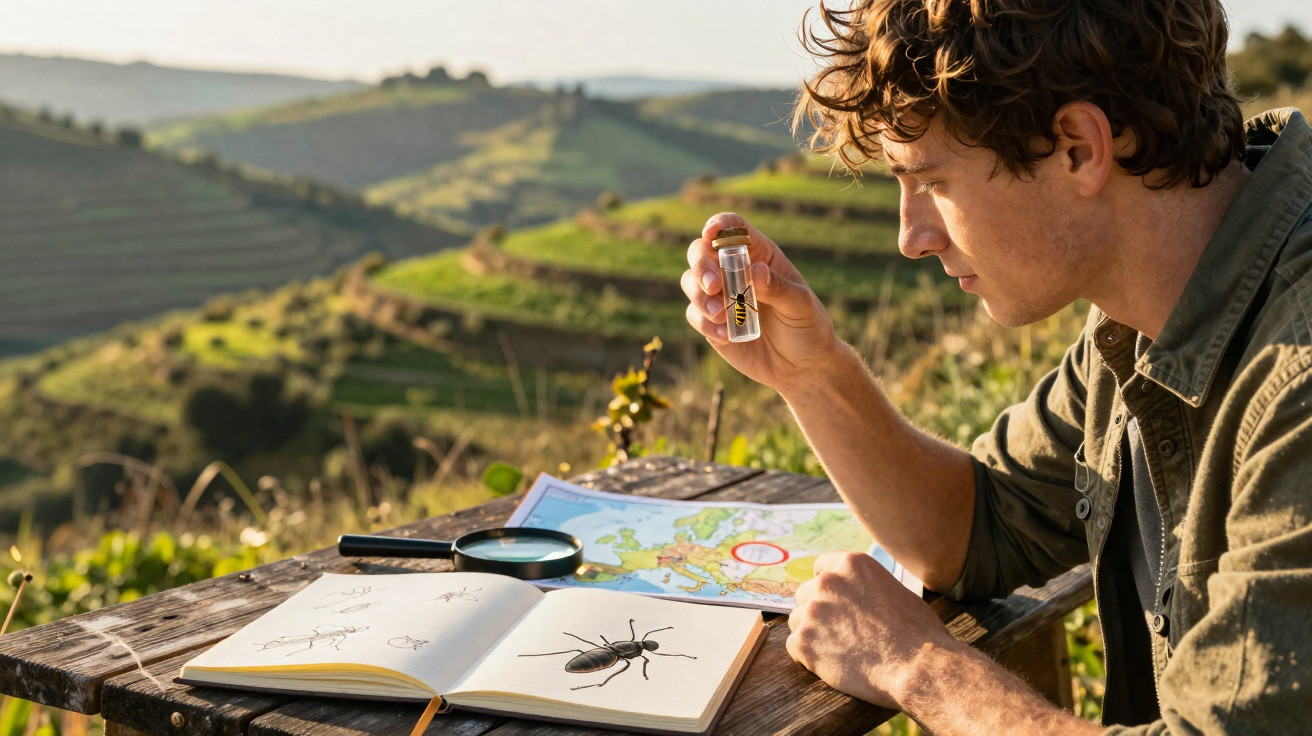
A biologist accustomed to photographing and documenting animal species in Portugal has discovered the wasp Exephanes ischioxanthus in Baião, marking its first-ever record in the country.
Daniel Ferreira, a researcher at the Landscape Laboratory in Guimarães, photographed the insect in 2020 on a plot of land in Baião, Porto district, within the Serra da Aboboreira Protected Landscape. In April, he published a paper on the finding with biologist José Manuel Grosso-Silva in the journal Arquivos Entomolóxicos.
First Portuguese record of Exephanes ischioxanthus
Ferreira told Lusa that the identification has now been confirmed, making it the first record of the species in Portugal.
“It belongs to a family with thousands and thousands of species that are very similar to one another. (...) [This one] is distributed very widely across Europe, with records in Spain, the nearest in Galicia. But there really had not been one for Portugal,” he said.
For Ferreira, the significance of the confirmation lies in being able to “validate another record so far west” within the species’ European range. He considers it likely that the wasp was already widespread in Portugal and says it is not “an invasive, exotic species, as are sometimes brought in by humans”.
“It is a parasitoid species of some butterfly species, and it may even help to control that species, which can sometimes have an agricultural impact,” he said.
European distribution and characteristics
Grosso-Silva, who co-authored the paper, is curator of entomology at the Natural History and Science Museum of the University of Porto. The wasp had previously been confirmed in Belgium, Germany, France, Luxembourg, the Netherlands, Poland, Slovenia, Slovakia, Spain and the United Kingdom.
A specimen collected in 1915 is held at the National Museum of Natural Sciences in Madrid. It displays the main characteristics of this insect, which belongs to the subfamily Ichneumoninae: a predominantly black body with white markings in places.
Insect recording and citizen science
The discovery poses no danger or risk of negative impacts. Ferreira nevertheless used it to appeal to “ordinary citizens, who can make records, take part and contribute to scientific data”. As a starting point, he suggested iNaturalist, the free platform where he submitted his photographs.
“Nowadays, we already have a growing number of studies in Portugal focusing on insects, and their ecological role in various matters and the various services they provide in ecosystems is understood. There has been a lot of discussion about pollination and pollinators. (...) More work is beginning to be done, and the more work is done, the more it becomes clear that it really is urgent, and that much work remains to be done,” he added.








Comments
No comments yet. Be the first to comment!
Leave a Comment