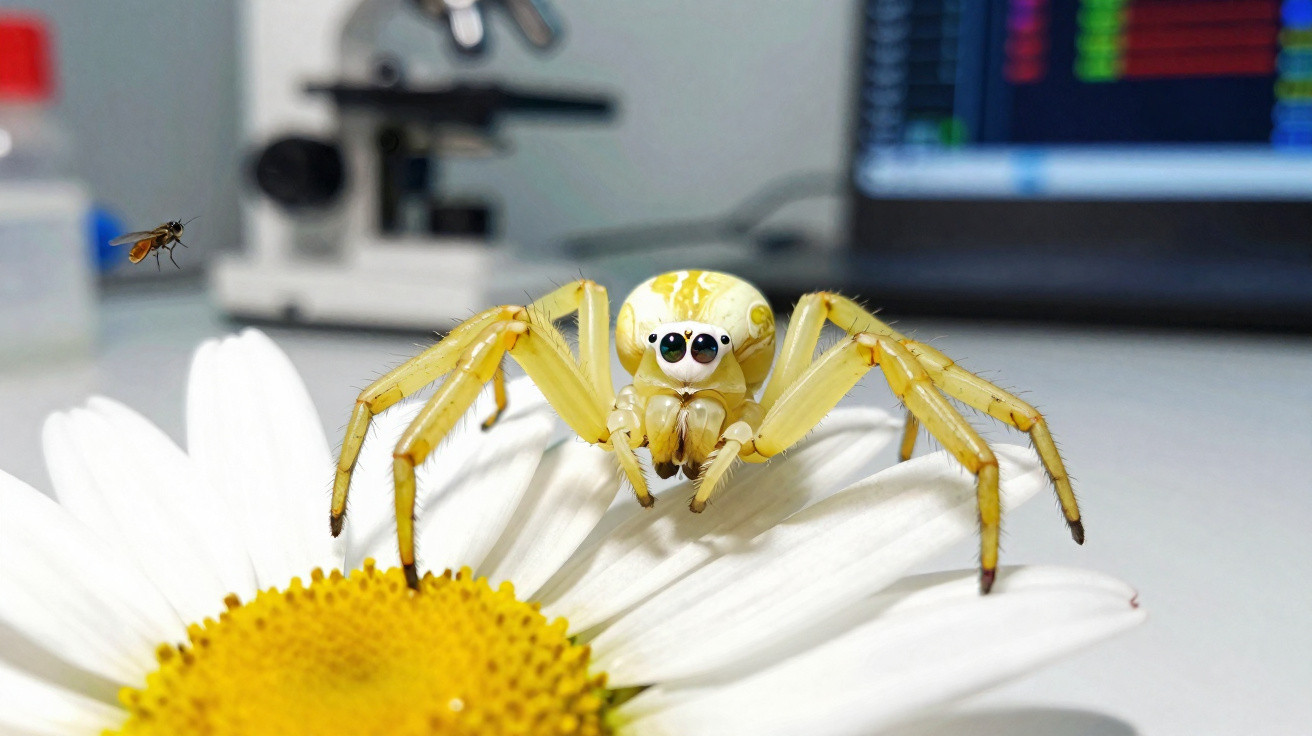
Eight eyes might seem more than sufficient, but new research into crab spider vision suggests their lenses do not quite live up to expectations. Biologists have traditionally placed the family alongside web-builders rather than visual hunters, assuming that camouflage and patience do most of the work.
An Australian team recently set out to establish how much those tiny eyes contribute to catching prey. When the researchers covered them, the outcome defied what the spiders’ anatomy would suggest.
Overlooked sensory tools
The crab spider family includes around 2,000 species, living on every continent apart from Antarctica. Some can change their body colour from white to yellow to blend in with the flower on which they are sitting.
This camouflage is effective because the spider remains almost motionless, allowing bees and flies to come within striking distance.
Their anatomy appeared to support this camouflage-first explanation. Each eye is small, and earlier surveys placed crab spiders with web-builders instead of active hunters. Since they do not use a web, the assumption was that they depended on their front legs and good fortune.
A team led by Sam J. England, a postdoctoral researcher at the Museum of Natural History in Berlin, joined colleagues at Macquarie University in Sydney to test that idea. They covered the spiders’ eyes with paint and observed what followed.
Blindfold test in the lab
Early in 2024, the researchers collected 47 Sidymella rubrosignata, a small green Australian crab spider, from leaves around Sydney. In the laboratory, they applied black acrylic paint over all eight eyes of half the spiders. The others retained their sight.
Each spider was placed on its own in a clear plastic container with one live fruit fly. After 24 hours, the team checked whether the fly was dead, partly eaten or still alive. A damaged carcass or an absent fly was recorded as a catch.
The deliberately simple set-up made the comparison straightforward. If vision made no difference, spiders with painted eyes should have performed much like those without paint. A substantial difference would be difficult to attribute to another cause.
Wide gap in capture rates
The difference was substantial. Within a day, 21 of the 23 sighted spiders caught and killed their fly, giving them a success rate of 91%. Of the 22 spiders whose eyes were painted, just 13 succeeded, a rate of 59%.
Statistical analysis supported the finding: sight was the strongest individual predictor of success. Body size also had a smaller but genuine effect, with larger spiders catching prey more consistently in both groups.
A 32-point fall in capture success is considerable. Even when the spider and its food share a container the size of a film canister, sight clearly helps, including when prey is right under its nose.
Lenses tell another story
England’s team then used micro-CT to scan the eyes of S. rubrosignata and six other spider species. The X-ray technique creates three-dimensional models of minute internal structures.
The researchers wanted to compare eye size among crab spiders, web-builders and recognised visual hunters.
Crab spider lenses proved to be tiny. Both S. rubrosignata and the European crab spider Misumena vatia ranked far below visual hunters measured in an earlier study. Their combined eye size was closer to that of an orb-weaver than to that of a spider that hunts by sight.
The internal arrangement was similarly modest. Active hunters usually possess one exceptionally large pair of eyes. Jumping spiders, for example, use large forward-facing lenses to track their prey.
Crab spiders, by contrast, had four pairs of roughly equal size, with no specialised pair and no clear investment in vision.
Crab spider vision aids the hunt
Before this study, nobody had directly tested whether crab spiders used their eyes while hunting. Previous research had looked at colour matching and UV signalling, examining how prey perceive the spider. The question of how the spider perceives its prey had not been investigated.
The blindfold experiment addresses that gap. Despite modest visual equipment, crab spiders gain a genuine performance advantage from their eyesight. The result changes how researchers view the relationship between eye size and behaviour.
Conventional thinking assumes a close link: larger, more specialised eyes indicate a more visually oriented way of life, whereas small, generic eyes suggest that sight has only a minor part to play.
Crab spiders do not fit that pattern. Their eyes are small and their investment in vision is low, yet sight makes a real contribution to feeding.
Rethinking spider eyesight
The clearest implication is that biologists can no longer judge whether a spider hunts by sight from eye anatomy alone. Behavioural tests are needed, and even a modest visual system can perform a meaningful role.
This matters for how biologists classify hunters. Researchers have long inferred a species’ reliance on vision from eye size and anatomy, but that approach may underestimate how many animals can see more than their eyes suggest.
If crab spiders, with their ordinary eyes, need sight to catch nine out of ten flies, other supposedly non-visual species probably do too. Similar experiments on other ambush-hunting families are the next logical step.
The blinded spiders nevertheless caught more than half their prey using senses other than sight, although the study does not establish which ones. Vision contributes to crab spider hunting, but it does not do the job alone.








Comments
No comments yet. Be the first to comment!
Leave a Comment