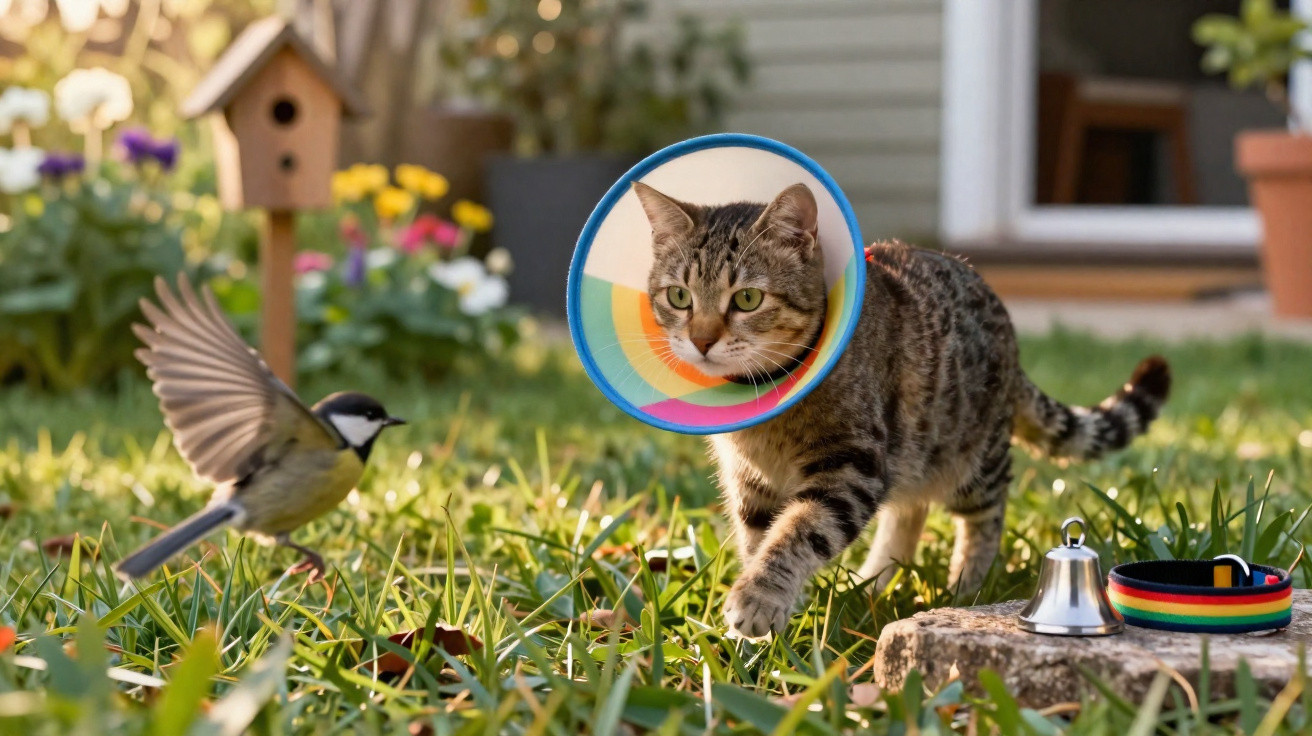
Anyone who owns an outdoor cat will eventually see evidence of its hunting. Sparrows, mice and robins often appear on the doormat as a supposed “token of love”. It is unpleasant for owners and an increasing problem for wildlife. Researchers and animal welfare campaigners are therefore turning to an unusual aid: a wide, brightly coloured collar that makes cats much easier for birds to spot.
Why outdoor cats become hunters
At home, domestic cats can seem contented, sleepy and well fed. Once outside, however, their bodies automatically switch into hunting mode. The behaviour is deeply rooted in their genes: even a cat with high-quality food in its bowl hunts through instinct rather than hunger.
Studies from several countries report similar figures. On average, an outdoor cat kills five to ten birds or small mammals each year. Some catch considerably more and others less, but across the whole cat population the pressure on native wildlife is substantial.
Millions of cats catching just a few animals each year add up to an unseen but enormous band of predators in our gardens.
The spring breeding season is especially critical. Young birds leave their nests before they can fly well and often remain in bushes or on the ground. Many cats take full advantage of this vulnerable stage. Even devoted owners do not want their pets bringing home fresh victims every week.
How a colourful cat collar makes cats visible to birds
The idea behind the conspicuous collar is remarkably straightforward. If a cat can no longer blend into its surroundings, birds have a much better chance of escaping. Instead of stalking unnoticed, the hunter carries a bright warning signal.
A typical product resembles a soft, wide fabric tube or a colourful “collarette” fitted around an ordinary collar. Many versions come in neon shades or rainbow colours. At first glance, the effect can seem rather silly, almost like a fancy-dress costume for a cat. Yet that clownish appearance saves lives.
Birds see colours exceptionally well, so the bright collar gives away a cat long before it is ready to pounce.
Mice and other small mammals have limited colour vision, whereas birds perceive colours with great precision. They use this ability to identify ripe berries, mates and predators. A cat’s body is normally well camouflaged: tabby, grey or black fur helps it disappear into the shadows. A colourful band completely breaks up that camouflage.
How much does the cat collar reduce hunting success?
Several studies, including research in North America and Great Britain, have found a similar pattern: cats wearing colourful collars brought home far fewer birds. In some studies, the number killed fell by half; in others, the reduction was between 30 and 60 per cent.
Hunting cannot be eliminated entirely, because the instinct remains. Nevertheless, every blackbird or tit that can fly away in time matters. For threatened species or those in steep decline, such a change could ultimately make a decisive difference to their populations.
Combining colour, bells and limits on outdoor time
A colourful collar is an important part of the solution, but it works best alongside a few straightforward changes in behaviour. Owners who love their cats and want to protect garden birds can achieve a great deal with a handful of adjustments.
- A lightweight bell on the collar: A small, good-quality bell does not harm a cat’s hearing, but its sound provides prey with an extra warning. For many birds, noise and colour together form a clear alarm signal.
- No outdoor access at night or dusk: Most birds are most vulnerable at dusk and early in the morning. Keeping a cat indoors from nightfall until after sunrise prevents it from hunting during the most effective periods.
- More indoor play and enrichment: Cats that burn off energy are less likely to hunt outdoors out of boredom. Wand toys, activity boards and food puzzles replace some hunting opportunities without leaving a trail of blood in the front garden.
Using colourful collars, restricting outdoor time and providing stimulating indoor alternatives can demonstrably reduce the number of animals caught by around half.
Consistency is important if these measures are to work. Wearing a collar for a few days and then going without it causes confusion and does little for birds. A clear routine is ideal: put the band on before every trip outside, every day without exception.
Is a colourful collar safe and comfortable for cats?
Many owners are initially concerned. Will it hurt? Could the cat get caught on something? Might it feel uncomfortable? Experts recommend purpose-made safety collars with a breakaway mechanism. These open if a cat becomes caught on a branch, for example, reducing the risk of strangulation.
Choose a light, soft material that will not rub the skin or pull at the fur. Most cats are puzzled at first but adapt within a few days. A brief, patient training period can help: put the collar on indoors, give the cat a treat and then take it off again. This helps the cat associate its new accessory with positive experiences.
When a cat collar may not be suitable
There are some exceptions where caution is advisable:
- Very young kittens under six months old
- Anxious cats that panic easily
- Animals with skin problems or significant fur loss around the neck
In these cases, it is worth speaking to a vet first. Sometimes it helps to try a very narrow, lightweight band before moving on to the wider, colourful version.
Why bird protection by cat owners matters increasingly
Many native bird species are under pressure. Intensive farming, fewer insects, disappearing hedges and land covered by buildings and paving deprive them of food and habitat. Add a high density of free-roaming cats in residential areas, and many small individual losses become a serious problem.
Responsible cat ownership protects songbirds and supports the wider balance of the garden ecosystem.
Fewer dead birds means more insect-eaters, more pollinators and more birdsong in spring. Children can once again watch tits flying in and out of a nest box rather than finding a motionless bundle of feathers on the patio in the morning. The emotional aspect is more significant than many people realise.
There is another benefit: cats wearing colourful collars bring bloody “gifts” indoors less often. Anyone who has tried to remove a partly dismembered robin from a carpet knows what that means in everyday life. Owners face less stress and less frustration over having to scold an animal that was only following its instincts.
Practical tips for getting started with a cat collar
A few simple steps can help at the beginning:
- First try a plain safety collar, so the cat becomes accustomed to the feeling around its neck.
- After a few days, switch to the colourful collar cover and watch the cat’s reaction.
- Initially, use the band only for short trips outside, then bring the cat back indoors.
- Play actively with the cat inside to help satisfy its need for exercise.
Many manufacturers now offer a choice of designs, from neon red and pink to multicoloured patterns. What matters is not the owner’s fashion preference but how strongly the band stands out against the cat’s fur and its surroundings. The brighter it is, the better for birds.
Owners with several cats can give each one a different colour, making them easier to tell apart at a distance. The garden becomes more colourful without reducing the animals’ quality of life. On the contrary, they can still go outside, only with a built-in brake on their inner miniature leopards.















Comments
No comments yet. Be the first to comment!
Leave a Comment