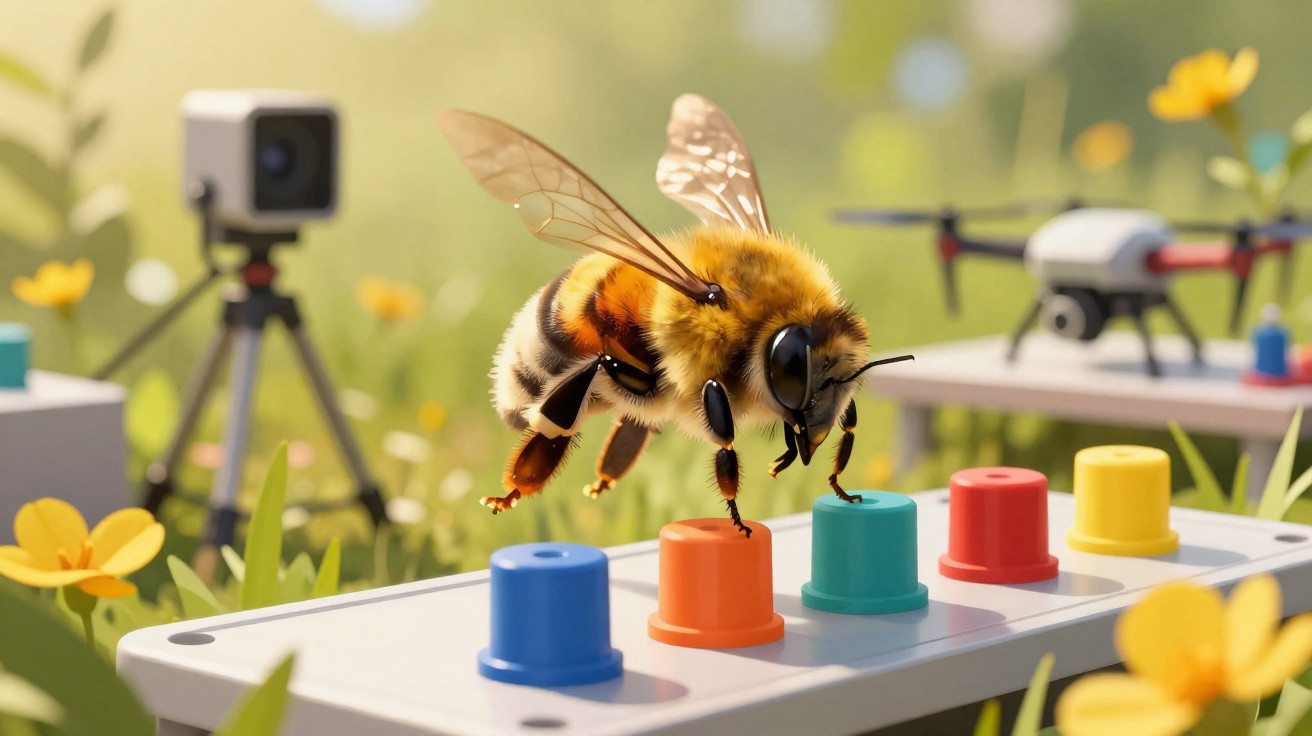
A bumblebee settling on a flower faces a greater risk than it might appear. Crab spiders lie concealed among the petals, waiting for an unwary visitor.
Recognising the danger in time can determine whether the bee gets a meal or becomes one. New research indicates that stress may give bees an unexpected advantage in such fraught encounters.
Scientists at Newcastle University discovered that a burst of acute stress alters bumblebees’ vision. The insects see more sharply and make decisions more quickly.
A predator without warning
Stress is generally viewed negatively. We associate it with difficulty concentrating, slower thought and awkward errors when under pressure.
But stress did not evolve to cause harm. Brief periods of it prepare the brain and body to meet an unexpected challenge.
“While stress is negative, it can prepare an individual for future challenges by changing how they respond,” said Dr Vivek Nityananda, the study’s senior author and a senior lecturer at Newcastle University.
A shake that mimics attack
The team startled each bee to simulate an ambush by a predator. Bees in the stressed group were shaken inside a soft, padded cage for 60 seconds.
The vigorous shaking mirrors the turmoil of an actual attack, putting the bee into a heightened defensive state.
Researchers then put the bees through a Y-maze. Each had been trained to distinguish horizontal stripes from vertical stripes, with the horizontal pattern signalling a sugar reward.
The experiment examined two fundamental aspects of vision: contrast and fine detail. Both influence how clearly an animal perceives its surroundings.
Sharper sight under pressure
Bees that had been shaken processed contrast differently from their calm counterparts. They required greater contrast to identify the pattern reliably.
At first, that might seem like a straightforward decline in ability. The stressed bees did find faint stripes with low contrast more difficult to distinguish.
Finer details come into focus
But the trade-off revealed a more intriguing result: shaken bees became better at resolving fine spatial detail.
They could distinguish narrower, more closely spaced stripes than the calm bees. Their eyes had become tuned to smaller, sharper features.
“Interestingly, we did not simply find that stress alters vision – importantly, its effects translated into action,” said Dr Olga Procenko, a postdoctoral researcher at the University of Birmingham who conducted the work at Newcastle University.
Faster choices, equal accuracy
The researchers also looked at what the bees did after seeing the patterns. Each insect still needed to choose an arm of the maze and enter a reward chamber.
Compared with the control bees, those that had been shaken committed to a choice more readily. They were less inclined to hesitate or avoid a decision entirely.
When their first assessment of the pattern was right, they responded faster. That extra speed did not reduce accuracy: they remained equally likely to choose correctly.
“Specifically, stress increased the bees’ readiness to act on their early perceptual judgment and commit to a choice and do so faster, without compromising accuracy,” Procenko said.
Why speed aids bumblebee survival
A faster, sharper response suits an animal at risk of being hunted. Seeing a concealed spider even slightly earlier could save a bee’s life.
“For bees, this may mean an increased ability to detect small details, like a camouflaged spider hiding on a flower,” Procenko said.
The stress response appears to adjust the senses purposefully. Rather than overwhelming the brain with noise, it boosts the most important signals.
“In bumblebees, we found that stress sharpens aspects of their vision and helps them respond more quickly to what they see,” Nityananda said.
“Rather than overwhelming the system, it could help prioritise the most relevant information, allowing bees to act rapidly and effectively in potentially threatening situations.”
A shared rule across species
Stress also changes human vision. Threats attract attention more quickly, while visual searches become more efficient.
The species differ, however, in the direction of that change. Humans tend to favour coarse features, whereas bees shift towards finer ones.
“What’s remarkable is that despite the very different visual worlds these animals inhabit, the underlying principle appears to be the same – stress doesn’t simply impair or enhance vision, it reshapes it in ways that are ecologically meaningful,” Procenko said.
From bee brains to robots
A brain smaller than a grain of rice can help answer substantial questions. It shows how an internal state can change perception itself.
“Understanding how stress reshapes perception is important not just for studying animal behaviour, but for a much wider range of fields,” Nityananda said.
“Whether we’re looking at how the human brain responds in stressful environments or designing artificial systems that need to make rapid decisions based on visual input, these are shared challenges.”
“By uncovering these fundamental mechanisms in bees, we can begin to identify broader principles that could inform research in neuroscience, as well as the development of robots that operate effectively under pressure.”
The team now hopes to identify the brain chemistry responsible for these changes. The researchers also want to investigate how different types and durations of stress affect what an animal sees.





Comments
No comments yet. Be the first to comment!
Leave a Comment