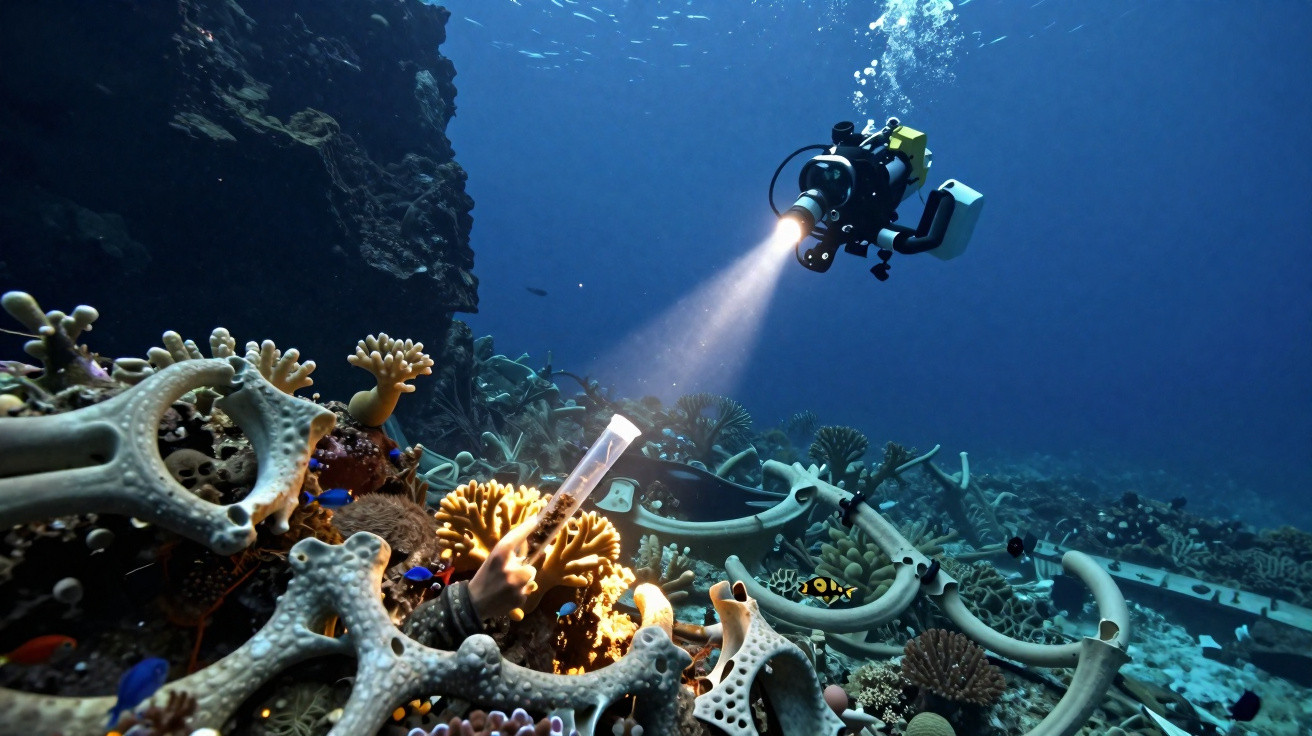
Far beneath the waters surrounding the Galápagos, ancient coral ecosystems survived enormous climate shifts that transformed the planet. New research, however, shows that they were not as invulnerable as they might have appeared.
At one stage, these deep-water corals vanished for more than 1,000 years before returning, demonstrating that even reefs hidden from view can be driven to collapse.
The study reconstructed 117,000 years of deep-sea coral history in the Galápagos region. Researchers led by the University of Bristol examined more than 900 fossilised deep-sea stony corals collected at depths of up to 1,000 metres.
Using uranium-thorium dating, the team assembled one of the most detailed records ever produced for this type of ecosystem.
Galápagos deep-sea coral life in the dark
Deep-sea coral reefs receive less attention than their tropical counterparts. They grow in cold, dark waters far below the surface, making them more difficult to investigate and easier to miss.
Yet they are thriving ecosystems, home to fish, invertebrates and other marine species. In their own quiet way, they are biodiversity hotspots.
These corals had survived some of the most dramatic climate upheavals of the past 117,000 years, including the last Ice Age and the subsequent warming. Despite making it through those changes, they appear to have reached a breaking point around 5,000 years ago.
They then disappeared from the fossil record for more than a millennium, suggesting a major change in the conditions on which they relied. Their absence also indicates that the deep ocean may be more sensitive to climate shifts than many people had assumed.
Corals absent for centuries
One of the study’s most troubling findings is the apparent duration of the collapse. The corals were gone for over 1,000 years before they eventually became established in the region again.
Whatever forced them out was therefore powerful enough to shut down an ecosystem that had otherwise endured vast swings in climate.
The researchers believe the timing points towards a likely cause: the El Niño Southern Oscillation, or ENSO, a climate system associated with changes in winds and sea-surface temperatures across the tropical Pacific. In this instance, though, El Niño itself does not appear to have been responsible.
“The disappearance of the corals coincided with a prolonged La Niña phase,” said lead author Joseph Stewart, a lecturer at the University of Bristol.
“During that time, stronger ocean circulation brought deep, nutrient-rich water to the surface, which likely led to lower oxygen levels at depth, making it harder for deep-sea corals to survive.”
The finding challenges familiar ideas about coral stress. Scientists frequently associate stress on surface reefs with marine heatwaves and bleaching during El Niño events.
This study, by contrast, suggests that deep-water corals may be susceptible to another form of climate disruption: oxygen loss and changes in circulation far beneath the surface.
Deep oceans are not protected
It is tempting to picture the deep ocean as sheltered from the turmoil above. The study makes that assumption look far less secure.
Although the corals lived far from sunlight, storms and warm surface waters, large-scale climate patterns could still affect them. Remote as these ecosystems may seem, the wider climate system can influence them severely.
“Understanding the great antiquity of this ecosystem, its sensitivity to change, and the centuries it takes to recover from disturbance will be vital for conservation efforts,” said co-author Laura Robinson from the University of Bristol.
The corals did return, but their recovery took centuries. That is a sobering prospect in a rapidly warming world: an ecosystem may come back, but on a timescale far slower than the pace at which humans are changing the planet.
La Niña’s importance for deep-sea corals
The findings challenge established thinking about ocean conditions. El Niño events are well known for causing heat stress in shallow-water corals, but the study shows that prolonged La Niña-like conditions can also cause harm, particularly in the deep ocean.
“Even subtle shifts in global climate patterns can trigger large-scale ecosystem collapse far below the surface. As climate change is expected to alter ENSO behaviour, deep-sea coral reefs – key biodiversity hotspots – may be at greater risk than previously thought,” Stewart said.
It is a warning that deserves attention. The threat extends beyond reefs that are easy to see to deep marine systems that most people rarely consider, precisely because they are hidden from view.
That risk can be underestimated until fossil evidence makes it visible. Here, the fossils reveal more than minor stress: they show an entire ecosystem disappearing.
Protection efforts for deep reefs
There is reason for hope as well. The corals eventually returned, so their disappearance was not permanent.
Even so, the study shows that resilience does not guarantee safety. An ecosystem can recover while remaining extremely vulnerable.
“This study has implications for how we design and manage Marine Protected Areas, many of which were originally set up to safeguard biodiversity in shallow coastal waters,” said co-author Stuart Banks, the principal investigator for the Charles Darwin Foundation’s deep-ocean conservation programme.
“We also now know that deep, unique, and largely unseen ocean life across the Pacific is also influenced in different ways by changing climate conditions.”
“The fact that these coral ecosystems eventually recovered tells us that resilience is possible. The challenge for conservation is to safeguard conditions that allow such recovery to happen.”
“In the Eastern Tropical Pacific, this means building Marine Protected Area networks that protect the deep seafloor, supporting natural connectivity between habitats and robustness to climate-driven change.”
Learning from ancient collapse
If unsuitable climate conditions, such as prolonged La Niña events, can cause deep-sea coral ecosystems to collapse and delay their recovery for centuries, conservation planning cannot afford to treat them as an afterthought.
The research shows that the deep ocean is not simply a stable backup for the living world above. It has vulnerabilities and tipping points of its own, along with a long memory of climate change.
At times, the clearest warning about the future comes from life that vanished in the darkness long ago.
The full study was published in the journal PNAS.

















Comments
No comments yet. Be the first to comment!
Leave a Comment