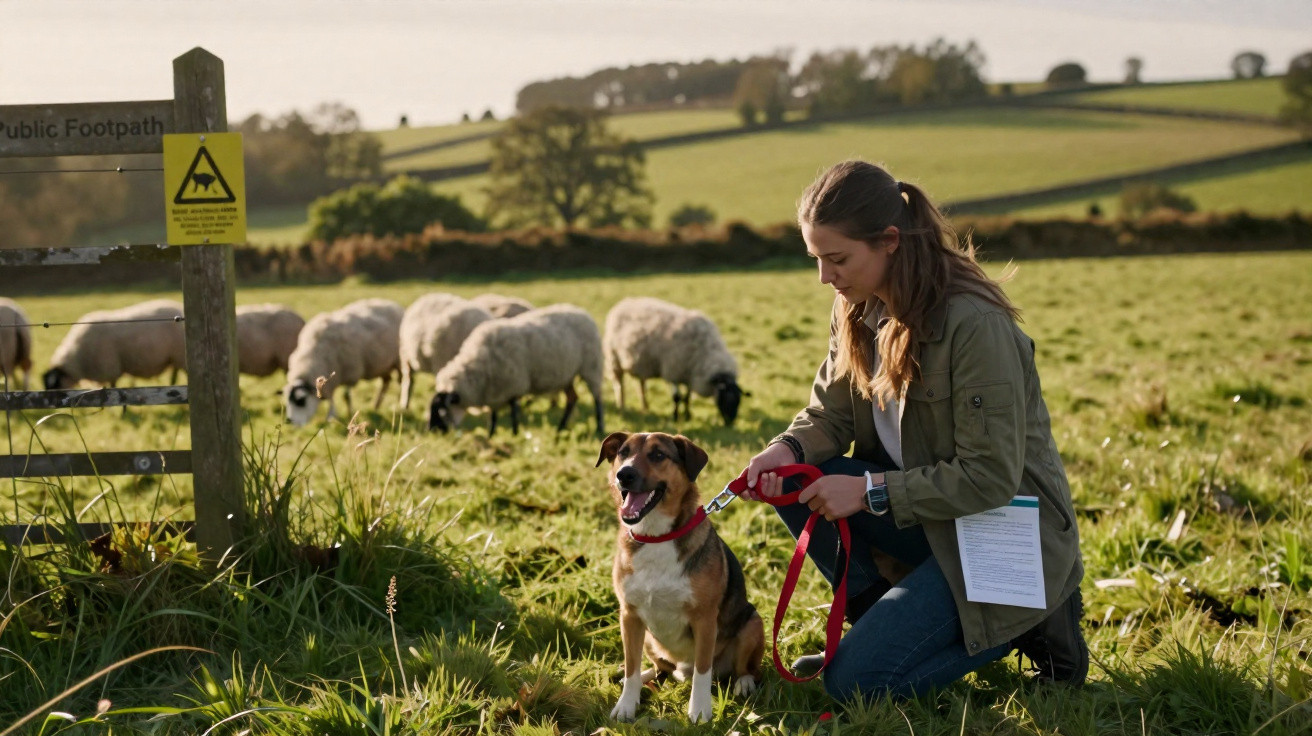
A new dog law in England and Wales is changing what a leisurely walk along country paths can involve. What may sound like a minor update could have substantial financial consequences for millions of British owners and people holidaying with dogs, as well as introducing new responsibilities when walking them.
What does the new dog law change for walks?
The Dogs (Protection of Livestock) (Amendment) Act 2025 has applied in England and Wales since 18 March 2026, substantially updating rules dating back to 1953. It focuses on dogs near livestock, including sheep, cattle, goats and pigs, as well as llamas and alpacas, which have now been added.
The central point of the new law: a dog chasing, frightening or disturbing grazing animals can trigger a criminal offence, even if it does not bite them.
The British government is responding to a growing number of incidents in fields and pastures. Chasing dogs injure countless animals every year, pregnant ewes lose lambs and panicked cows break through fences. Farmers are often left to bear the considerable losses.
No contact needed: chasing alone can be an offence
The important distinction is that a dog does not have to touch an animal for an offence to occur. Running after livestock, scattering a herd or visibly causing animals to panic can be enough.
The law therefore covers more than straightforward attacks: it addresses all forms of livestock “worrying”. For owners, that means even a normally gentle family dog that “just wants a quick look” could cause a legal problem.
- No bite is required: chasing or pursuing livestock can be enough.
- The rules also apply on paths directly beside pastures.
- Dogs of every breed and size are covered.
The provisions extend beyond open fields to roads and public paths running immediately alongside grazing land. Whether the dog stays on the path makes no difference; what matters is how the livestock behave.
Unlimited fines: how much could an incident cost?
Previously, the maximum fine for such incidents was £1,000. That cap has now been removed entirely. Courts can theoretically impose fines of any amount, taking account of the severity and consequences of the incident.
Fines will no longer have a fixed upper limit and may reflect the damage, the owner's income and their conduct.
Owners could also face additional expenses, including:
- Charges for catching and keeping the dog
- Veterinary bills for injured livestock
- Compensation for animals killed or that die afterwards
Police have been given wider powers to enter premises, seize dogs, take samples and order measures intended to prevent further incidents. Owners involved in repeated incidents could ultimately lose their dog altogether.
Why has the government taken such a tough approach?
The Labour government's main aims are to give farmers better protection and prevent animal suffering. Recent years have brought increasing reports of whole flocks panicking or some sheep being bitten to death. Such attacks can deal a severe financial blow to farmers.
At the same time, the number of dogs in Britain continues to rise. Particularly since the pandemic, dogs have increasingly been treated as family members who accompany their owners everywhere, including recreational areas and walking routes through farmland. More dogs, more people visiting the countryside and an often underestimated instinct to chase combine to increase the risk.
What does this mean for family trips and holidays with dogs?
The government stresses that it does not want to spoil family time outdoors. Walks, hikes and picnics are all still expressly welcome, but owners' responsibility for their dogs is being made much clearer.
The message is simple: enjoy the countryside, yes; let a dog run uncontrolled near grazing livestock, no.
Owners should follow practical ground rules, particularly visitors travelling to England or Wales with dogs from German-speaking countries:
- Use a lead near grazing animals – Put the dog on a short lead as soon as sheep, cattle or other livestock are visible.
- Plan ahead – Check walking routes in advance and take particular care if they cross grazing land.
- Be realistic about recall – Even well-trained dogs may instinctively chase animals that suddenly run away.
- Do not take a shortcut through a flock – Avoid walking straight through sheep, even if the dog appears calm.
A new safeguard for responsible owners
Another change concerns dogs that come into someone else's hands without their owner's knowledge or consent, for example through theft or an unauthorised walk. In those circumstances, the owner is not automatically held fully responsible. The provision is intended to protect people who take conscientious care to keep their dogs under control in everyday life.
The law does not, however, remove the duty to take precautions. Owners remain responsible for a secure garden fence, a reliable collar and clear rules about who is allowed to walk their dog.
What counts as livestock in England and Wales?
Sheep may be the first animals that come to mind, but the law explicitly covers several other species. These include:
- Sheep and goats
- Cattle
- Pigs
- Poultry on pasture
- Llamas and alpacas, known as camelids
To many dogs, llamas and alpacas may look more like exotic playmates. Their unusual appearance and behaviour can strongly excite dogs, which is why they are now specifically mentioned in the legislation.
What German dog owners can learn from the new law
Although the rules initially apply only in England and Wales, they point to a clear trend: protecting grazing animals is becoming more important politically, while dog owners' responsibilities are receiving greater attention. Similar discussions regularly arise in Germany, Austria and Switzerland, particularly in areas with alpine and pasture farming.
Many conflicts occur because owners underestimate their dog's instinct to chase. Even the best-behaved family dog can suddenly “switch” when a flock of sheep starts running. Training professionals therefore recommend consistent recall training, a long training lead in the countryside and clear everyday rules.
Common risk situations on dog walks
Anyone walking a dog should pay particular attention to situations such as:
- Open pastures without a secure fence
- Paths passing directly alongside herds or flocks
- Fields containing young animals, such as lambs or calves
- Twilight, when wildlife and livestock are more active
A simple rule helps in each case: until you can be sure what lies around the next bend, keep the dog close and within easy reach, ideally on a lead.
Why the new rules could benefit dogs too
The law may appear strict at first, but it could be beneficial for many dogs in the long term. Consistently securing and training a dog protects it not only from conflicts with farmers and police, but also from injuries caused by panicking cattle or barbed-wire fences.
Clear rules can also make sharing the countryside more relaxed. Farmers know that breaches are taken seriously, walkers with dogs understand the rules, and everyone can enjoy the landscape with greater peace of mind. This creates a framework in which enjoying nature and protecting animals can work side by side.














Comments
No comments yet. Be the first to comment!
Leave a Comment