Think back to the last time you fell asleep. Your body became still and your breathing slowed, but staying in place required no effort.
Now imagine trying to sleep while your body repeatedly pushes you upwards and out of bed.
Whenever you begin to drift off, you rise. To get any rest, you would need to keep easing yourself back down, again and again, without properly waking.
That is much like the problem a sperm whale encounters underwater. A new study of whales off Norway has shed light on how they manage it.
A sperm whale’s buoyant body
Noémie Freymond, of the Université de Neuchâtel in Switzerland, joined Alec Burslem and Patrick Miller of the University of St Andrews in the UK to investigate how sperm whales remain submerged while resting.
The difficulty begins with the head. It accounts for almost a third of a sperm whale’s body and is packed with oil, wax and air, all of which are buoyant.
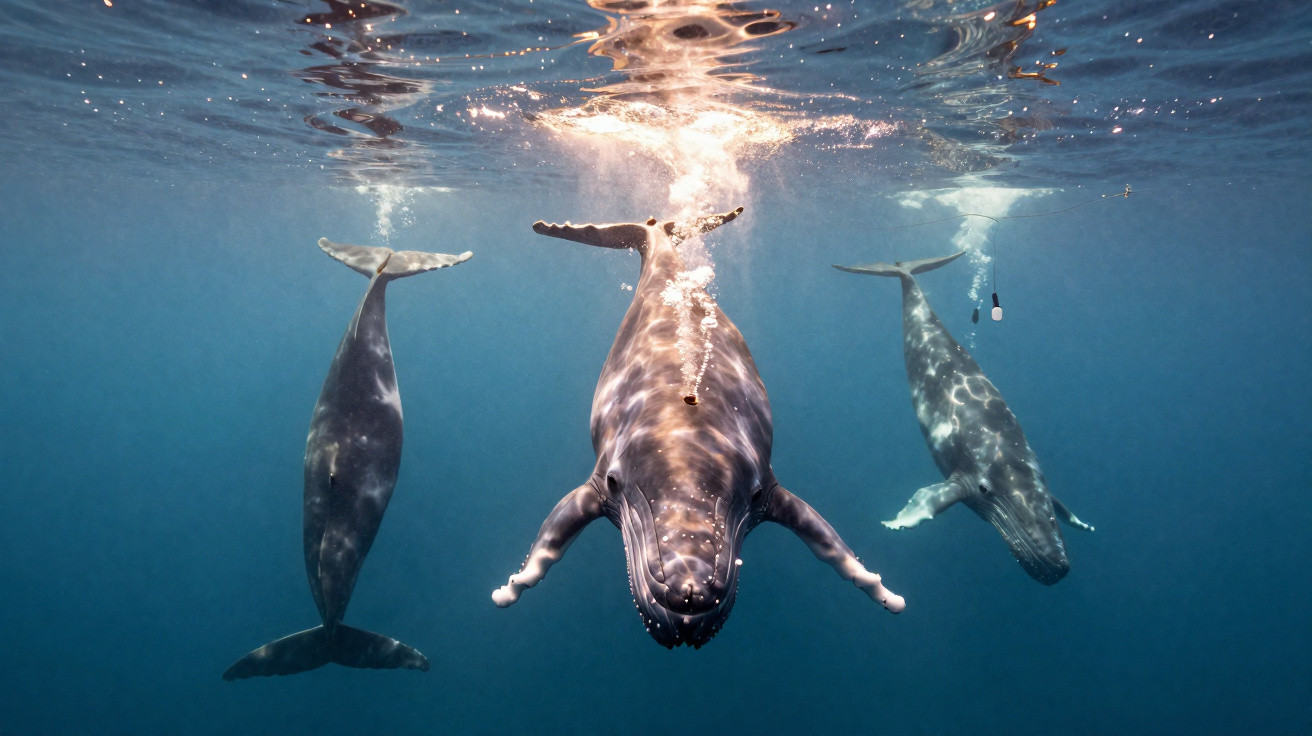
When a whale pauses for a nap, hanging quietly about 25 metres down with its head angled towards the surface, physics works against it. Without intervention, it would bob upwards like a cork.
Safety and stillness beneath the surface
There are good reasons to remain underwater. At the surface, waves make the water rough and ships pass through.
A short distance below, conditions are calmer, yet the surface remains close enough for the whale to rise and breathe when necessary.
“It is fascinating to discover the diverse adaptations that marine mammals have evolved to overcome the challenges of sleeping underwater,” Freymond told Earth.com in a direct interview.
She cited dolphins, which can shut down one half of their brain at a time while the other half continues to manage breathing and keep watch.
No one has measured the brain activity of a wild sperm whale, she added, so it remains unknown whether they do something similar.
Listening to resting whales
Observing a wild sperm whale asleep is almost impossible: it would mean following the animal day and night in the open ocean, including in darkness.
Near the Lofoten Islands off northern Norway, the researchers instead allowed the whales to collect their own recordings.
From a small boat, they used a long pole to fasten sound-and-motion tags to 42 whales with suction cups.
The tags recorded the hiss of escaping air while monitoring each whale’s depth and whether its head was pointing upwards or downwards.
Once a tag detached, it floated to the surface for collection. The researchers then faced the lengthy task of reviewing the recordings.
Seventeen of the 42 tagged sperm whales were recorded resting. A rest period could last from a few minutes to more than three hours, divided into naps of roughly six to 30 minutes each.
Three ways to rest
The sperm whales did not all rest in the same manner. Some gently descended tail-first and hung about 8 metres below the surface.
Others plunged head-first to around 27 metres before slowly rolling into a head-up position.
A few floated upwards after returning from a deep dive, sometimes from depths greater than 200 metres.
The variety surprised the researchers. “It was also surprising to find that some individuals rested in more than one way, using different types of resting dives,” Freymond told Earth.com.
One finding proved particularly revealing: the tags recorded bubbles during almost every rest, 56 out of 61 in total.
Releasing air to stay submerged
Those bubbles provided the answer. As a resting whale gradually rises, air in its lungs expands, much as a balloon would swell while floating up from the bottom of a pool.
The expanding air creates more lift, which would carry the whale straight towards the rough surface. Releasing a little air reduces its buoyancy and helps it hold its position.
The behaviour was most consistent during dives that began with a head-down plunge, which were also the whales’ most common form of rest.
Freymond said researchers already knew that resting sperm whales released bubbles, but she was still surprised by how consistently they did so on those head-down dives.
A model backs up the bubbles
Whales resting at shallow depths released bubbles around 11 times per nap, with each burst lasting about eight seconds.
Those drifting up from deep water released air only three or four times throughout their ascent. They were already heavy enough because the intense pressure at depth had compressed the air inside their bodies.
Freymond and her colleagues created a computer model of the forces acting on a drifting whale and compared it with the actual dive records.
The figures matched only when the whales were assumed to release air steadily as they rose.
With each stage of a nap, their air supply became a little smaller, falling by about 5 per cent at a time.
Taking less air into a sleep dive
Another clue suggested that the whales prepare in advance. Before a foraging dive, they take in a large breath. Before resting, they carry much less air – only about a third as much.
Freymond told Earth.com that she regards this as a second way of managing buoyancy.
Sperm whales appear to inhale less air before a sleep dive than before a hunting dive, suggesting that they adjust their supply to suit the dive ahead.
For a whale weighing approximately 30 tonnes, the resting supply amounts to roughly 235 litres of air. That is enough to hover without shooting upwards. The whales seem to prepare for a coming nap by taking in less air.
Only two other animals have been observed using bubbles in this way.
Grey whales appear to release them to extend foraging dives, while bowhead whales seem to do something similar during their own drift dives. Those are the only other known examples, making it a rare behaviour.
Are sperm whales awake or asleep?
There are important caveats. Because nobody has recorded a sperm whale’s brain activity in the wild, the team prefers to describe the behaviour as resting rather than sleeping.
It is not yet clear whether these giants are completely asleep or doze like dolphins, with one half of the brain awake and keeping watch.
“At this stage, we cannot determine whether bubble release is a conscious act or an automatic process occurring during sleep,” Freymond told Earth.com.
If sperm whales sleep with one hemisphere at a time, she noted, the awake half might control these precise buoyancy adjustments. Air release could also be compatible with a brain that is fully asleep.
Releasing carbon dioxide and nitrogen
Either way, the bubbles suggest some degree of awareness. To release them at the right time, a whale must detect that it is moving too close to the surface and respond – a notable feat for an animal that might be fast asleep.
The researchers offer another caution: some of the escaping gas may have nothing to do with buoyancy.
Resting near the surface could allow whales to release carbon dioxide and nitrogen that accumulate after a series of deep dives. Both explanations could be correct at the same time.
That brings us back to the starting point. When you drift off, your body stays in place without any effort on your part.
A sperm whale, by contrast, quietly adjusts its depth breath by breath as it drifts off in the dark. Whether it is awake enough to recognise what it is doing remains unknown.
The full study was published in the Journal of Experimental Biology.













Comments
No comments yet. Be the first to comment!
Leave a Comment