What determines which microbes make a home in an animal’s gut? Scientists have been investigating this question for years.
Gut bacteria aid digestion, guard against disease and even support the immune system. At the same time, the body must regulate which microbes remain and which are removed.
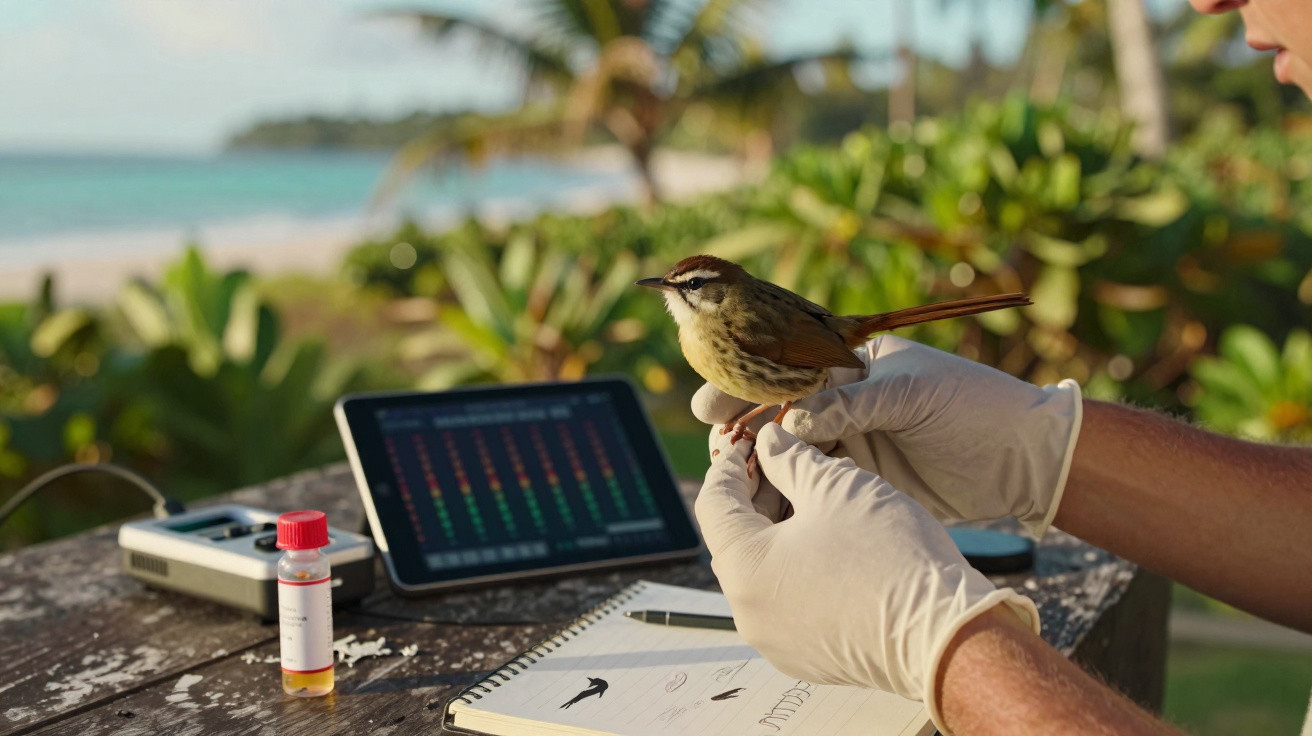
Researchers at the University of East Anglia in the United Kingdom investigated this puzzle by studying a tiny bird on a remote island.
Their work centred on the Seychelles warbler, a small songbird found only on Cousin Island in the Seychelles. The bird helped the team reveal how immune genes shape the gut microbiome and influence health.
Seychelles warblers reveal gut microbes
Cousin Island, in the Indian Ocean, presents scientists with a rare research opportunity. The island is small and isolated, and its warblers never leave, allowing researchers to follow the entire population over many years.
“Cousin Island is small, isolated, and the warblers never leave it,” said Professor David Richardson from the University of East Anglia.
Each bird on the island wears coloured leg rings, enabling scientists to identify individuals. Researchers can follow each bird’s behaviour, health, genetics and reproduction throughout its life.
“This offers scientists an exceptional opportunity to study life-long biological processes in the wild,” noted Professor Richardson.
Scientists track birds for years
Despite the detailed information collected by scientists, the birds continue to live naturally in the wild. They eat their usual natural food and interact with their environment as they normally would.
“It gives us the best of both worlds,” said Professor Richardson. “We can study animals living natural lives, with natural diets and gut bacteria, while still being able to collect detailed data from known individuals.”
Monitoring of the population began in the 1980s. The island is now home to about 320 birds across more than 100 territories. Almost every bird has been identified and studied over its lifetime.
Bird droppings reveal gut bacteria
Researchers gathered faecal samples from the birds to investigate their gut bacteria. The samples enabled them to analyse the gut microbiome, including the many bacteria that live in the digestive system.
Dr Chuen Zhang Lee conducted the fieldwork for his PhD research. The scientists used advanced DNA sequencing to examine the kinds of bacteria present and the genes carried by those microbes.
The study included hundreds of samples from many birds, collected over several years. Small blood samples were also taken so researchers could analyse the birds’ immune system genes.
Together, the information allowed the scientists to investigate interactions between immune genes and gut microbes.
Immune genes influence gut microbes
The research concentrated on a group of immune genes known as the major histocompatibility complex, or MHC. These genes help the immune system recognise harmful microbes and infections.
The scientists found that differences in these genes affect which bacteria can inhabit the gut. Certain gene variations allow some microbes to flourish while others disappear.
“What we found is that immune genes help shape the gut microbiome in wild animals, with potential beneficial impacts on health and survival,” noted Dr Lee.
Professor Richardson also explained the two-way relationship. “In simple terms, an animal’s immune system may help determine which microbes can live in its gut, while those microbes in turn help support and train the individuals immune system.”
Changes in bacteria inside the gut
The research found that particular patterns of immune genes altered the types of bacteria living inside the birds.
For instance, some genes reduced the presence of bacteria such as Lactococcus lactis while increasing others, including Staphylococcus lloydii.
A further specific immune gene variant also affected bacteria. When the gene was present, some microbes declined, while others, such as Escherichia coli, increased in the gut.
These changes suggest that the immune system carefully regulates which microbes stay inside the body.
The scientists also found that immune genes did more than alter which microbes were present: they influenced what the microbes actually did.
How microbes support the body
Rather than only identifying the bacteria, the researchers examined their functions. Some microbes assist with digesting nutrients, while others defend the body against infections.
“We also looked at what those bacteria are actually doing,” said Dr Lee. “For example, whether they are involved in metabolism, nutrient processing, or defence against viruses and other infections.”
The results revealed a pattern: birds with greater diversity in certain immune genes had more microbial defence genes, but fewer genes associated with metabolism.
This points to a trade-off. Strong immune control may increase protection against disease while reducing some beneficial digestive functions.
Why this discovery matters
The findings indicate that immune genes and gut microbes evolve together. Immune systems shape microbial communities, while microbes in turn affect immune responses.
“Our work suggests a two-way relationship. Immune genes influence the gut microbiome, and the microbiome feeds back to influence immune function,” Dr Lee explained.
The study concentrated on birds, but the same biological systems are present in humans and many other animals.
A better understanding of how immune genes shape gut microbes could help scientists investigate health, immunity and disease in the future.
Several organisations took part in the research, including the Centre for Microbial Interactions and the Quadram Institute.
















Comments
No comments yet. Be the first to comment!
Leave a Comment