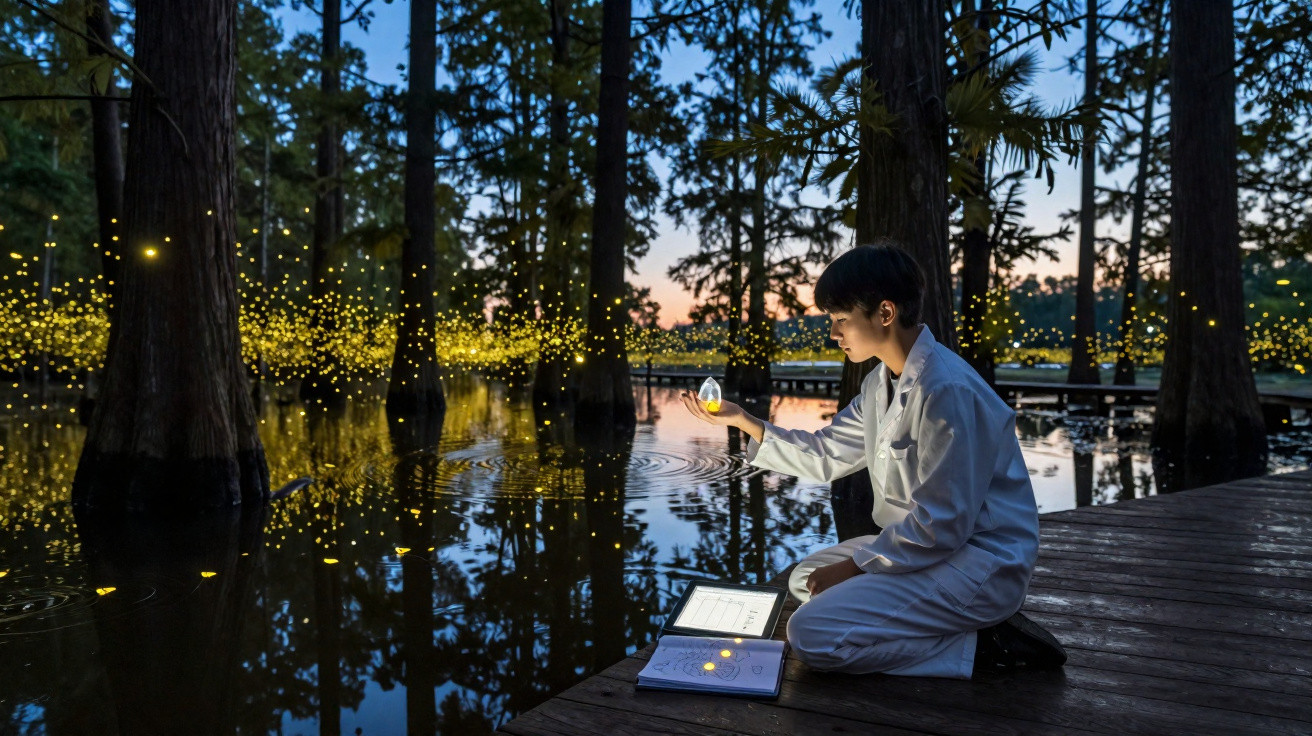
Every May, a park in South Carolina becomes the setting for an almost unreal spectacle. In the darkness of an old-growth swamp, thousands of male fireflies flash together, keeping the same rhythm as though a conductor were guiding them.
Congaree National Park is among the few places in the United States where this sort of synchronised light display can be seen.
A new study by engineers at the University of Colorado Boulder suggests there is a rule behind the magic.
The secret of synchronised fireflies
The team has identified a mathematical rule that helps the fireflies keep time together. It bears a surprising resemblance to the way people naturally synchronise their clapping at a concert.
According to the researchers, the same principle could eventually inform the design of better swarming robots. It may also provide clues about synchrony in biology, including brain activity and circadian rhythms.
“It’s magical,” said Orit Peleg, an associate professor at CU Boulder. “At certain times of night, fireflies have a single rhythm for the entire group, and they’re very punctual.”
Peleg is presenting the team’s findings at the American Physical Society’s 2026 Global Physics Summit in Denver.
A swamp, a tent and an artificial firefly
To investigate the logic behind the group flashes, the researchers used a straightforward experiment. They caught male fireflies individually and took them into a tent that shut out all external light. There, they tested each insect’s response to a dim LED, which served as a small artificial firefly.
Lead author Owen Martin, who received his doctorate in computer science from CU Boulder in 2025, carried out the work at Congaree over several summers.
He describes the park as a place with an ancient atmosphere, where towering cypress and tupelo trees stand above water reflecting the insects’ light.
“It makes me think of what that part of the Earth was like before people were there,” he said. “There is this strong sensation that everything is old.”
Inside the dark tent, Martin pointed the LED at a firefly and varied its blinking speed. In the wild, males generally flash about once or twice a second. The team set the LED to blink at rates ranging from once a second to once every 300 milliseconds.
Fireflies do not simply copy
The insects did not automatically match every pattern produced by the LED. Instead, their behaviour resembled that of a musician trying to settle into a rhythm.
When the LED flashed slightly faster than a firefly’s natural rhythm, the insect tended to accelerate. When the LED blinked more slowly, the firefly slowed down too.
The most telling responses came when the LED’s timing was close to the firefly’s own, falling just before or just after it.
If the LED flashed immediately before the firefly was due to flash, the male often brought its next flash forward to catch up. If the LED flashed just afterwards, the insect waited a little longer before flashing again.
How a crowd falls into sync
When the LED was far out of step with the insect’s rhythm, either much too fast or much too slow, the firefly generally ignored it.
Martin compares the process to clapping along in a crowded concert hall. Rather than copying every sound exactly, people adjust according to whether they are a little early or late, and the crowd gradually synchronises.
For Martin, seeing that happen was an unexpectedly thrilling experience.
“For a whole season, I spent pretty much every night in the dark watching lights blink at a fixed frequency,” he said.
“Then, occasionally, I’d get this magical experience where I’d see the firefly just start syncing with the light. I would wonder if I was just seeing things.”
Turning firefly timing into a formula
Martin and Peleg used their observations to construct what mathematicians call a “phase-response curve”. In essence, it is a compact rule for predicting how an external signal will alter an animal’s internal rhythm.
Here, the curve describes how a flash from a nearby light source changes the timing of a firefly’s next flash.
Such curves are used across fields in which synchrony is important. They appear in models of neurons firing together and in research into how biological clocks keep time.
The researchers say fireflies provide another clear example of a system in which individual units follow a simple local rule, producing a coordinated pattern across the group.
“This research opens the door to discovering other examples of synchronisation in nature that we haven’t seen yet,” Martin said.
What the study has yet to capture
The team acknowledges that one firefly in a dark tent is not the same as Congaree on a peak night.
In the wild, males do not normally react to a single flashing “partner”. Instead, they see dozens, and sometimes hundreds, of other fireflies blinking around them simultaneously.
That complexity helps make the Congaree display mesmerising, but it also makes the phenomenon difficult to study.
The tent experiment is a first step because it isolates the basic rule. The next challenge is to apply it at the scale of a whole swarm, with all the noise and chaos that entails.
Smarter swarms and quieter communication
Understanding how nature brings thousands of individuals into coordination without a leader could allow that idea to be put to use elsewhere.
Peleg envisages fleets of small robots working together without central control. The potential benefit becomes clear when considering group tasks that rely on timing.
“If you’re trying to get a lot of robots to push a large object, and they’re pushing at different times, then they’re going to struggle,” she said.
“But if they’re all pushing at the same time, they’ll be a lot more successful.”
Study co-author Kaushik Jayaram, an engineer at Imperial College London, highlights another possibility: swarming drones that use light rather than radio to communicate.
Visual signals could consume less power and, in some circumstances, offer greater security, particularly for tiny drones constrained by size, weight and power budgets.
“Peer-peer optical communication can be lower power and more secure, resulting in more efficient swarming and robust aggregations despite requiring line-of-sight, adding a complementary capability to today’s miniature SWAP-constrained drones which largely rely on radio frequency-based approaches,” Jayaram said.
A small rule behind a grand spectacle
The Congaree fireflies appear to perform an impossibly coordinated display. The study suggests, however, that they are not working to a master plan.
Instead, like many living systems, they adjust their timing in response to small differences between rhythms.
Repeated thousands of times across a swamp, that simple rule creates a spectacle that leaves people silent and staring.
The researchers posted their findings online in bioRxiv ahead of peer review.















Comments
No comments yet. Be the first to comment!
Leave a Comment