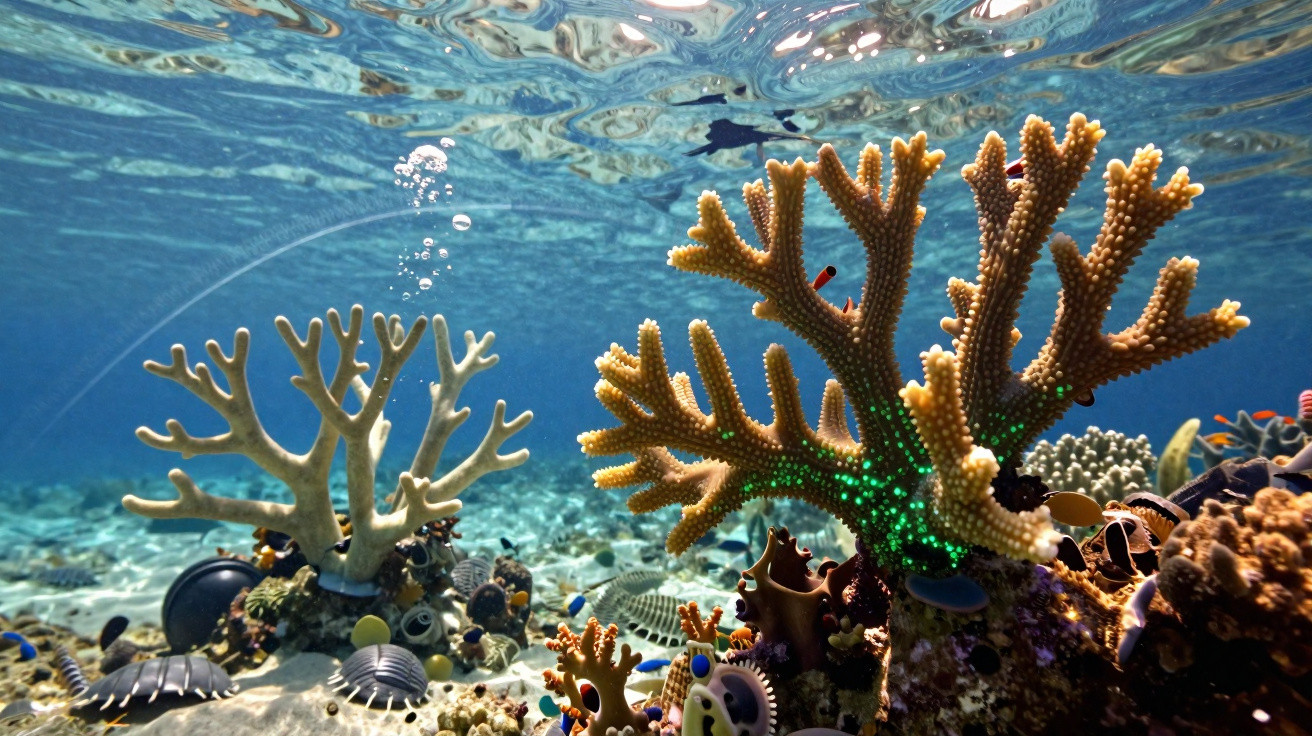
A new study has found that the partnership between corals and the algae living inside their tissues, which underpins today’s tropical reefs, has not always been the successful strategy it appears to be. For most of the past 500 million years, corals without algae had the advantage.
The finding challenges the long-held assumption that hosting algae is inherently a better way for corals to live. It also has a clear message for the present: the reef-building corals of today are among those most exposed as the oceans warm.
Two kinds of coral
Corals fall into two broad groups, separated by a single partnership. Around half of the roughly 6,000 coral species living today host tiny algae that convert sunlight into food, an arrangement known as photosymbiosis.
The food supplied by those algae allows corals to grow quickly and construct the vast reefs that fringe tropical coastlines. It also ties them to clear, sunlit water. The other half of coral species have no algae, and many live well beyond the reach of sunlight.
To establish which strategy succeeded, and when, an international team reconstructed approximately 500 million years of coral history using the fossil record. The researchers used statistical modelling and artificial intelligence to process the extensive dataset. The oldest corals they followed date back around 470 million years.
The study was led by Zhensheng Wei of the China University of Geosciences (CUG) in Wuhan, China, alongside colleagues in Germany and the United Kingdom. Its central finding challenges assumptions held for decades.
“Our analyses show that no way of life is permanently superior,” said Wolfgang Kiessling, a palaeontologist and study co-author.
Corals without algae
During the first few hundred million years covered by the record, corals without algae were the more successful group. Throughout the Palaeozoic Era, the long period before the dinosaurs, they consistently outperformed their light-dependent relatives.
Algae-hosting corals were particularly fragile during major upheavals. Following a mass extinction late in the Devonian Period, about 370 million years ago, they failed to recover, while corals without algae persisted. Both groups were almost equally vulnerable to warming seas and the loss of oxygen from the water.
The difference between them lay not just in which corals survived, but in how they did so. The study found that algae-hosting corals rose or declined according to the speed at which they produced new species. Algae-free corals followed a quieter path, becoming extinct less often and enduring difficult periods.
The Triassic turning point for corals
The balance shifted around 245 million years ago, during the Triassic Period, with the emergence of a new lineage of stony reef-building corals.
These hard-skeleton builders, the ancestors of every modern reef coral, hosted algae. From that point, the partnership became a driver of new species rather than a disadvantage.
From the Triassic onwards, hosting algae increased coral diversity in a way it had not before. Fossil and chemical evidence from early stony corals indicates that the animals partnered with algae almost from the beginning. A separate study of Triassic reefs preserved in northern Italy supports that finding.
The reversal offers a clear lesson about evolutionary success. Researchers had long regarded the coral–algae relationship as an inherent advantage that explained the emergence of reefs.
This is the first study to trace both types of coral across their entire history and demonstrate that the advantage arose only when conditions were right.
Why the rules changed
The more difficult question is why the partnership suddenly became beneficial. The team links the answer to seawater chemistry, particularly changes taking place in the Triassic oceans at around the same time.
New kinds of plankton with chalky shells spread through the oceans during this period, apparently for the first time. As they grew, they removed dissolved carbonate from the water.
Corals rely on the same mineral to build their skeletons, and the team suggests that the resulting change in ocean chemistry may have affected which coral strategy was most successful. The rise of these shelled drifters is well documented in the fossil record, including in a paper tracing chalky plankton back to the Triassic.
The changing chemistry appears to have reversed the relationship between heat and coral survival. During the Palaeozoic Era, warm periods tended to drive algae-hosting corals towards extinction. After the Triassic Period, however, warmth was associated with their success instead.
The researchers present the change in seawater as a likely explanation, not a proven one. “Environmental conditions are the crucial factor that decides whether species succeed,” said Kiessling.
What survival means now
This deep-time pattern has direct implications today. The shallow-water, algae-hosting corals identified by the study as most sensitive to heat are the very corals now experiencing bleaching: the whitening that occurs when stressed corals expel the algae that feed them and give them colour.
Their algae-free relatives in deeper water appear better placed to withstand sudden warm spells. That relative safety has limits, however. Deep reefs are not a guaranteed refuge, and a study of a major reef system found that bleaching reached well below the surface during a severe heat event.
Warming is not the only threat to reefs. As the oceans absorb carbon dioxide, they become more acidic. This ocean acidification erodes the carbonate skeletons on which all corals depend, regardless of how they feed.
Deeper corals are not permanently protected either. Over longer periods, they too will have to move as their waters warm, much as other marine animals already are, according to co-author Michael J. Benton of the University of Bristol.
For people working to save reefs, the lesson is that no single rescue plan suits every coral. The study shows that the coral–algae partnership is not a fixed advantage: the surrounding environment can make it beneficial or otherwise.
Understanding how these survival rules have changed gives scientists a clearer view of which corals have the most to lose as the climate warms. It also helps conservation efforts identify where the danger is most pressing today: the bright, shallow reefs whose success was built on sunlight.












Comments
No comments yet. Be the first to comment!
Leave a Comment