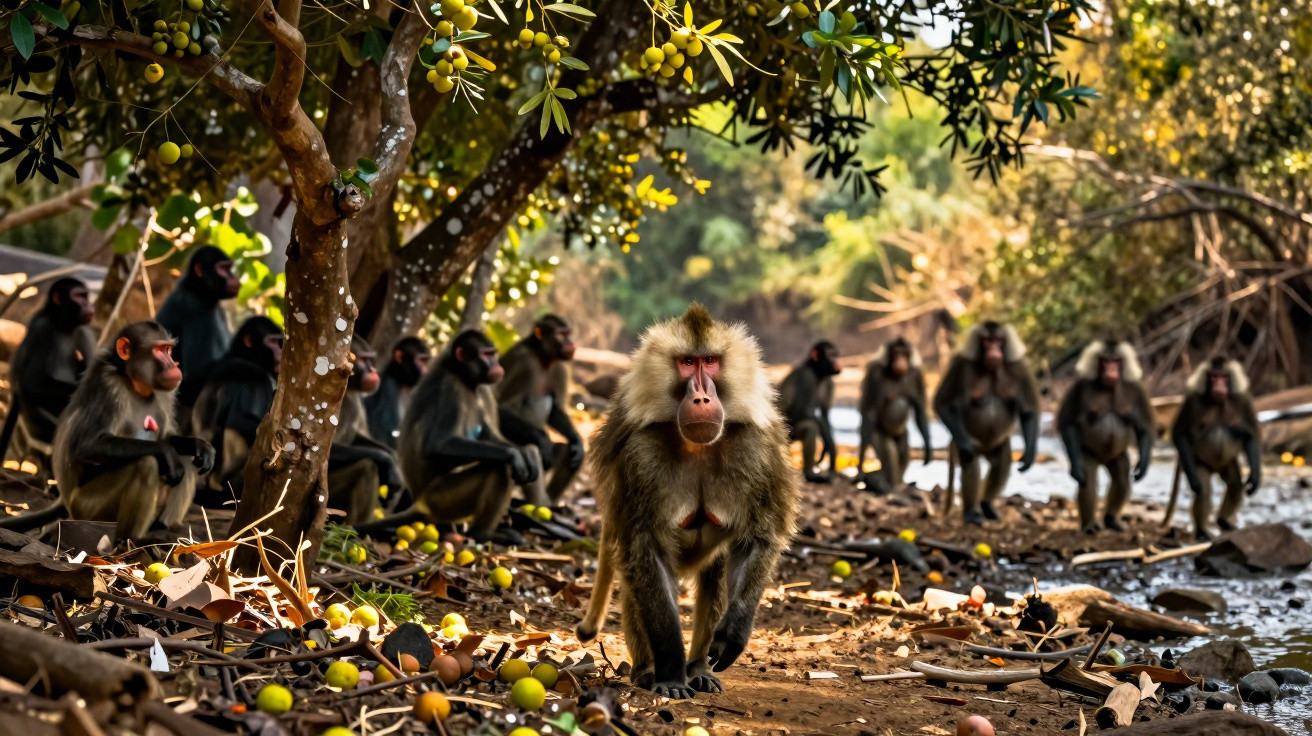
For decades, scientists believed they understood why male primates are often considerably larger than females. The explanation appeared straightforward: males compete with one another within their social groups, and being bigger gives them a better chance of winning access to mates.
A new study, however, suggests that scientists may have taken too narrow a view.
The researchers propose that constant pressure from neighbouring groups, as they compete for territory, resources and mating opportunities, may be far more important than previously recognised.
“What really surprised me most was that there was actually such a strong effect of between-group competition,” said the study’s lead author, Cyril Grueter, an evolutionary biologist at the University of Oxford.
“Living in a landscape of chronic pressure can be a strong selective force for body-sized dimorphism,” he said, referring to differences in body size between males and females.
Competition outside the primate group
In an interview, Grueter explained that primatologists usually have access to just one group when observing primates.
They study its behaviour and social dynamics, and “it’s easier to study competition within groups.”
As a result of that limitation, traditional explanations have tended to place greater emphasis on competition between males in the same troop.
Rather than revisit that established idea, Grueter said he and his colleagues “tried to move this question in a different direction.” He added: “We tried to put more emphasis on between-group competition.”
Comparing primate lifestyles
To examine whether competition between groups could explain body size dimorphism in non-human primates, the team assembled behavioural and morphological data on 146 primate species.
The dataset covered both anthropoid and strepsirrhine primates, including monkeys, apes, lemurs and lorises.
To separate the dynamics within groups from those between them, the researchers left out solitary primates. They also excluded data from heavily food-provisioned populations and species living outside their native habitats, so the results would better reflect natural environmental conditions.
The team measured home range overlap: the percentage of a group’s total territory shared with neighbouring groups.
They also recorded how often groups encountered one another each day, their mating systems and the proportion of encounters that involved physical altercations. The researchers then assessed how well each factor predicted differences in body size between species.
Neighbour pressure and primate size
Once the evolutionary history of primates was taken into account, the researchers found that mating system did not predict sexual size dimorphism, whether a species was monogamous, polygynous or polygynandrous.
By contrast, both home range overlap and daily encounter rates between groups had clear positive relationships with male-biased size dimorphism.
Species whose groups shared more territory with their neighbours tended to have males that were larger relative to females. The same pattern appeared when primate groups met one another more frequently each day.
Grueter said that greater territorial overlap and more frequent encounters put males under stronger pressure to become larger.
Larger males can be more effective at deterring rivals, monopolising females, defending food resources and preventing outsiders from mating with members of their group.
A dominant male may sometimes also mate with members of neighbouring groups, and a stronger or larger male is more likely to succeed in such competition.
“Dimorphism likely evolved as a response to that constant pressure that individuals face from competitors outside their groups,” Grueter said.
Primate competition without combat
Even where territories overlap more and encounters with rival groups are more frequent, primates do not necessarily fight those groups more often. Some meetings do become aggressive, involving chases or physical altercations.
Yet when the researchers examined this factor across different subsets of species, Grueter said they found “no correlation between the frequency of antagonism in the group encounters and dimorphism.”
That finding suggests that violent interactions themselves are not responsible for body size differences. Instead, the researchers argue that evolutionary pressure favours larger males because their size helps them protect resources or access to females across overlapping territories.
Over time, those physical characteristics become effective deterrents. A large male signals competitiveness, making rival groups less inclined to escalate encounters into physical conflict.
According to Grueter, the underlying force behind dimorphism appears to be the chronic competitive pressure of living among neighbouring groups.
That pressure involves continually watching the surroundings, keeping track of competitors and neighbouring groups, and stopping rivals from entering the territory.
Could neighbours shape evolution?
The findings could also help explain dimorphism in other animals, especially group-living species such as lions and cooperatively breeding birds.
The proposed idea is that competition between neighbouring groups, without necessarily involving direct fighting, could influence body size differences in ways researchers may have missed.
The researchers caution, however, that the explanation may not apply in every case. Other factors could be involved in species such as hyenas, where females are larger than males.
“We don’t know if that’s because of competition within groups or between groups, or maybe there are some ecological factors at play,” Grueter said.











Comments
No comments yet. Be the first to comment!
Leave a Comment