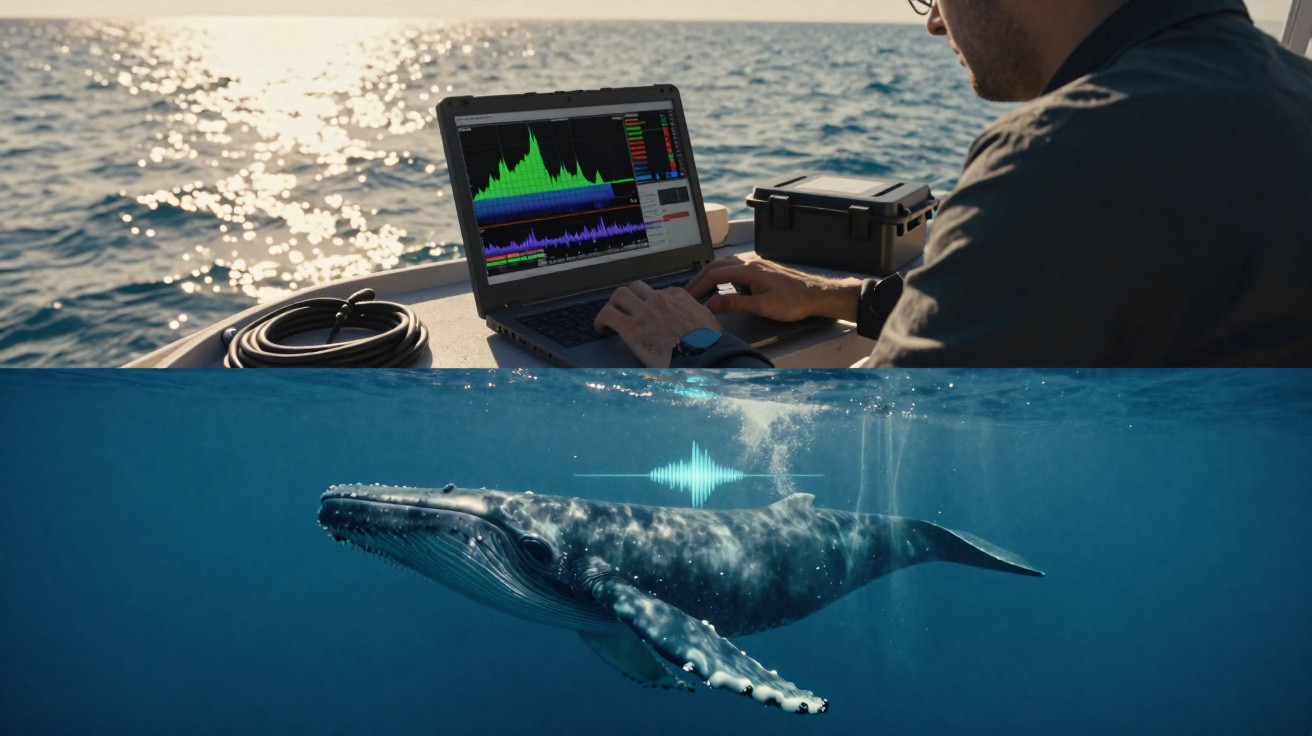
Researchers have shown that an AI system can learn from a single recorded blue whale call and accurately detect the same song in vast, long-running ocean recordings.
The study offers a scalable way to use rare animal sounds, which can be difficult to capture, to search decades of archived data that might otherwise go largely unused.
A hidden archive of blue whale songs
In decades of underwater recordings, blue whale songs recur as acoustic signals buried in immense, continuous streams of ocean noise.
A team led by Ben Jancovich, a PhD candidate at the University of New South Wales (UNSW), turned one call into many realistic variations. The results demonstrated that even limited evidence could train a detector.
Jancovich’s team developed software that flags target sounds, allowing old audio to reveal whale calls overlooked in previous searches. The approach also points to a wider problem: rare animals often leave evidence well before people can interpret it.
One call can train AI
Rather than gathering thousands of examples, the researchers copied a single clear call and modified it in controlled ways.
They used data augmentation, a technique that teaches a system with altered copies, changing the pitch, length and background noise. Those copies showed the computer how natural variation and ocean distortion could affect the same basic song.
“The surprising outcome is that a relatively simple data augmentation process enables really good performance from that one single training example,” said Jancovich.
Blue whales sing consistent songs
Heavy hunting during the 20th century caused blue whale populations to collapse. Some groups are recovering slowly, but the whales remain endangered.
NOAA Fisheries, the US agency responsible for marine resources, reports that vessel strikes, entanglement and ocean noise continue to threaten blue whales.
Unlike many animals, blue whale groups sing highly consistent songs, with a population often repeating one signature pattern. This consistency gave the model a narrow target: it needed to recognise only a call with stable sound features.
For conservation, dependable listening can help researchers follow whale movements without relying on constant sightings.
Training without waste
When each pattern has to be learnt from scratch, training large computer models can consume considerable time, money and electricity.
In this study, the team used transfer learning, which reuses a model trained for one task, to adapt software originally developed for human speech. A neural network – a system made up of layers that learn patterns – then compared the shapes of whale calls with the altered examples.
The completed system was trained on a standard laptop in a matter of hours, putting the method within reach of smaller research groups.
Numbers that matter
One-call training worked best for the Chagos pygmy blue whale, a smaller species associated with the central Indian Ocean.
A recall score of 99.4% means the model found almost every call already included in the test set. After disputed labels were checked, 91.2% of the flagged sounds were genuine calls.
The F1 score, a single measure balancing missed calls and false alarms, was 95.1%. That indicated strong performance, although it did not prove the system was perfect.
AI pinpoints meaningful sounds
Many older recordings come from passive acoustic monitoring, in which recorders listen unattended for months or years. Underwater microphones known as hydrophones can record ocean sound continuously, but the files they produce soon become overwhelming.
Human analysts previously examined visual sound charts by hand, with fatigue sometimes leading to missed calls or inconsistent labels. Automation does not replace expert judgement, but it can reduce the volume of material so people can review the most meaningful sounds.
Limitations of the method
The consistency that makes the method effective also restricts where it can be used. Dolphins, for instance, often produce individual whistles, so a single call would not capture enough of their vocal range.
A dense whale chorus can also confuse the system: numerous overlapping calls may resemble the target without having clear boundaries. Future versions may need chorus examples and other difficult noise added to the training set as sounds to reject.
Archives become evidence
The team plans to apply its detector to 25 years of recordings from across the central Indian Ocean. That long record could reveal whether whale songs changed over time, shifted through the seasons or responded to human noise.
Sound travels long distances underwater, allowing acoustic archives to reveal animals that no ship, aircraft or satellite happened to see. Such records can turn scattered listening moments into evidence of behaviour, movement and recovery.
Beyond the ocean
Microphones in forests, recorders in deserts and remote listening stations face the same challenge as ocean archives. Birds, insects, frogs and other animals with repeatable calls could benefit if one strong recording can train an effective detector.
That possibility is important for rare species, particularly when scientists hear them only a few times before conditions change.
“If accurate detectors can be trained from a single good recording, this can help us study rare and elusive species that have seldom been heard by humans,” said Jancovich.
One whale song cannot resolve every monitoring challenge, but it reduces the difficulty of turning overlooked recordings into usable evidence. Future tools will need rigorous validation, clearly defined limits and open access so researchers can apply them reliably at scale.











Comments
No comments yet. Be the first to comment!
Leave a Comment