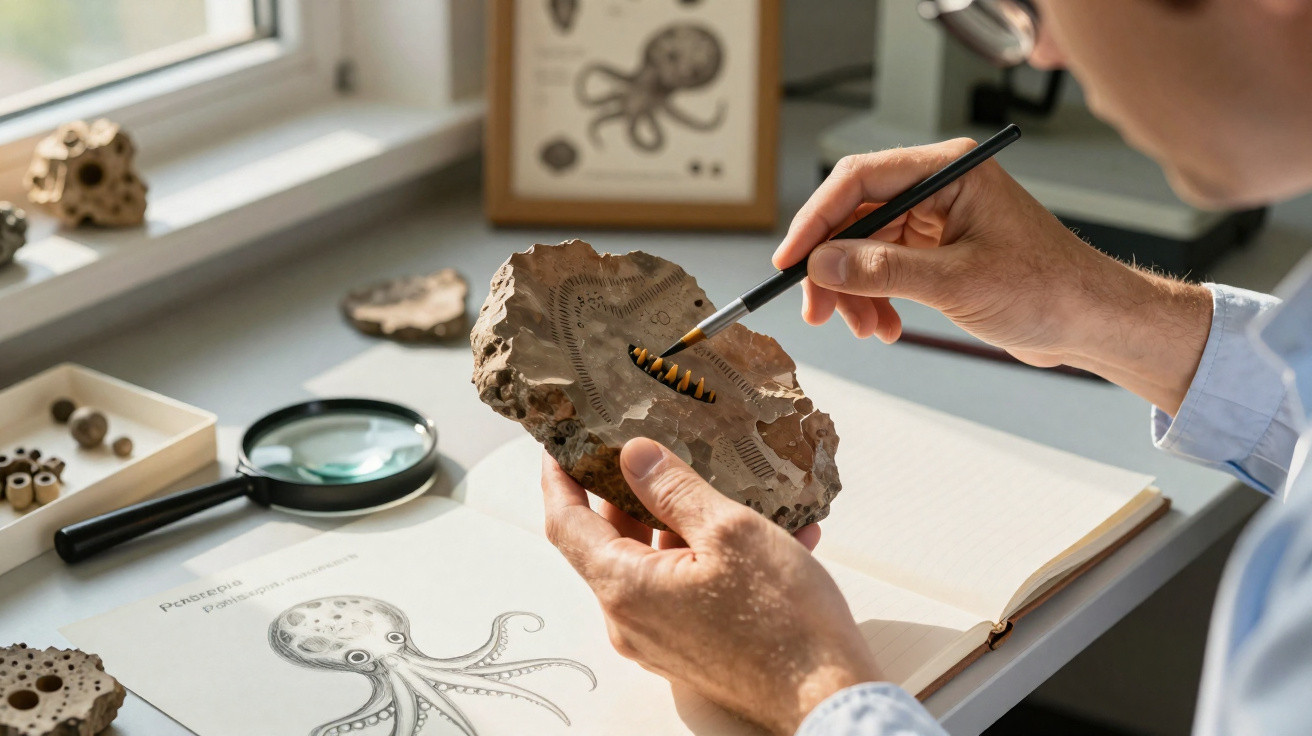
For more than 20 years, the fossil known as Pohlsepia mazonensis enjoyed an unusual distinction. Textbooks and the Guinness Book of Records described it as the world’s “oldest known octopus”.
Dating back around 300 million years, the specimen appeared to transform the timeline of octopus evolution.
But scientific interpretations are not always final. When researchers revisited the fossil, they uncovered an unexpected detail beneath its surface: the animal was not an octopus at all.
The reversal was not based on speculation. It came from technology capable of looking inside rock and revealing features that had previously been invisible.
Finding Pohlsepia mazonensis
Pohlsepia mazonensis was first described in 2000, following its discovery in Illinois. At the time, it seemed to possess the characteristic features of an octopus.
Researchers thought they could make out eight arms and soft body structures resembling those of modern octopuses.
That interpretation endured for decades and moved the apparent origin of octopuses back by approximately 150 million years.
Some scientists nevertheless questioned the identification. The difficulty was that there was no clear way to investigate their doubts without damaging the fossil.
That changed with the use of synchrotron imaging. The technique sends beams of light brighter than the sun through rock, scanning its interior without breaking it open. It operates like a powerful X-ray, but produces much more detailed images.
Tiny teeth inside the rock
The scans revealed something that had never previously been seen in the Pohlsepia mazonensis fossil: tiny teeth.
The discovery transformed the interpretation of the specimen. The teeth belonged to a radula, a ribbon-like feeding structure found in molluscs. Their number was particularly revealing: the fossil had at least 11 tooth-like elements in each row.
That count is inconsistent with an octopus, which usually has seven or nine. Nautiloids, by contrast, have around 13, making them a much closer match.
Decomposing nautilus relative
Dr Thomas Clements, the study’s lead author and Lecturer in Invertebrate Zoology at the University of Reading, said the discovery overturned an assumption that had stood for many years.
“It turns out the world’s most famous octopus fossil was never an octopus at all,” Clements explained. “It was a nautilus relative that had been decomposing for weeks before it became buried and later preserved in rock, and that decomposition is what made it look so convincingly octopus-like.”
He said scientists had first identified Pohlsepia mazonensis as an octopus 25 years ago, but modern imaging had finally solved the case by exposing what was hidden beneath the rock’s surface.
The fossil provides the oldest soft tissue evidence of a nautiloid ever found and gives a much clearer picture of when octopuses first appeared on Earth.
Clements added that using new techniques to re-examine controversial fossils can reveal small clues that lead to “really exciting discoveries”.
When decay rewrites anatomy
There was a reason the fossil misled scientists: the animal’s body had changed shape long before it was studied.
Decay began after its death, causing soft tissues to shift and collapse. Those changes gradually produced a form that closely resembled an octopus. The alteration had already occurred by the time the animal fossilised.
The decisive clue was concealed inside the rock. Researchers matched the tiny teeth to those of Paleocadmus pohli, a known nautiloid species found at the same site, confirming the fossil’s true identity.
The discovery also established a new record. The remains are now the oldest known example of nautiloid soft tissue, extending that record back by about 220 million years.
Rethinking octopus history
Now that this fossil is no longer considered an octopus, scientists place the origin of octopuses much later. The evidence points to the Jurassic period rather than a time hundreds of millions of years earlier.
This changes researchers’ understanding of when octopuses diverged from relatives such as squids. Rather than an ancient split deep in Earth’s early history, the divergence likely occurred during the Mesozoic era.
Dr Clements expressed the significance simply: “It’s amazing to think a row of tiny hidden teeth, hidden in the rock for 300 million years, have fundamentally changed what we know about when and how octopuses evolved.”
Lessons from Pohlsepia mazonensis
Fossils do not tell an uncomplicated story on their own. Time, pressure and decay leave their marks, and the evidence visible to researchers is often incomplete or misleading.
New tools are changing how scientists approach those remains. Methods such as synchrotron imaging allow them to revisit earlier discoveries and investigate new questions without damaging the specimens. Each re-examination can produce unexpected findings.
The case demonstrates that even familiar fossils can conceal secrets. A single small feature, hidden for hundreds of millions of years, was enough to change part of evolutionary history.
Pohlsepia mazonensis may ultimately be remembered less as a “mistake” than as a warning about interpreting decomposed fossils, as well as a success story for the discoveries made possible by modern imaging.
The full study was published in Proceedings of the Royal Society B Biological Sciences.
















Comments
No comments yet. Be the first to comment!
Leave a Comment