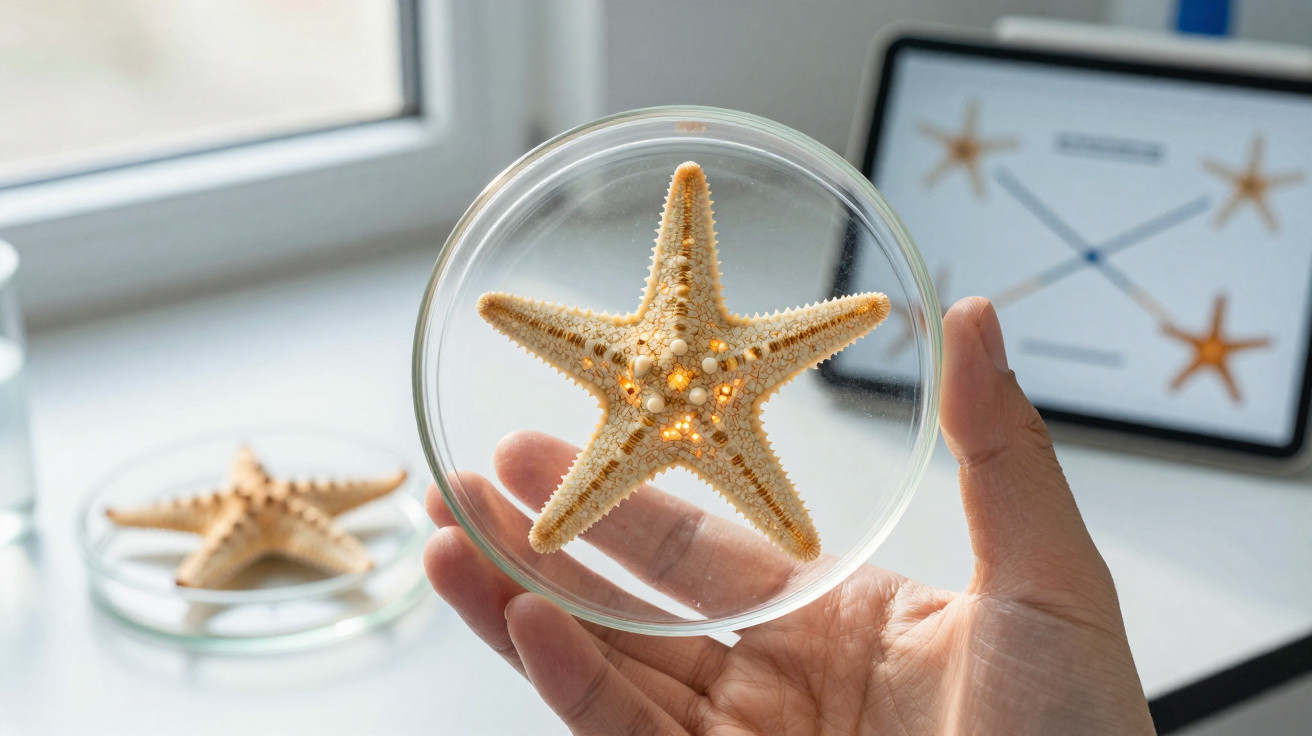
A recent study has found that sea stars can construct an identical organ through strikingly different processes.
Although the three species examined all produced the same internal structure, each took a distinct developmental route to achieve it.
By observing organ formation in transparent sea star larvae, scientists showed that evolution may reach one outcome by several paths.
The results address a long-standing question in developmental biology: must organs be built according to one blueprint, or can different processes produce the same final structure?
The finding may matter beyond sea stars. The organ in question starts as a simple tube, as do many human organs, including the heart, lungs and kidneys.
That makes sea stars a valuable model for investigating how complex organs develop.
Sea stars have been closely studied
The research was conducted in the laboratory of Margherita Perillo at the Marine Biological Laboratory (MBL) in Woods Hole, Massachusetts.
Her group tracked Forbes’ sea star, Asterias forbesi, a keystone predator in the North Atlantic, from its egg stage through to young adulthood.
Despite being studied for more than 70 years, this is the first comprehensive account of the species’ development. One reason Forbes’ sea stars have attracted such close attention is disease.
They are among the species monitored by researchers seeking to understand sea star wasting disease, an epidemic that has killed billions along the Pacific coast.
By eliminating a leading predator, the disease helped drive the decline of kelp forests. Its cause was identified only last year, when a study linked it to a bacterium.
Transparent from birth
Sea stars are especially well suited to this type of research. Their eggs and larvae are almost transparent, and they can be reared in their thousands.
Researchers can therefore record an entire organ while it develops. Sea stars are also among humans’ closest invertebrate relatives.
That relationship is helpful for studies of organ development. Sea stars “form embryonic organs like vertebrates do,” Perillo says.
The sea star hydro-vascular organ fills the body cavity
The researchers examined the hydro-vascular organ: a hollow, coiled tube that occupies the larval body cavity before becoming part of the water-powered system that a starfish uses for movement.
In Forbes’ sea star, this organ develops in four stages, all of which can be observed under a microscope.
It begins at a small scale. Two sacs emerge from the end of the developing gut, detach and lengthen into tubes running back beside the stomach.
The tubes then extend forwards, pass over the mouth and join to form one sealed loop. However, the two tubes are not exact counterparts.
The tube on the left develops a broader internal passage than the right-hand tube and connects to the outside via a minute pore.
Time-lapse footage showed the expanding tube flickering and contracting, apparently as though it were pumping fluid through itself.
Different paths to the same organ
To establish whether all sea stars create this loop in the same manner, the researchers compared Forbes’ sea star with two more distantly related species.
One was the bat star, a species from the Pacific. The other was the red comb star, which lives in the Mediterranean.
All three species belong to separate family branches, but each ultimately develops the same looped organ.
Their methods differ. In Forbes’ sea star, both tubes initially grow backwards towards the stomach, before bending forwards and uniting above the mouth.
A new look at sea star development
The bat star follows the reverse sequence: its tubes connect over the mouth early on, before growing back towards the stomach.
The red comb star takes a third route. Its first connection forms at the rear, close to the intestine, with the front of the loop closing only afterwards.
Thus, every species arrives at the same outcome through its own order of events; before this research, nobody had compared those sequences directly.
For one of the three species, such a comparison had previously not been possible.
The development of the red comb star had never been recorded on film. It was known solely through hand-drawn illustrations produced in 1939, which the new imaging closely reproduced.
Lessons from the tubes
This coiled tube is not merely an unusual feature of larvae. In previous research involving the bat star, Perillo’s team mapped the molecular mechanisms of tubulogenesis, the creation of biological tubes.
A 2023 paper showed that one signalling pathway promotes tube growth, while another guides the direction in which the tubes develop.
This machinery is not exclusive to starfish. Related molecular signalling families construct tubes in animals throughout the tree of life.
Human hearts, lungs and kidneys likewise start as simple tubes before folding into their adult forms. The sea star organ is essential too: larvae engineered without it do not survive.
Learning how an uncomplicated tube consistently develops into a functioning organ has relevance beyond the tide pool.
When tube formation fails in human embryos, organs may develop in the wrong place or with abnormal shapes.
Beyond fixed blueprints
At later stages of life, organs may become rigid and cease to function as scar tissue accumulates, a condition known as fibrosis.
For the moment, the central finding is that one organ can be assembled in several ways while still producing the same result.
No previous study had compared these developmental stages between sea star species, and the new comparison indicates that the instructions for constructing an organ may be more adaptable than a fixed sequence.
Perillo said the team’s next goals are to understand “How we form organs starting from tubes, how these tubes maintain their proper orientation and shape.”
Resolving this may reveal how a single set of developmental instructions can create the same organ through multiple routes, in sea stars and potentially in far more distantly related animals.








Comments
No comments yet. Be the first to comment!
Leave a Comment