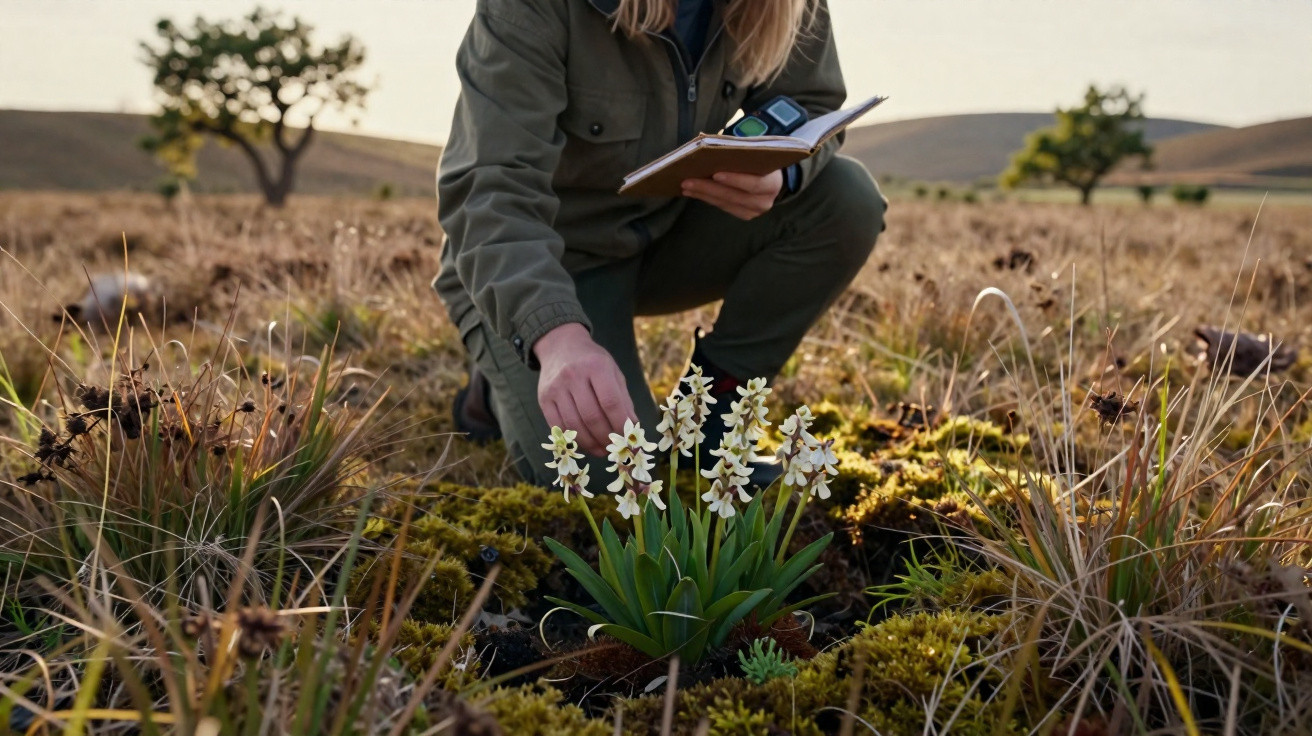
A rare plant growing within a National Nature Reserve appears to enjoy an unspoken assurance of protection.
The boundaries are established, the land is carefully managed and the threats have been considered. In principle, the species rooted there should be secure.
Yet new research on a dozen of Britain’s rarest plants suggests that this assurance misses a crucial point: a suitable place today may not remain suitable in future.
The refuge problem for Britain’s rare plants
Britain’s wild plants are struggling. According to a national survey, more than half of its native species have declined since the 1950s.
Farming, pollution and a warming climate have all taken their toll. Protected areas were intended to provide a safety net.
That hope depends on what scientists call climate refugia: places that remain habitable for a species both today and in a warmer future.
Some are sites where a plant already grows. Others are unoccupied areas that would meet its needs, provided it could reach them.
To examine how well reserves will cope, University of York biologist Freya Read and her colleagues studied 12 rare plants selected for conservation by the charity Plantlife.
Using computer models, they mapped where each species can live now and where it could live in 2080.
Unsuitable living space
The figures make sobering reading. Across the 12 plants, only around four in ten sites they currently occupy will still offer suitable conditions in 2080.
Every species loses at least some of the reserves in which it now grows. One does especially badly.
The orchid Irish lady’s-tresses, Spiranthes romanzoffiana, loses every reserve where it grows by the end of the century. As the climate warms, none of its existing homes would remain suitable.
No protected site currently supporting it would continue to provide the right conditions. Reserves can keep bulldozers at bay, but they cannot keep the climate fixed.
As temperatures rise, the narrow range of conditions a plant needs moves uphill or towards the poles, potentially shifting entirely beyond the boundary drawn to safeguard it.
The case of vacant refuges
The study offers more hopeful findings too. The same models revealed many reserves that would suit these plants, even though the species do not currently grow there.
These sites are suitable but vacant. Approximately seven in ten of the sites mapped by the team have no resident population of the species that could live there.
Unoccupied ground can help only if a plant can get to it. Many reserves are a long way from the places where the species still survive, with roads and farmland in between. A plant rooted on a hillside cannot make the journey itself.
That brings in assisted colonisation, the deliberate movement of a species by people to a new home. For the orchid facing the loss of all its existing homes, it may be the only option left.
The researchers identified 27 reserves where Irish lady’s-tresses could be introduced and survive. The list is short, but it offers genuine possibilities. Moving such a plant becomes a practical decision rather than just a thought experiment.
What creates shelter
Looking beyond the individual maps, the team investigated what the strongest reserves had in common. Several straightforward features emerged repeatedly.
Elevation mattered most. Reserves on higher ground sheltered more species, probably because cooler conditions at altitude remain suitable for longer as temperatures rise.
This movement upwards is well documented: numerous studies have followed species shifting to higher elevations. A broad range of elevations within a single reserve was beneficial too.
An ascent of about 168 metres cools the air by roughly as much as travelling 145 kilometres north, so a hilly reserve offers cooler ground. Larger reserves also performed well, providing more space for suitable habitat.
North and east
A reserve’s geographical position mattered too, particularly its latitude. Those farther north tended to be suitable for more of the plants in future.
That fits a broader pattern across Britain, where more than eight in ten studied species have already moved northwards as the country warms.
One finding surprised the researchers. They had expected the cool, wet west to contain the best future refuges, but the models placed the greatest concentration of suitable land farther east.
Many of these plants favour eastern habitats, and researchers have surveyed the east more thoroughly for decades. The pattern may therefore reflect the extent of surveying as much as the plants themselves.
Another anticipated relationship did not emerge. To the team’s surprise, the number of different habitats within a reserve made no measurable difference.
These demanding specialists depend on a small number of specific habitats, such as chalk grassland or bare inland rock. For them, one appropriate habitat matters more than having many.
The changes ahead
The findings carry a clear message for plant protection in Britain. Simply guarding the exact places where species grow today will not, by itself, see many of them through a warming century.
For the first time, the safest future homes for these plants have been mapped, and many are unoccupied. Conservationists can now make more informed choices.
As Britain pledges to protect 30% of its land by 2030, the research supports creating reserves designed to endure: high, hilly and large, and located towards the north and east.
Those same characteristics can inform the management of existing reserves. For some plants, however, careful management alone will not suffice.
When a species has no future on the land it currently occupies, saving it may require carrying it somewhere else and helping it take root.
An idea once considered marginal is gradually moving towards standard practice. The orchid with 27 possible homes may be among the first to test it.










Comments
No comments yet. Be the first to comment!
Leave a Comment