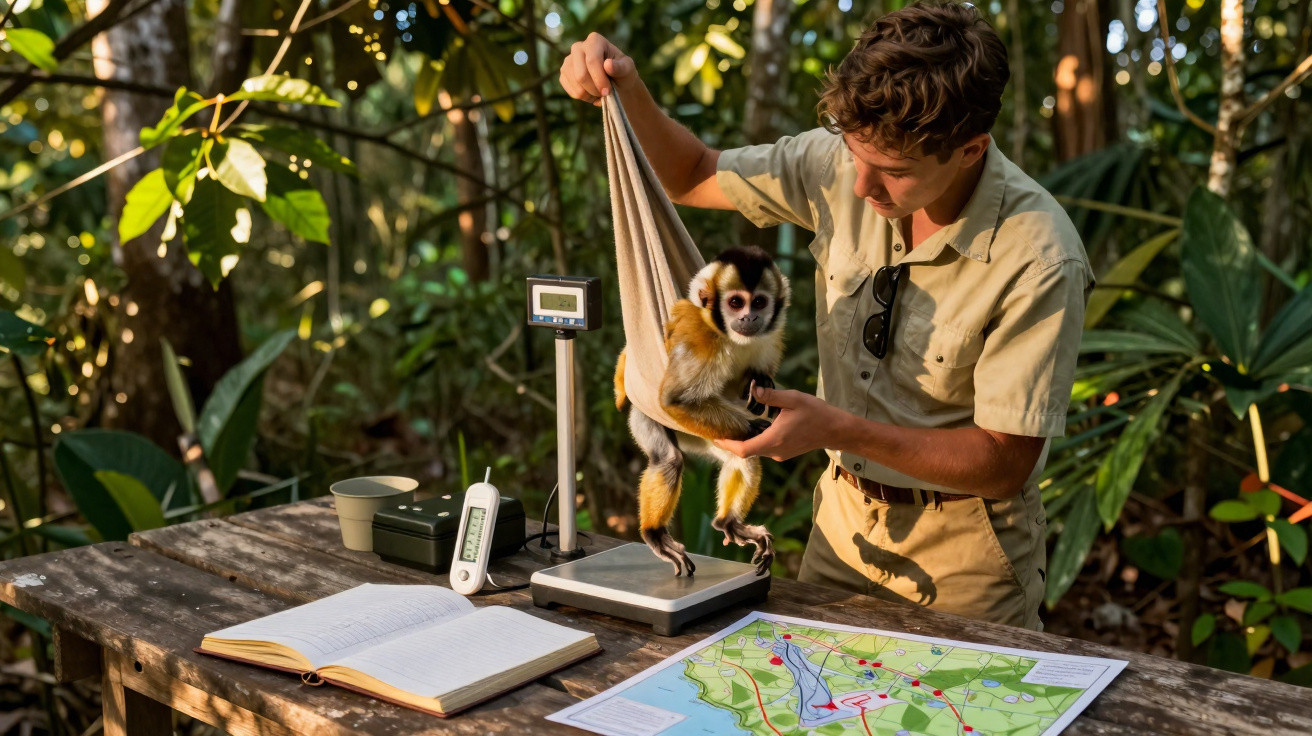
Body mass and temperature are expected to trend in opposite ways. Warmer climates should favour lighter animals – a prediction that has stood for more than 170 years. Yet new research following owl monkey weight gain in a warming Argentine forest challenges that established rule directly.
For 24 years, scientists have followed a small population of Azara’s owl monkeys – Aotus azarae – in northern Argentina. As temperatures have risen, the monkeys have become heavier, contrary to the predictions of textbook biology.
Owl monkey weight gain
Jonathan Pertile, a PhD student in anthropology at Yale University, headed the new analysis. Its data were gathered by the Owl Monkey Project, which is led in Argentina by senior author Eduardo Fernandez-Duque of Yale.
The researchers assessed 287 weight records from 180 wild owl monkeys collected from 1999 to 2023. By the end of the study period, the animals were approximately 50 grams heavier – a 4% increase for a species with an average weight of just under 1.3 kilograms.
Over the same 24-year span, average daily temperatures at the site increased from 22.2°C to 23.8°C. After accounting for other factors, the researchers found that temperature in early life was the strongest individual predictor of adult body weight.
Breaking Bergmann’s rule
The result conflicts with one of biology’s longest-standing expectations. Bergmann’s rule, named after a German biologist in the 1840s, proposes that warm-blooded animals become larger in colder environments and remain smaller in warmer ones.
The reasoning centres on heat. Smaller bodies can release surplus heat more effectively, and broad mammal surveys have generally supported this principle.
Studies of animal body-size evolution have reinforced the trend across numerous groups. More recently, research found that small mammals throughout North America were becoming smaller as their environments warmed.
A monkey increasing in weight while its forest becomes hotter is therefore more than a minor exception. It opposes the textbook prediction outright and is among the first documented examples in a wild primate population.
Dinosaur fossils have also been used to question Bergmann’s rule, but evidence from living primates brings a different dimension to the debate.
Two decades in Formosa
Azara’s owl monkeys inhabit the Gran Chaco, a hot, dry region of forest and savanna spanning central South America. These mostly monogamous, pair-living primates are active at dawn, dusk and during the night.
For over two decades, biologists from the Owl Monkey Project have tracked individuals on a cattle ranch in Formosa province. Certain monkeys were weighed only once, whereas others were measured repeatedly over successive years as they passed through different phases of life.
This lengthy dataset enabled the analysis. Changes in a wild mammal’s body size occur gradually, and without consistent measurements over two decades by the same team, a 4% shift could easily have been lost in background variation.
Three life stages
Pertile’s researchers weighed more than adult monkeys. They captured individuals across three stages: juveniles living with their natal families, solitary young adults looking for partners, and established breeding animals occupying their own territories.
Alongside each weight measurement, the team recorded body length from the top of the skull to the base of the tail. While some monkeys occur only once in the dataset, others were documented repeatedly as they matured, formed pairs and established adult lives.
The team considered several explanations for owl monkey weight gain, including improved food availability, heavier mothers transmitting greater weight to offspring, and an older sample of monkeys. None explained the pattern.
Instead, early-life temperature was the clearest predictor: monkeys experiencing warmer conditions in infancy became heavier adults.
Heat during infancy
This relationship suggests that youth is particularly important. Small mammals use a substantial share of their daily energy to remain warm, while infant primates, with their slight bodies and thin coats, expend even more. Cold nights divert calories away from growth.
When nights are warmer, fewer resources are needed for thermoregulation – the metabolic process that keeps body temperature stable. The remaining energy can instead be invested in tissue. Pertile’s team suggests that warmth early in life establishes a larger body build that persists throughout life.
Pertile, who examined over two decades of field records for the research, said the findings overturn almost every prediction in the field.
“Owl monkeys today weigh more, not less, than they did in 1999,” he said. This includes the first principle most ecology students learn – that warmth makes animals smaller.
Bulk without length
The monkeys’ additional mass did not make them longer. Their body lengths remained unchanged throughout the 24 years. Whatever happened to the extra energy, skeletal lengthening was not involved.
This unequal pattern aligns with a wider view of development. Height relies on receiving sufficient nutrients during a particular developmental period. After that requirement is met, extra calories are more likely to be stored than used to extend the skeleton.
Human populations display a similar tendency. Average heights have levelled off in wealthy nations as food has become abundant and the metabolic demands of keeping warm have declined.
A broader assessment of body-size shifts in other species under warming conditions has identified comparable patterns.
What changes now
For the first time, researchers have observed a wild primate defying Bergmann’s expectation in real time. The shift is not caused by mutation, but by phenotypic plasticity – a single genetic blueprint creating different bodies in different conditions.
That difference has practical implications. Models forecasting mammal responses to a warming planet have often assumed that higher temperatures mean smaller bodies.
Such assumptions underpin long-term conservation planning, and this new result makes the outlook more complex for tropical species that already live with heat.
The owl monkey weight gain recorded in this study is the first known example of a wild primate becoming heavier as its forest warms. Whether other tropical mammals are quietly changing in the same way remains unknown.















Comments
No comments yet. Be the first to comment!
Leave a Comment