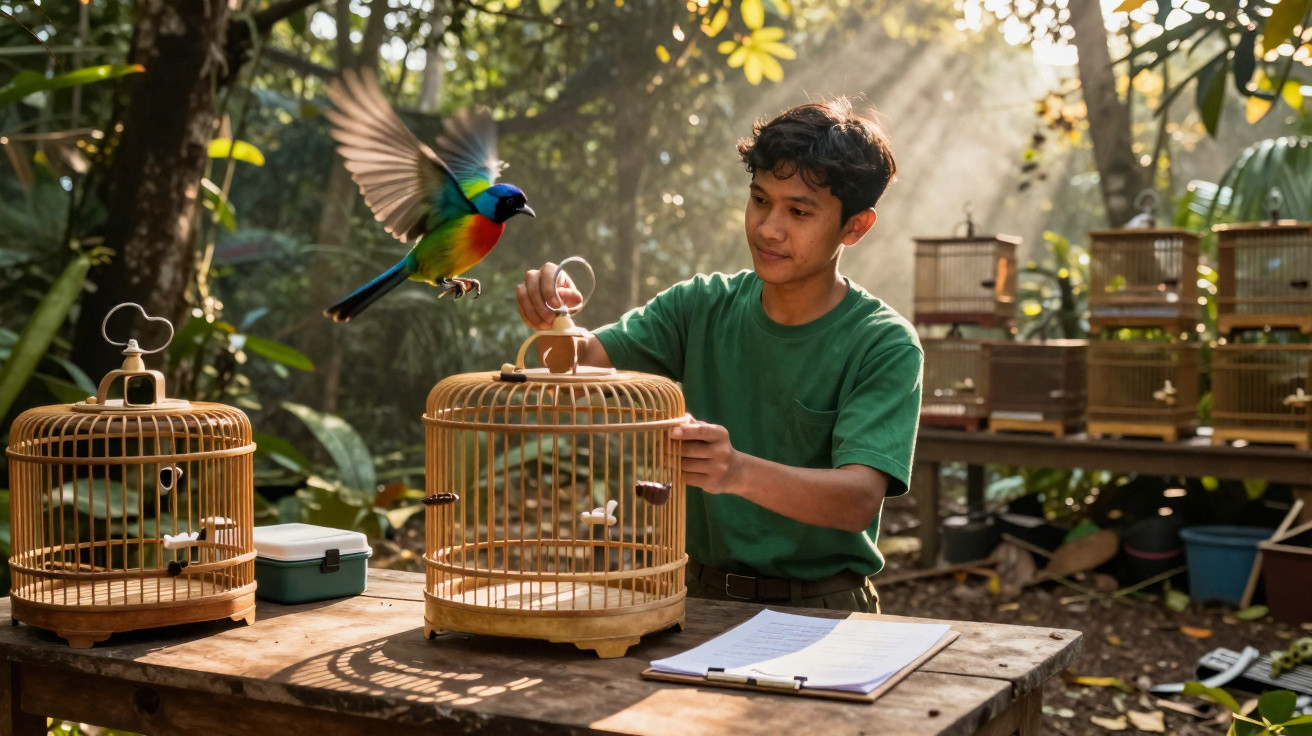
In parts of Southeast Asia, forests once filled with birdsong are beginning to fall silent. Millions of songbirds are caught each year for the pet trade and competitions offering cash, motorcycles and prestige, driving an environmental crisis that could have irreversible consequences.
Why do songbird competitions put birds at risk?
In Indonesia, singing contests draw hundreds of participants, with as many as 1,000 birds appearing at a single event. The birds are judged on pitch, volume, repertoire and behaviour. Prizes can be worth several years’ wages, so a winning bird can become both a source of income and a symbol of social standing.
The belief that wild birds sing better encourages people to take them directly from forests. Hunters catch them and carry them in small boxes, pipes or bottles, often on long, suffocating journeys. Estimates suggest that 30% to 80% die in transit, while those that survive spend their lives in captivity.
The illegal bird trade has reached an alarming scale
Java has one of the world’s largest populations of caged birds. An estimated 66 million to 84 million birds are kept on the island, where one in three households owns birds. Across Indonesia, as many as 90 million people may keep between 164 million and 187 million birds taken from the wild.
Chris Shepherd, an expert at the Center for Biological Diversity, describes Indonesia’s trade as among the most intense in the world. Of the country’s roughly 1,800 bird species, one in five has been recorded in markets. These include protected and threatened species, as well as endemic birds found nowhere else.
Which species are close to disappearing?
A group associated with the International Union for Conservation of Nature identified 52 Asian species particularly affected by the trade. Some are sought for their plumage, rarity or singing ability. These qualities raise their price, making dwindling populations even more desirable to collectors.
- White-winged myna: fewer than 250 individuals remain in the wild.
- Javan green magpie: fewer than 100 may still survive in the wild.
- Bali starling: sought after for its white plumage and the blue ring around its eyes.
- Straw-headed bulbul: prized for its duets and vocal repertoire.
Alexander Lees, a conservation biologist at Manchester Metropolitan University, warns of what is known as empty forest syndrome. Vegetation may still look healthy even though the animals have disappeared. Without birds, seed dispersal, pollination and insect control can all be severely affected.
Watch the video shared by the YouTube channel Planeta Aves showing some of the planet’s rarest and nearly extinct birds.
How are rehabilitation centres trying to reverse the crisis?
The Wak Gatak Rescue and Rehabilitation Centre, established by Planet Indonesia, takes in birds seized in West Kalimantan. Many arrive malnourished, injured or exhausted. Veterinarian Happy Ferdiansyah says that 70% to 80% of the animals in a serious condition die within the first two weeks after rescue.
Survivors undergo quarantine and examinations, receive suitable food and are rehabilitated in aviaries with plants and perches. Once they show they can live without human contact, they are gradually released into protected areas. Since 2022, nearly 3,000 birds from 45 species have passed through the centre, and 348 have returned to the wild.
Demand must fall before the forests fall silent
Rescues matter, but they cannot keep pace with the rate of capture. Experts call for more effective enforcement, legal protection, educational campaigns and changes to competitions. A 2023 study of 305 projects in 80 countries also found that local community support increases released animals’ chances of survival and reproduction by 10%.
The crisis can only be brought under control when keeping wild birds in cages is no longer seen as prestigious or entertaining. Every purchase, competition or capture adds pressure to already fragile populations. Reducing demand is urgent: a forest without birdsong may still look green to human eyes, but it will have lost an essential part of its life.





Comments
No comments yet. Be the first to comment!
Leave a Comment