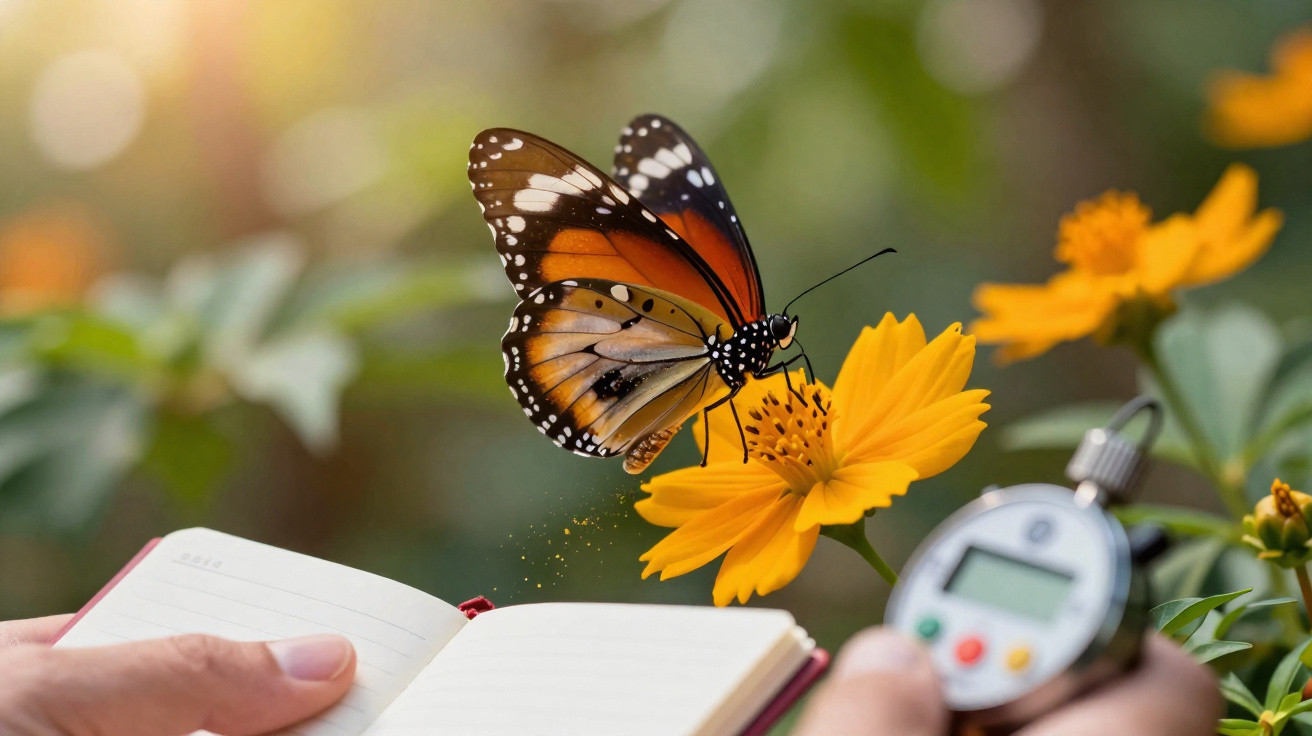
Most butterflies live for only a few weeks. Yet a group of tropical species found throughout South and Central America can survive for up to a year, and some seem to show barely any signs of ageing.
New research confirms that Heliconius butterflies do far more than simply outlive their close relatives by a considerable margin. They have evolved a fundamentally different relationship with time, postponing the physiological decline associated with ageing in ways that are still poorly understood.
Scientists believe that studying these butterflies could reveal new insights into the biology of longevity, potentially with relevance to humans as well.
Jessica Foley of the University of Bristol’s School of Biological Sciences led the study, working with researchers from the Smithsonian Tropical Research Institute in Panama.
The team brought together data from butterfly houses, mark-release-recapture studies and controlled insectary experiments. They compared lifespans and ageing patterns across the Heliconiini tribe, using a dataset broad enough to separate genuine trends from noise.
A 25-fold difference in Heliconius lifespan
The figures are striking. The longest-lived species studied, Heliconius hewitsoni, had a maximum recorded lifespan of 348 days. One of its closest relatives, Dione juno, survived for just 14 days.
That is a 25-fold difference between species with a relatively recent common ancestor – an evolutionary disparity in longevity with few parallels in the animal kingdom.
On average, Heliconius species live around three times as long as their close relatives. They also have lower baseline mortality and slower rates of ageing across the board.
The tribe as a whole appears to have followed a different evolutionary path, treating ageing not as unavoidable but as something that can be delayed, at least in part. Researchers are now investigating how and when that path diverged from the one taken by their shorter-lived cousins.
“Heliconius butterflies are among the longest-lived butterflies, but what makes them particularly remarkable is that they appear to have evolved not only longer lifespans, but also slower ageing,” Foley said.
“This allows them to live significantly longer than closely related species from which they diverged relatively recently in evolutionary time.”
Barely declining with age
One of the study’s most unexpected results emerged from a straightforward physical test. Researchers measured grip strength – how firmly a butterfly holds on to a surface – to assess physical performance over time.
In the short-lived relative Dryas iulia, grip strength weakened with age, as expected. But in Heliconius hecale, a longer-lived Heliconius species, the team detected no deterioration: older butterflies performed just as well as younger ones.
That is unusual because physical decline with age is almost universal among animals. A butterfly that appears largely to avoid it is a finding that calls for an explanation.
The pollen hypothesis
Most butterflies live on nectar alone, which supplies energy but little else. Adult Heliconius butterflies have a rare ability to digest pollen, allowing them to obtain amino acids and other nutrients that nectar cannot provide.
The hypothesis is that this richer diet helps the butterflies maintain their bodies more effectively, slowing the accumulation of damage over time.
The new study tested the idea directly. Even when deprived of dietary pollen, Heliconius hecale still lived substantially longer than its relative that does not feed on pollen.
The findings suggest that pollen contributes to longevity, but does not explain it entirely. Something in the biology of Heliconius – an evolved trait rather than diet alone – appears to be doing additional work.
Discovering what that is will require closer investigation of the molecular and cellular mechanisms that set these butterflies apart from their shorter-lived cousins.
“The exciting implication of this lifespan extension is that it provides a powerful opportunity to identify the mechanisms that underpin longevity,” Foley said.
“By comparing long-lived Heliconius butterflies with their short-lived relatives, we have a natural evolutionary experiment that can help reveal how lifespan is extended, making them a highly promising new model for research into the biology of ageing and longevity.”
Why longevity research in insects is important
Research into longevity tends to concentrate on mammals, including mice, primates and humans. Insects receive less attention, despite the remarkable variation they show.
“As the most species-rich animal class, insects are renowned for their extraordinary morphological and ecological diversity,” Foley explained.
“They also exhibit extreme variation in longevity, with maximum lifespans ranging from just a few days in adult mayflies to several decades in the reproductive castes of some ants and termites.”
“This represents a roughly 5,000-fold difference within the class, compared with around a 100-fold difference in lifespan observed in mammals.”
A 5,000-fold range in lifespan within one class of animals amounts to an enormous natural experiment. Within that variation lie mechanisms that determine how long a body can last and how gracefully it gets there.
Heliconius butterflies may be among the best places to begin looking: they flutter through tropical rainforests for the better part of a year while their relatives die after just weeks.







Comments
No comments yet. Be the first to comment!
Leave a Comment