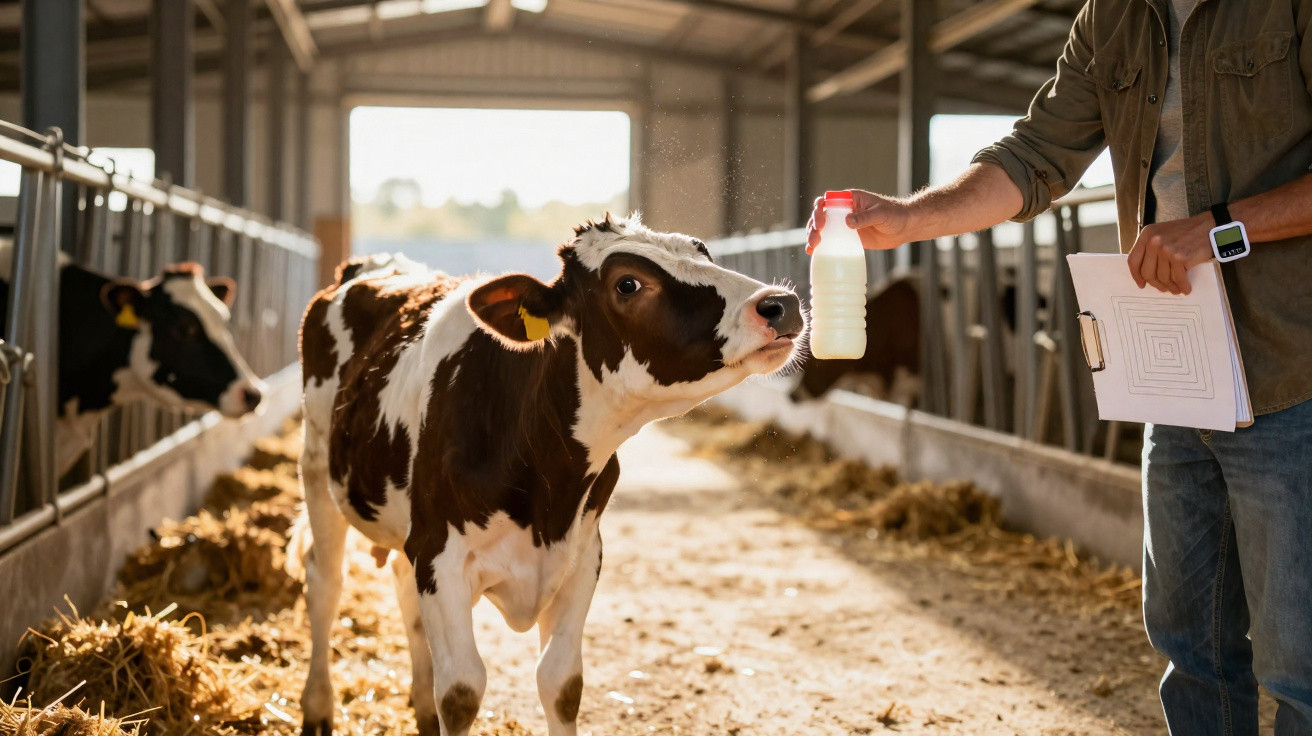
Hunger does more than make young calves want food. A new study suggests it can change their priorities altogether.
When their milk supply is restricted, calves become faster, sharper and more intent on obtaining a food reward. Hungry calves also appear to sacrifice something important: play.
Led by the University of Bristol, the research examined the behaviour of dairy calves given different quantities of milk.
Its findings suggest that, as calves become hungrier, the drive to find food starts to displace other motivations.
That is significant because play is often regarded as one of the clearest indications that an animal feels well enough to do more than satisfy its basic needs.
Food takes priority for dairy calves
To investigate, the researchers studied two groups of dairy calves. One was given 12 litres of milk a day; the other received 6 litres, described in the study as the normal amount commonly provided on dairy farms.
The calves were then put through a maze with milk as the reward. The test was designed to reveal how motivated they were to find food and how well they remembered the route after learning it.
The contrast between the groups was striking.
Calves receiving less milk finished the tasks more quickly and had better recall of the route. They showed greater focus and determination, and were more clearly motivated by the milk reward.
Those given more milk responded differently. They showed less interest in pursuing the reward and were more likely to play instead. Hunger appeared to narrow the calves’ world.
What play reveals
Play may seem unimportant to an outside observer, but it generally is not. Animals tend to play when they feel comfortable and safe enough, and have enough freedom, to use energy on an activity that is not immediately essential to survival.
When calves stop playing and concentrate almost exclusively on food, it is more than an oddity of behaviour. It may reveal how hunger is affecting their emotional and mental state.
“The study is among the first to show that hungry animals will trade-off play to prioritise finding food,” said study lead author Jillian Hendricks, a PhD student at the University of Bristol.
“It expands our understanding of how hunger suppresses other competing motivations and emotions, like play opportunities.”
“It also paves the way for future research, exploring how animals prioritise conflicting behaviours and incentives. This is especially important in farm animals who are often offered limited opportunity to express certain behaviours.”
When hunger pushes play further aside, it may therefore signal a serious welfare issue, rather than simply a question of feeding efficiency.
Faster does not necessarily mean better
The calves receiving less milk might initially appear to be better learners. They completed tasks faster, remembered more and seemed highly motivated.
That, however, is not really the study’s message.
The researchers are not suggesting that less milk is beneficial because it improves calves’ performance. Rather, their findings show that hunger makes the reward more important.
A hungrier calf will work harder to obtain milk, but that does not mean the animal is better off.
Indeed, the response of the calves given more milk may be the more revealing finding.
They were less fixated on the reward and had room, so to speak, to take an interest in something else, such as play.
What farmers should consider
For dairy farmers, the results pose an uncomfortable but useful question: if calves receiving the standard milk allowance are more motivated by food and less inclined to play, what does that reveal about how hungry they are?
“The key takeaway for dairy farmers is that the standard milk allowance for calves may disrupt other important behaviours, which indicate that they may experience hunger,” said study co-author Ben Lecorps from Bristol.
“The research suggests feeding calves more may not only be beneficial as it suppresses hunger, but also because it contributes to the expression of other important behaviours like play.”
Hunger is therefore influencing behaviour in ways that simple growth measures cannot capture. A calf may gain weight while still being hungry enough for that hunger to alter its behaviour.
That is one reason the study is interesting: it invites people to look beyond productivity and consider what the animal is actually experiencing.
Feeding after a long wait
One aspect of the experiment makes the findings particularly striking. The calves received different milk allowances for three weeks, but all went without food for 16 hours before testing.
According to the researchers, this reflected normal farm practice: feeding twice daily, at 8 am and 4 pm. For a young calf, the gap is a long one.
Yet even after going without milk for that length of time, calves that had received more still displayed greater interest in play.
“This tells us a lot about how much play matters for them,” Lecorps said.
Welfare matters more than learning
Ultimately, the study concerns more than calves finding their way through a maze. It examines what hunger does to the mind.
Hunger can sharpen attention, but it can also narrow it. Animals may become so focused on food that other behaviours begin to recede.
When the next meal feels urgent enough, curiosity, exploration and play all become less important.
The findings should not, therefore, be treated as a simple story about motivation. At their heart, they concern welfare.
If calves learn faster because they are hungrier, that is not necessarily evidence that the system is working well. It could indicate that hunger is shaping their lives more than it should.













Comments
No comments yet. Be the first to comment!
Leave a Comment