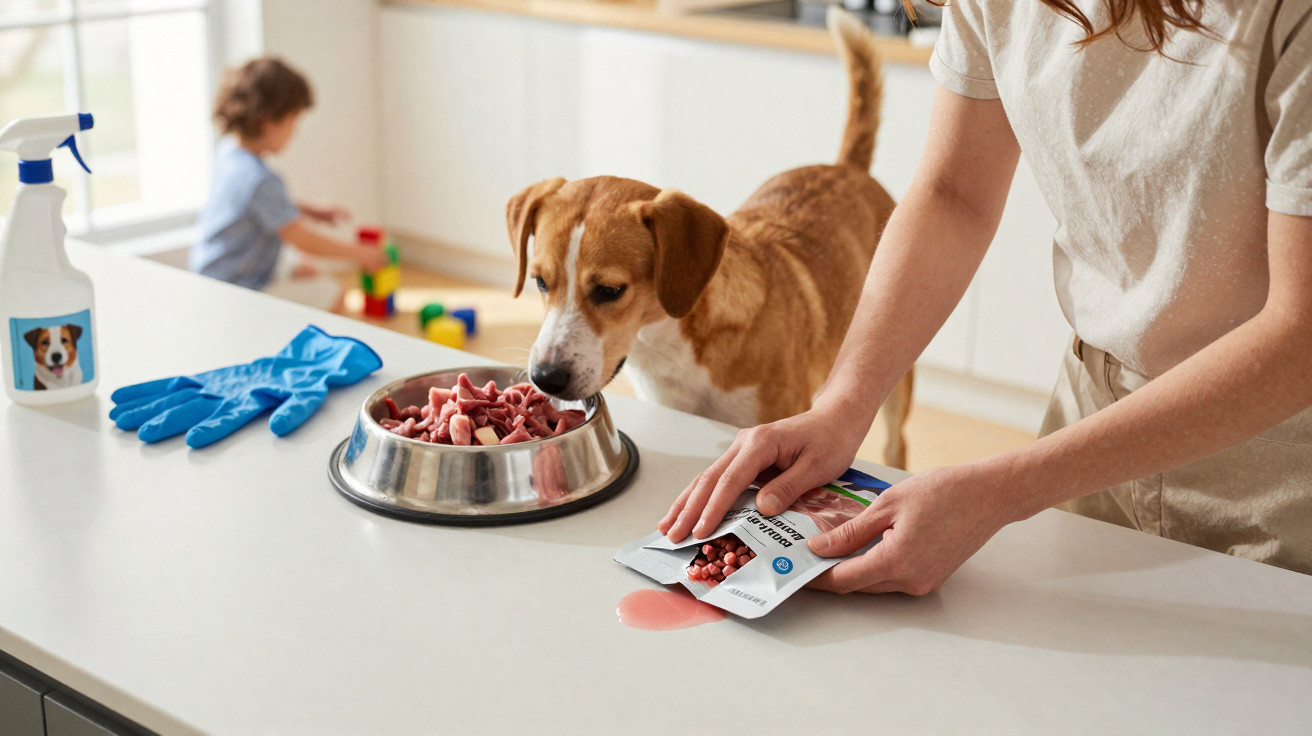
A new study found harmful bacteria in more than one in three raw pet food products sold in the UK, with nearly three in ten exceeding safety limits.
The findings turn a niche feeding practice into a public health concern: contamination can pass from a pet’s food to hands, kitchens and shared living areas.
Raw pet food contamination
Researchers examined 380 frozen products bought in the UK between March 2023 and February 2024. Contamination was frequent enough to make everyday handling a source of risk.
Frieda Jorgensen and colleagues at the UK Health Security Agency (UKHSA) found Salmonella in 21 percent of samples and Campylobacter in 14 percent.
They also detected Shiga toxin-producing E. coli in 12 percent of samples. This strain releases a toxin that can damage the gut and kidneys. Methicillin-resistant staph was found in 10 percent.
The figures show the extent of contamination, but they do not on their own explain how food kept in a pet owner’s freezer can become a source of exposure.
Why bacteria survive in raw food
These meals are not cooked, so many bacteria that would be killed by heat remain alive when defrosting starts.
Freezing slows bacterial growth but does not sterilise food. Germs can therefore survive and spread through liquid that escapes as the food thaws.
Even the lower levels of Campylobacter found in the study were significant. This bacterium can cause intestinal illness, and small doses can make people or pets ill.
Once thawing liquid spreads, the issue becomes less about pet nutrition and more about routine exposure in the kitchen.
Resistant germs found
Some contamination was particularly concerning because the team identified antimicrobial resistance in multiple samples. This means certain drugs no longer stop the bacteria.
About one in five samples contained E. coli resistant to penicillins and related drugs. Methicillin-resistant staph was also found frequently.
One percent carried E. coli resistant to colistin, an antibiotic used as a last resort. None showed resistance to carbapenems, another group of last-line drugs.
The lack of carbapenem resistance does not remove the concern, though it indicates that the riskiest resistance patterns were unusual rather than widespread.
When packaging leaks
The risk extended beyond the food itself: some packs leaked as they thawed, allowing fluid containing bacteria to escape.
About 8 percent of packs leaked, while bacteria were also found on the outside of some packaging before it had been opened.
This illustrates cross-contamination, in which germs move between food, hands and surfaces, making storage and cleaning part of the risk.
Low bacterial counts on packaging provided some reassurance, but leaking seals still created opportunities for hands, worktops and bowls to become contaminated.
Pets, bacteria and people
The risk does not stop in the kitchen. Animals can consume the bacteria and later shed them in their faeces.
Previous research found that dogs fed raw meat were more likely to shed resistant E. coli after eating.
That is especially relevant in homes where pets lick people’s hands, get on furniture or live alongside babies, older adults or people who are ill.
Rather than simply eating contaminated food, an animal can become a moving link in the chain of exposure.
Earlier warnings
The UK has already seen evidence that this risk is more than theoretical, with severe illness linked to raw feed.
A 2021 cluster of serious E. coli illness in England included people who had been exposed to dogs fed raw tripe.
Investigators discovered contaminated pet food during the outbreak, strengthening the evidence that raw diets can indirectly expose humans.
Those earlier outbreaks make it harder to dismiss the new survey as evidence of a limited manufacturing issue or a one-off scare.
Rules and gaps
The survey also revealed a gap between legal requirements and the products reaching household freezers.
Roughly 29 percent exceeded UK legal limits, usually because Salmonella was present or E. coli counts were above the permitted level.
Around 41 percent lacked clear hand-washing instructions, while about 17 percent did not clearly state that the food was not intended for humans.
Although missing warnings do not themselves cause contamination, they remove one of the simplest safeguards when contamination is present.
Who faces the greatest danger
The risk was greatest in households with young children, pregnant women, older adults or anyone with a weakened immune system.
The Food Standards Agency echoed that concern, urging people to take extra care with raw pet food.
“This survey shows that these products can pose risks to human and animal health,” said Rick Mumford, Interim Chief Scientific Advisor at the Food Standards Agency.
People who never handle the food can also be exposed, as bowls, floors and faeces may carry contamination onwards.
How households can respond
The safest approach is straightforward, but it relies on treating raw pet food in the same way as raw meat.
Current Food Standards Agency guidance advises owners to freeze it, defrost it separately from food for people and disinfect surfaces it has touched.
Using separate equipment matters because shared knives, containers or fridge shelves can give bacteria a route into family meals.
Even thorough cleaning cannot eliminate every risk of transmission from animals to humans, but it can greatly reduce the chance of everyday spread in the kitchen.
What changes now
The study did not establish that every raw meal will make a person or pet ill, but it did reduce some of the uncertainty.
Owners, vets and regulators now have a clearer picture: raw pet food should be considered alongside raw meat when discussing risk.





Comments
No comments yet. Be the first to comment!
Leave a Comment