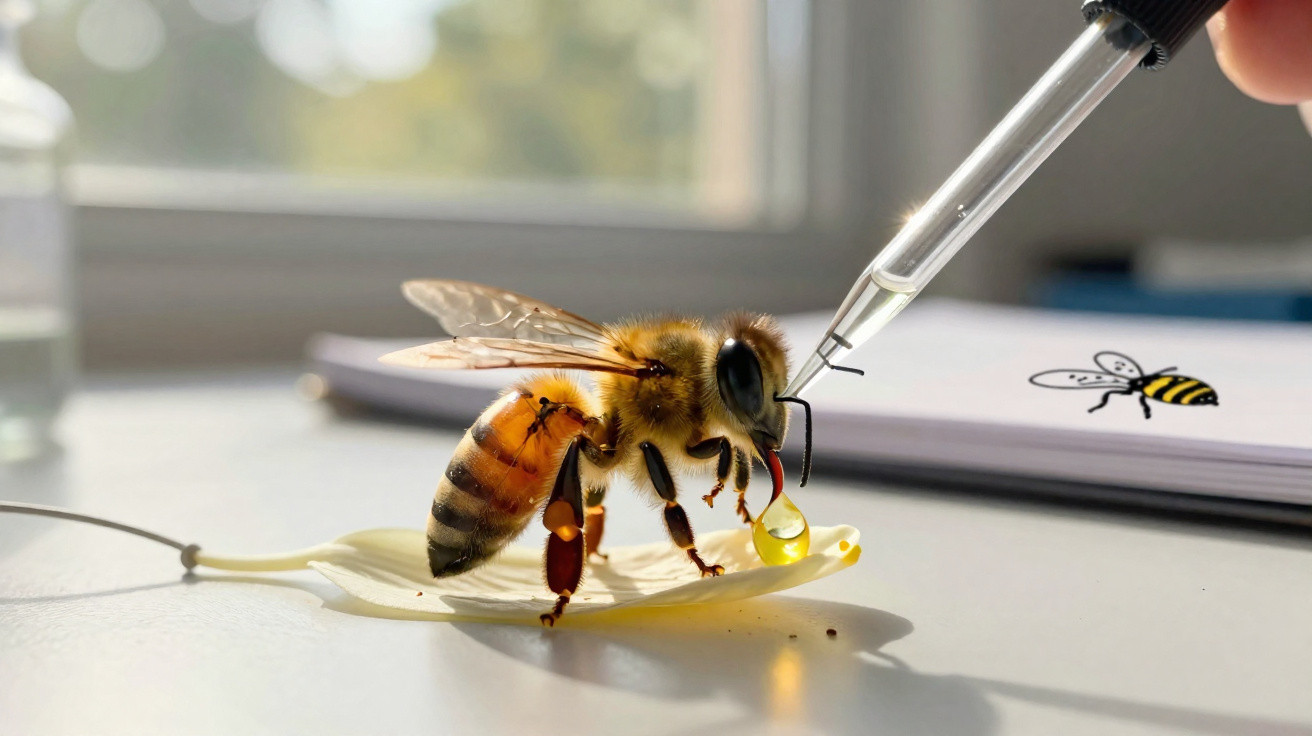
Most of us take it for granted that bees can find food. Whether they can actually enjoy it is another matter, and a new study suggests they might.
Researchers discovered that bumblebees make different facial and mouth movements in response to sweet, bitter and salty tastes. The movements closely resemble the expressions mammals show when food tastes pleasant or unpleasant.
Scientists have used these spontaneous responses to investigate pleasure and disgust in mammals for many years. Now, for the first time, they have recorded comparable reactions in an insect.
The results suggest that a brain smaller than a grain of sand may still assess experiences as pleasant or unpleasant.
Watching bees taste food
The study was conducted by a team led by professors Fei Peng and Cwyn Solvi at Southern Medical University in Guangzhou, China, alongside collaborators in Australia and the United Kingdom.
The researchers examined 18 colonies of buff-tailed bumblebees, the widespread European species Bombus terrestris.
Each bee was filmed in slow motion while tasting a drink. When given sugar water, a bee repeatedly extended and retracted its tongue, a movement the researchers liken to licking its lips.
Salty and bitter drinks prompted the reverse reaction. Bees shook their heads, rubbed their mouths with their front legs and rapidly withdrew their tongues. The researchers interpreted this collection of movements as rejection.
Andrew Barron, a professor at Macquarie University in Sydney, studies how behaviour is connected to the nervous system. He regards an animal’s facial expressions as a way of looking into its feelings.
For years, he has argued against the idea that insects are merely machines driven by reflexes.
“There’s always been a tension between thinking of insects as animals or some sort of mini robots,” said Barron. The mini-robot interpretation dominated the field for much of its history.
Pleasure goes beyond hunger
The study makes a careful, specific claim. Few people would challenge the idea that bees look for food. The more difficult question is whether they assess a taste as pleasant or unpleasant once it is in their mouths.
Wanting is different from liking. Wanting draws an animal towards a reward, whereas liking describes the pleasure felt when that reward is received.
The two do not always occur together. Demonstrating liking in an insect is considerably more difficult because it suggests an internal assessment, rather than a reflexive response.
Researchers can often see liking in mammals’ facial expressions. Both rats and newborn humans respond to sweetness with a relaxed expression and an extended tongue, while bitterness produces a scrunched-up grimace. A test of the same kind now seems to work in insects too.
Investigating that more difficult question was the purpose of the study.
“Many people are comfortable saying that insects can sense, learn and make decisions, but much less comfortable saying that they may evaluate things as pleasant or unpleasant,” said Peng. “Our findings push on that intuition.”
The next step in bee research
The results build on earlier findings. Bees were already known for unexpectedly sophisticated mental abilities, including learning quickly and acquiring new behaviours by observing one another.
Some researchers involved in the new study recently demonstrated that bumblebees can develop an optimistic outlook from their nestmates. The cognitive bias effect was reported in a study last year.
That earlier research could not establish whether a bee assessed each taste as pleasant or unpleasant at the time it experienced it. The new study moves a step closer to answering that question.
A tiny but capable brain
The brain responsible for these abilities is exceptionally small. A bee’s brain weighs under a milligram and contains approximately a million neurons, yet it appears able to assess whether a taste is pleasant or unpleasant.
Barron thinks the implications reach far beyond bees. A bee’s brain is organised much like a fly’s, he argues, so the same question is relevant to many other insects.
The notion that insects are simple, hardwired machines has been losing ground for years. In one experiment, bumblebees endured a painful heat source to get richer food, balancing harm against reward rather than responding automatically.
These reactions cannot, however, show what a bee actually experiences. The researchers regard the movements as a measurable signal, not a direct view into subjective experience.
“We don’t yet understand what bees truly experience, but we can observe emotion-like behaviours,” said Barron.
Rethinking how we treat insects
A practical advantage of the findings is that scientists now have a more direct method of measuring an insect’s preferences.
Previously, researchers had to infer those preferences from the choices insects made. Facial reactions can be scored directly, reducing the need for guesswork and providing a new measure of liking.
The implications also reach beyond the laboratory. Insects are farmed and killed on a vast scale, while pollinators such as bees are central to food production.
Evidence that insects can assess experiences as pleasant or unpleasant could affect how people think they should be treated.
For brain scientists, the reactions present a rare chance to investigate how activity in neurons gives rise to subjective experience.
Barron hopes that future studies will link a bee’s mental life to specific brain mechanisms, helping to narrow the gap between physical processes and conscious experience.













Comments
No comments yet. Be the first to comment!
Leave a Comment