For thousands of years, dogs have lived alongside humans, yet precisely when that relationship began has remained one of archaeology’s great unsolved questions.
Older canine fossils have repeatedly appeared to extend the timeline, only for many to prove to be wolves.
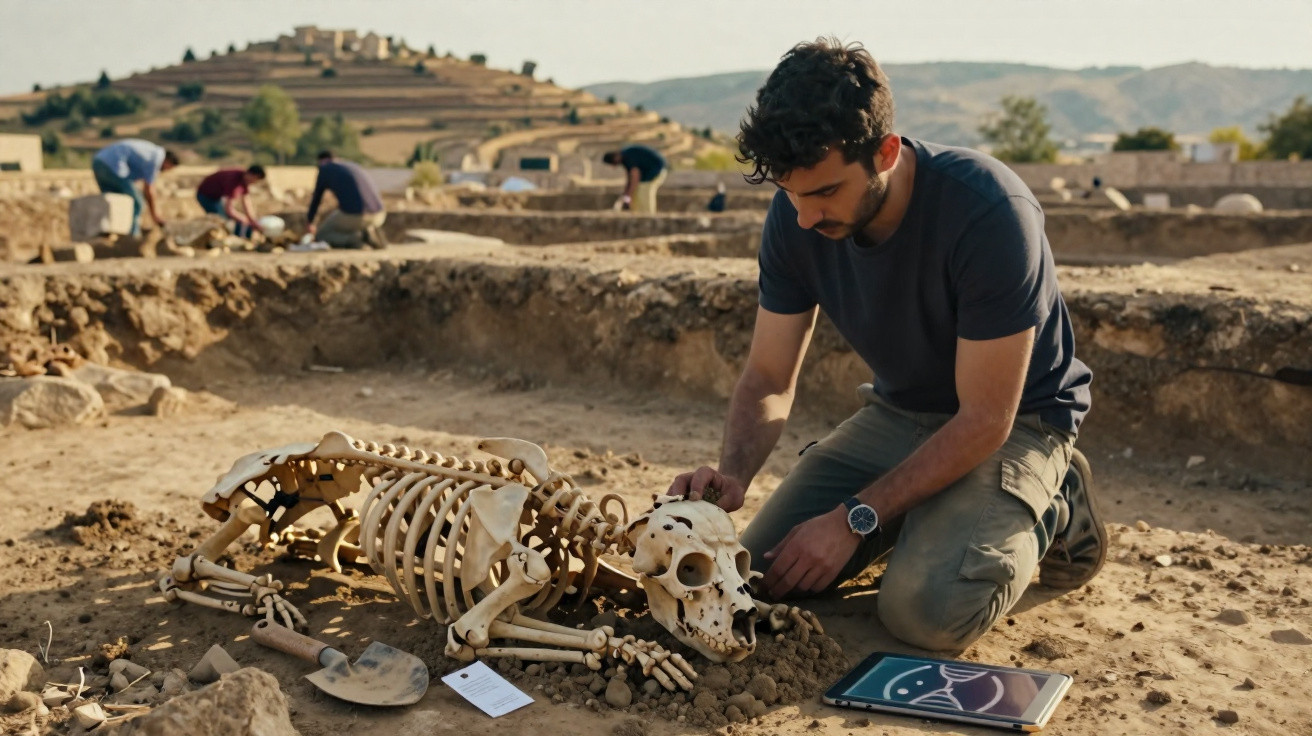
That picture may now have changed. In summer 2004, archaeologists digging at a remote hunter-gatherer site in central Turkey found three small puppies in a pit immediately above a human grave.
Their bones were too small to establish their species, although the circumstances of the burial pointed towards dogs.
The remains were dated to around 15,800 years ago – almost 5,000 years earlier than any dog previously confirmed through genetics. For 20 years, their identity remained in doubt.
Ancient DNA has now resolved the question. The animals were dogs, and the finding is changing scientific understanding of when and how humanity’s oldest relationship with another animal began.
Finding the first dogs
To investigate, researchers extracted and sequenced DNA from the Turkish puppies, something that had not been possible at the time of their discovery.
Their results established that the animals were dogs, not wolves, making them the oldest genetically verified dogs identified so far.
The ancient DNA work was led by palaeogeneticists Lachie Scarsbrook of Ludwig Maximilian University of Munich and William Marsh of the Natural History Museum in London.
Douglas Baird, a University of Liverpool archaeologist and co-author of both studies, led the excavation at Pınarbaşı.
A separate team, headed by Anders Bergström at the University of East Anglia, analysed dog remains from sites in England and Switzerland.
They sought to establish how these early dogs were related to one another and how they spread through Europe as farming emerged.
Published at the same time in Nature, the two studies together offer the clearest picture yet of Europe’s earliest dogs and their development into humanity’s oldest animal companions.
When wolves became dogs
Dogs have long presented archaeologists with a difficult puzzle. Scientists have known for a long time that they descended from grey wolves.
But the timing of that transition, and whether it took place once or on several occasions, has proved difficult to establish.
Before these studies, the oldest genetically confirmed dog was an 11,000-year-old canine from north-western Russia.
Researchers had identified other, older possible dogs from their skull shapes and other physical indications of domestication.
Shorter, broader skulls were among the strongest signs that wolves were changing. Without genetic verification, though, the evidence remained circumstantial.
Genetic testing has shown many supposed ancient dogs to be wolves. That was not the case here.
“It’s 100 percent a dog,” Scarsbrook said. “There’s no trace of wolfiness.”
More ancient dogs confirmed
The researchers also sequenced DNA from possible dogs found at Gough’s Cave in southern England and Kesslerloch Cave in northern Switzerland.
Both groups of remains were dated to around 14,200 to 14,300 years ago, and both were confirmed to be dogs.
Their mitochondrial DNA was a close match for canine remains of a similar age from western Germany and southern Italy, showing that dogs were already widespread in Europe by then.
Natalie Munro, an archaeozoologist at the University of Connecticut, was not involved in either study.
“It’s very, very important to have data from this time period,” said Munro. “Without it, we can’t talk about the deep history of dogs.”
A shared ancestry for ancient dogs
The genetic features shared by the Turkish, English and Swiss dogs are as remarkable as their age.
Although they lived far apart and among very different human cultures, their genetic signatures were strikingly alike.
At Gough’s Cave, the people were Magdalenians – accomplished artists who made cave paintings and, unusually, fashioned cups from human skulls.
At Pınarbaşı, the inhabitants were Anatolian hunter-gatherers and direct ancestors of the farmers who later introduced agriculture to Europe. The human populations were genetically distinct.
Their dogs, by contrast, were not. “They must have all come from the same population,” Marsh said.
The researchers propose that these animals may have been Europe’s original dogs: a generalised, unspecialised lineage that existed before selective breeding produced dogs suited to particular jobs.
Greger Larson, an evolutionary biologist at the University of Oxford and a co-author of both studies, describes them as a kind of “Swiss Army knife.”
Whatever their characteristics, the dogs appear to have moved readily between human cultures that otherwise differed considerably.
Dogs travelled with people
The team suggests that Epigravettian people may have had an important part in spreading dogs throughout Europe.
These skilled makers of stone tools lived in southern and eastern Europe between roughly 21,000 and 12,000 years ago.
Scarsbrook speculates that the early dogs might have looked noticeably different from wolves. They may have been smaller or had different coat colours, potentially making their arrival among unfamiliar groups something of an event.
Nicholas Conard, an archaeologist at the University of Tübingen who was not involved in either study, raised an intriguing possibility.
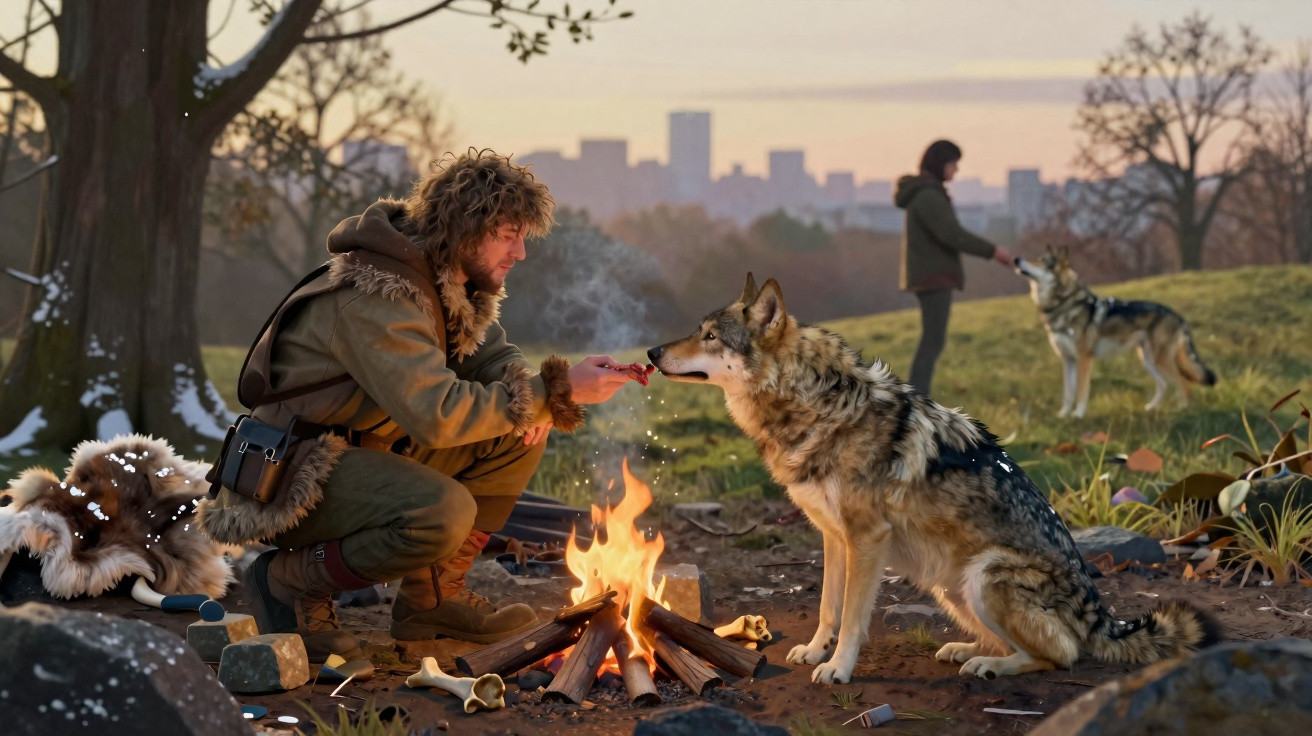
“You can imagine if you meet new people, you might pass along puppies as a gift,” he said. “It would give you something to offer in an unfamiliar place.”
It is an appealing image: dogs serving as social currency and easing encounters between groups with little else in common.
The role of early farmers
The second study looked at events thousands of years later, when early farmers moved into Europe.
Genetically, the newcomers replaced most of the earlier human population. Their dogs, however, did not entirely replace Europe’s existing dogs.
An analysis of canine remains from before and after agriculture arrived found that Near Eastern dog DNA displaced only about half of European dog DNA.
The early European dogs were absorbed rather than erased. In North America, the reverse occurred: European colonisers appear to have wiped out indigenous dogs completely.
There was something about Europe’s ancient dogs that made them worth keeping.
Where dogs first began
The deeper question of where dogs were first domesticated remains unresolved by either study.
Bergström’s research complicates the idea that dogs had several independent origins, suggesting instead that all modern dogs share a common ancestry. The question, however, remains open.
A few years after finding the Pınarbaşı puppies, Baird excavated a nearby site dating from a few thousand years later.
There, ancient dogs were not buried close to humans but alongside them. “The story continues,” said Baird.
Both studies are published in the journal Nature.














Comments
No comments yet. Be the first to comment!
Leave a Comment