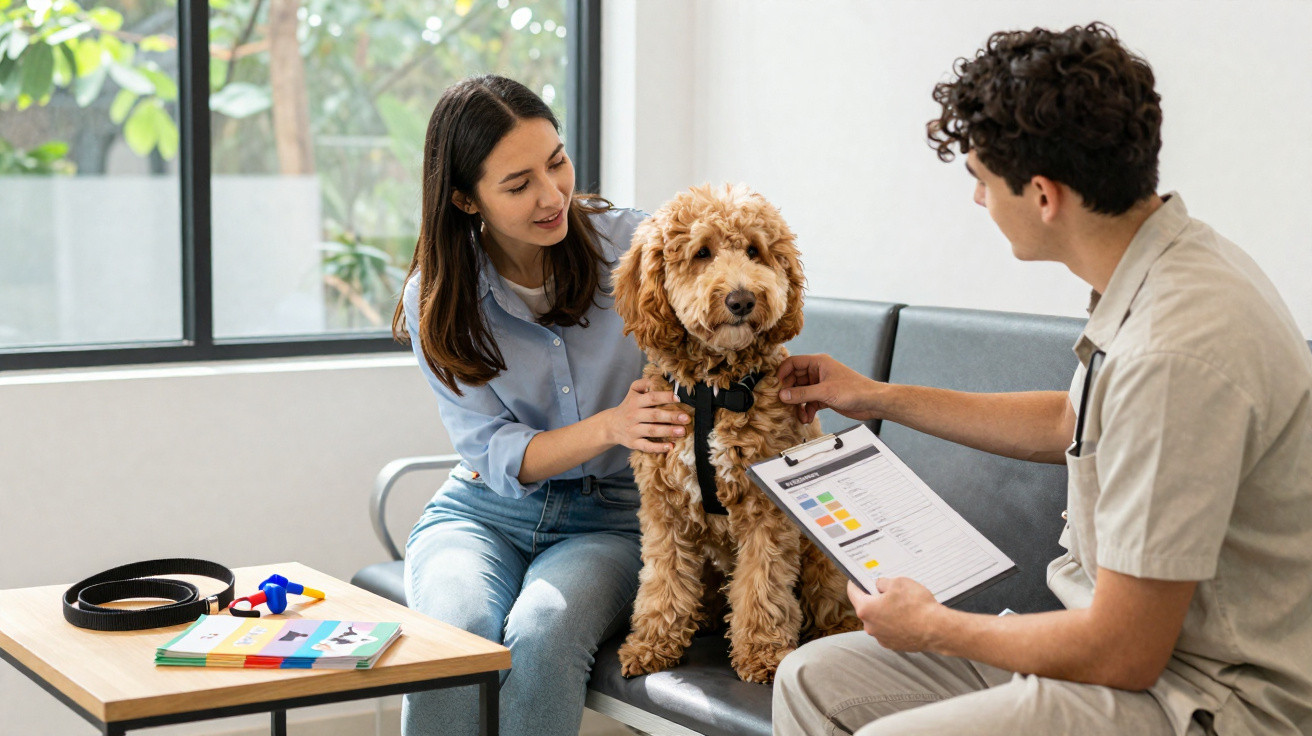
For years, dogs with imaginative names such as Labradoodle, Cockapoo and Cavapoo have enjoyed soaring popularity. Breeders, influencers and advertising sites portray them as easy-going, good-natured and almost perfect companions. A major UK study now challenges that image, suggesting that these popular crossbreeds show problematic behaviour more often than their pedigree parent breeds.
What the study actually examined
Researchers at the Royal Veterinary College in the UK analysed information supplied by the owners of 9,402 dogs in total. They concentrated on three particularly sought-after crosses:
- Cockapoo (Poodle × English Cocker Spaniel)
- Cavapoo (Poodle × Cavalier King Charles Spaniel)
- Labradoodle (Poodle × Labrador Retriever)
Every owner completed the same standardised questionnaire, the C-BARQ, or “Canine Behavioral Assessment and Research Questionnaire”. It measures 24 different behavioural traits, including:
- Aggression towards the dog’s owner
- Aggression towards strangers
- Anxiety and insecurity
- Excitability and excessive activity
- Fear of other dogs
- Problems being left alone (separation anxiety)
For each trait, the researchers compared the score for the crossbreed with those of both parent breeds. This allowed them to examine whether a mix tended to show the “good” or the “difficult” sides of its constituent breeds, or fell somewhere in between.
Many fashionable crossbreeds fare worse on behavioural measures than at least one parent breed – far more often than buyers might expect.
Popular crosses raise concerns more often than expected
The findings paint a surprisingly sober picture of dogs with designer names. Across 44.4% of all comparisons, the crossbreeds scored less favourably than at least one of their pedigree parent breeds. They showed a clear behavioural advantage in only 9.7% of cases. For almost half of the measures, there was no meaningful difference.
The study therefore challenges the common belief that crossing two “nice” breeds automatically produces a particularly balanced or easy-to-manage dog. Genetics does not work like an order form: traits combine at random, as do the risks associated with them.
Cockapoo stands out among designer dogs
The Cockapoo is particularly striking. This Poodle and Cocker Spaniel cross scored worse than its parent breeds in 16 of the 24 behavioural areas. The notable findings included:
- More frequent aggression towards its owner
- More pronounced aggression towards unfamiliar people
- High excitability and a tendency to become “overexcited” in everyday situations
For families hoping for a friendly, playful companion that is easy to train, such traits can become a real problem. A dog that becomes excited quickly, reacts anxiously or snaps can be overwhelming, particularly for inexperienced owners.
Cavapoo: a cute appearance and a sensitive nature
The Cavapoo fares somewhat better, but it also presents potential difficulties. It has less favourable scores than its parent breeds in 11 of the 24 behavioural dimensions. Two areas are especially prominent:
- A marked tendency towards separation anxiety
- Greater fear of other dogs
This reflects many reports from dog training schools: Cavapoos can seem friendly at first, yet quickly become stressed when left alone or faced with unfamiliar dogs. Anyone taking one on needs plenty of time for gradual training, day-to-day management and a calm environment.
Labradoodle: not perfect, but a more mixed picture
By comparison, the Labradoodle comes out somewhat better. It scores worse than its parent breeds in only five behavioural areas, while outperforming them in six others. In the analysis, for example, it appeared:
- Less aggressive towards its owner than the Poodle
- More relaxed around other dogs than the Poodle
That does not mean Labradoodles are always “easy”. It does, however, suggest that some breed combinations have different effects from others. Even with Doodles, there is no guarantee of a family dog that is entirely trouble-free.
Crossbreeds do not automatically inherit the best qualities of both breeds – sometimes the very traits people find difficult become more pronounced.
A billion-dollar market built on myths
Why, then, are these dogs in such demand? The study points to a vast business built on hopes and partial understanding. The market for Doodle crosses is now estimated to be worth more than a billion dollars a year.
Their popularity rests largely on promises for which there is little scientific evidence, such as:
- “Crossbreeds are healthier than pedigree dogs”
- “Doodles hardly shed and are ideal for allergy sufferers”
- “These dogs are calmer and easier to train”
- “Perfect family dogs for children”
Many buyers rely on appealing photographs, emotive descriptions and social media trends. Reliable information about typical behavioural profiles, training needs and potential problems can easily be overlooked.
What the findings mean for owners
The researchers warn that choosing a dog chiefly for its appearance and image risks frustration for both dog and owner. When temperament and energy levels fail to match expectations, everyday conflicts can mount, sometimes resulting in the dog being given up or rehomed.
A dog whose needs are not understood by its owners is more likely to show signs of stress: barking, damaging things in the home, growling aggressively or constantly following people around. These can all be read as a cry for help rather than “wilful disobedience”.
The better people understand a crossbreed’s typical strengths and weaknesses, the more effectively they can tailor its training, activities and environment.
How to choose a crossbreed more realistically
Anyone considering a Labradoodle, Cockapoo or Cavapoo should take a clear-eyed look at several questions:
| Question | Why it matters |
|---|---|
| How active are the breeds involved? | An energetic cross needs more exercise and activity; otherwise, that energy can turn into nervousness. |
| Are there known behavioural problems in the parent breeds? | Fear, prey drive or vigilance can become stronger in a crossbreed. |
| How much time is available for training and daily care? | Designer crosses rarely manage themselves; they need clear guidance and structure. |
| Where does the dog come from? | Some breeders pay little attention to temperament, focusing instead on appearance and a quick sale. |
Genetics is only half the story
The study sheds light on genetic tendencies, but it cannot replace consideration of the individual dog. Environment, upbringing and experiences shape a dog’s behaviour at least as strongly. An anxious Cockapoo can become more secure with good training, while a sensitive Cavapoo can thrive in a calm, attentive family.
Conversely, even a Labradoodle with a genetic tendency towards a calmer temperament can become nervous and reactive if it is constantly overwhelmed, gets little rest or lives in a chaotic environment. Taking on a fashionable crossbreed brings a responsibility to invest from the outset in a good dog training school, clear routines and enough activity.
What “separation anxiety” and “excitability” mean
Many owners underestimate what the technical terms used in the study involve. Separation anxiety, for instance, is not limited to howling when a dog is left alone. Common signs include:
- Scratched doors or window frames
- Urine or faeces in the home despite the dog being house-trained
- Frantic pacing when someone leaves the home
- Panic when someone is busy at the door
Increased excitability, meanwhile, means that a dog struggles to switch off, reacts to every stimulus, barks a lot and takes a long time to settle again. This can be exhausting for everyone involved, especially in a city or a family with children.
Why honest advice before buying can prevent trouble
Before bringing home a Labradoodle, Cockapoo or Cavapoo, it is worth having an open conversation with a dog trainer, vet or reputable breeder. Taking an interest not just in the coat but, above all, in the dog’s temperament will give prospective owners a much more realistic picture.
By contrast, falling for a puppy’s cute appearance alone or being guided by the promise of a “perfect family dog” can quickly lead to a situation that is good for neither animal nor human. The UK study shows that fashionable crosses are not worse dogs, but they are considerably more complex than advertising promises suggest.










Comments
No comments yet. Be the first to comment!
Leave a Comment