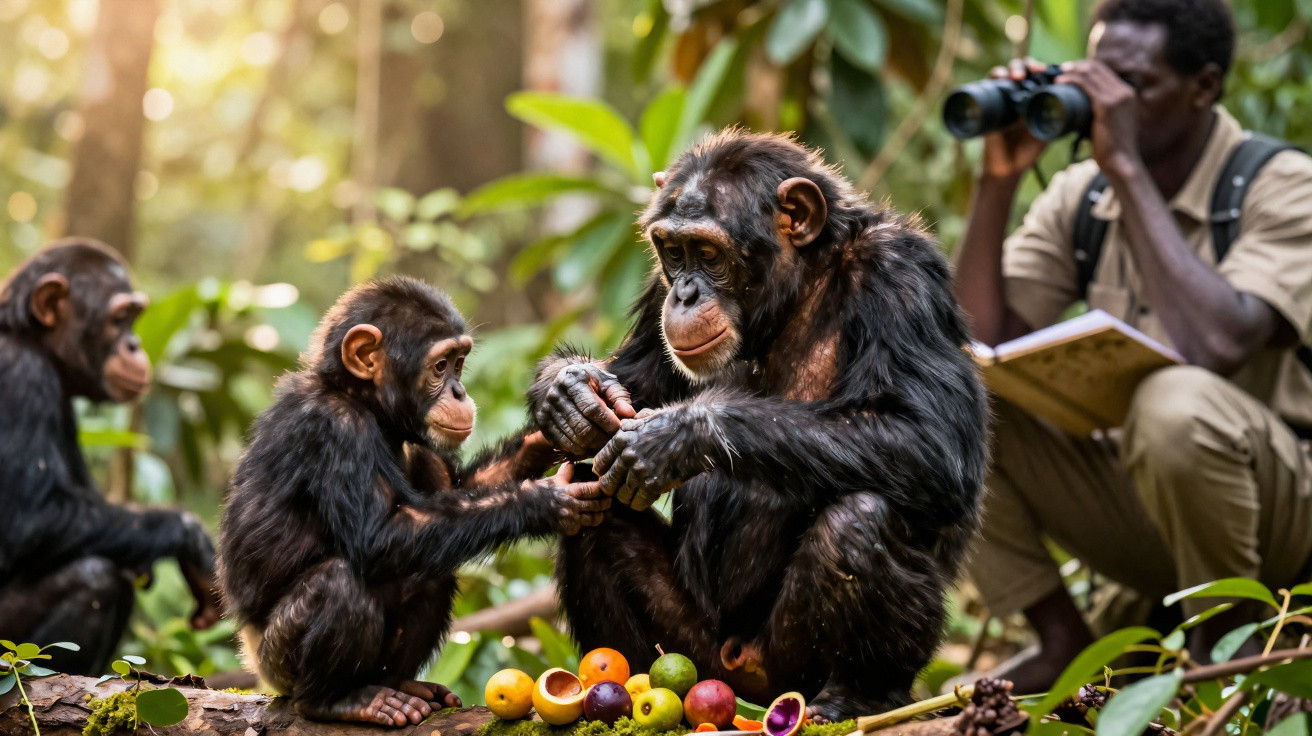
Chimpanzees neither attend school nor study books. Instead, young chimpanzees spend years observing older members of their group as they learn the skills needed to survive in the forest.
A new study in Uganda suggests that this learning process is far more complex than scientists previously believed.
Researchers from the Max Planck Institute of Animal Behavior, the Budongo Conservation Field Station and the University of St Andrews studied wild eastern chimpanzees in Budongo Forest for more than two and a half years.
Their findings show that chimpanzee culture extends well beyond well-known behaviours such as tool use.
Ordinary activities, including eating, grooming and social interactions, may also be handed down from one generation to another.
Looking beyond chimpanzee tools
For many years, scientists identified chimpanzee culture by comparing separate groups.
If one community cracked nuts with stone tools while another did not, researchers regarded the behaviour as cultural when neither environmental nor genetic differences could account for it.
This approach helped establish that animals can have culture, but it mostly captured conspicuous, dramatic behaviours. Shared everyday practices may have gone unnoticed because they seemed so ordinary.
“Excluding genetic and environmental causes of behavioural variation was an important first methodological step to demonstrate social transmission and as such the existence of animal culture,” said Nora Slania of the Max Planck Institute of Animal Behavior.
Watching the watchers
To reveal these less obvious layers of culture, the researchers concentrated on a behaviour called peering.
Peering happens when one chimpanzee closely watches another for several seconds, generally from a short distance and with intense attention.
The scientists suspected that this behaviour could show what chimpanzees regard as worth learning.
If peering was connected to learning, the team expected young chimpanzees to peer more often than adults and to concentrate on experienced individuals. Both predictions were confirmed by the study.
Thousands of observations
The researchers followed 28 chimpanzees from the Sonso community during roughly 1,100 hours of observation. The group consisted of 17 immature chimpanzees and 11 adults.
Observers recorded behaviours at three-minute intervals and noted every peering event they witnessed. Altogether, the team documented 358 peering events.
The data showed that peering reached its highest level at around five years of age, then declined steadily into adulthood.
Young chimpanzees accounted for most of the close observation, lending support to the idea that peering helps individuals gain important skills as they develop.
Rare foods attract attention
The food being eaten had a strong influence on peering behaviour.
Chimpanzees paid closer attention to foods that needed several processing steps before they could be eaten. Uncommon foods also drew more interest than familiar items.
This pattern suggests that young chimpanzees depend heavily on social learning when faced with difficult tasks or those they encounter infrequently.
“Animal culture doesn’t have to be rare or complex. It can include basic skills used every day, like finding food and knowing how to eat it,” said Slania.
Chimpanzees with experience
Young chimpanzees showed a strong preference for observing older individuals.
Experienced adults are likely to hold valuable knowledge acquired over many years in the forest.
The researchers also observed a smaller peak in attention towards peers of a similar age, suggesting that juveniles learn from each other too.
Younger, less experienced chimpanzees received very little attention.
A wide social network
Scientists have long considered mothers the main source of cultural learning for young apes. The new findings offer a more complicated picture.
The youngest infants did mostly peer at their mothers. But a different pattern appeared when researchers accounted for how often mothers happened to be nearby.
From an early age, young chimpanzees also showed considerable interest in unrelated adults. By approximately three years old, unrelated group members were their preferred targets when available.
The results suggest that chimpanzee culture is spread through a broader social network than researchers previously assumed.
Everyday life matters
Perhaps the most surprising result concerned the number of behaviours associated with peering.
The researchers identified 166 distinct behaviours in the Sonso community. Of these, 69 behaviours drew peering attention at least once.
That figure is nearly twice the number in previous catalogues of chimpanzee cultural behaviours collected across multiple study sites.
Most peering events did not involve tool use. Around 53 per cent focused on feeding behaviours that did not use tools, while another 26 per cent involved grooming activities.
The findings indicate that everyday activities may carry much greater cultural significance than previously recognised.
Grooming traditions emerge
Although grooming may appear instinctive, earlier research has shown that chimpanzee groups can groom in different ways.
In the new study, young chimpanzees spent substantial time watching grooming behaviours. This supports the idea that particular grooming styles may spread socially through observation.
“The fact that so much of a chimpanzee’s diet is socially learned highlights how important social learning is for their development,” said Dr Caroline Schuppli, the study’s senior author.
“While some behaviours may be simple and learned quickly, acquiring the full range of their culture still takes young chimpanzees many years.”
Animals with rich cultures
The study has implications that reach well beyond chimpanzees.
If scientists have underestimated culture in one of humanity’s closest relatives, the same could be true of dolphins, monkeys, birds and many other animals.
“In humans, our everyday lives are full of culture, including the way we speak, dress, or eat. We don’t require behaviours to be especially remarkable or independent of our environment,” said Schuppli.
“Animals, however, have long been held to stricter standards. By adopting a more inclusive view of culture, and standards more comparable to those applied to humans, future research may reveal that many animals possess richer cultures than previously recognised.”
For decades, scientists looked for culture only in spectacular acts.
The study suggests they may have missed the most important lessons of all: ordinary ones passed from watchful eyes to curious minds every day.










Comments
No comments yet. Be the first to comment!
Leave a Comment