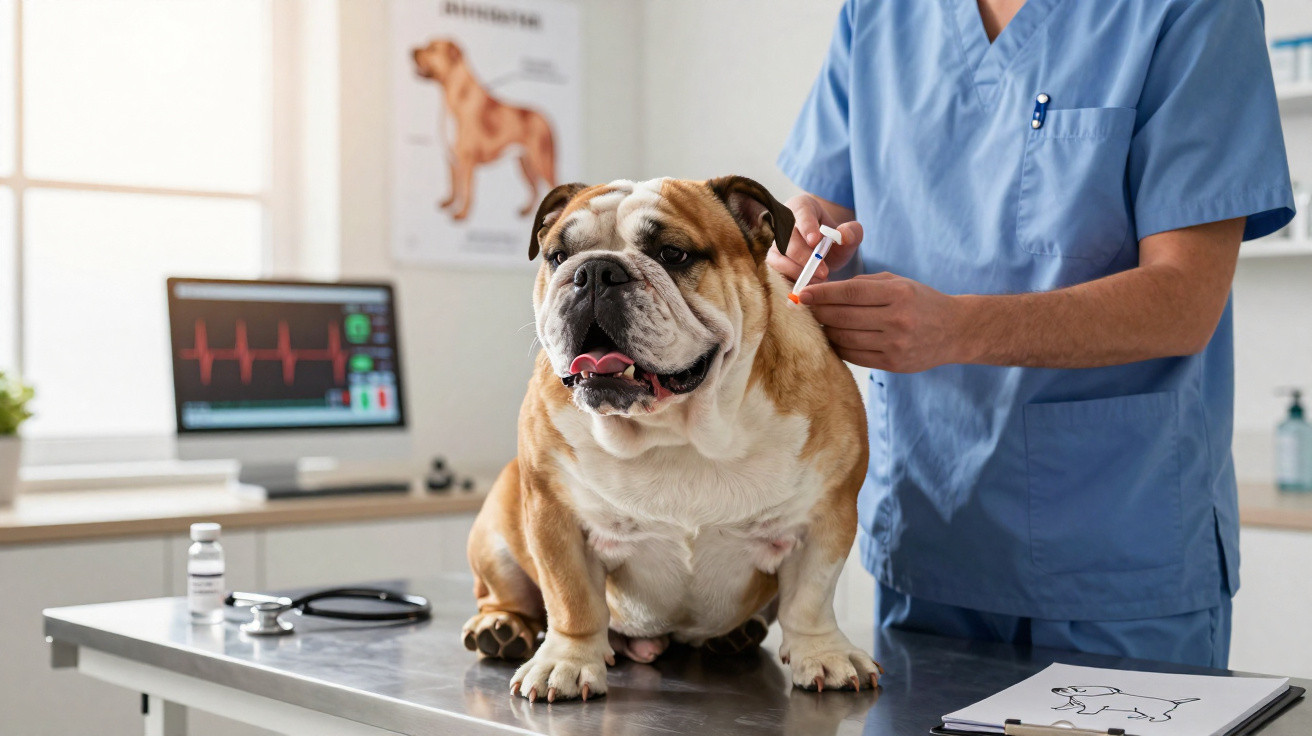
On a warm afternoon, a bulldog should be able to run, pant and rest just like any other dog. Yet for many flat-faced breeds, even breathing normally is a daily struggle.
Owners may regard their dogs’ snorts and gasps as ordinary sounds, but they can signal a serious health problem that has largely been accepted.
A new study by researchers at Snoretox Ltd and RMIT University offers fresh hope, introducing an unusual treatment that could change how vets manage breathing disorders in these dogs.
Breathing issues in flat-faced dogs
Brachycephalic breeds, including bulldogs, pugs and French bulldogs, have become immensely popular.
Their short faces and large eyes draw attention on social media and in popular culture, but that appearance comes at a cost.
Tony Sasse is Snoretox’s managing director and an adjunct professor at RMIT University.
“Decades of selective breeding for the popular flat-faced appearance have unfortunately led to serious breathing problems,” said Sasse.
“In severe cases, the condition has been shown to shorten a dog’s life by up to four years.”
The condition behind breathing problems in flat-faced dogs
These breathing difficulties are caused by Brachycephalic Obstructive Airway Syndrome (BOAS).
Clear signs of the disorder appear in between 45 and 50 per cent of extreme flat-faced breeds.
The problem stems from changes in their bodies over time. Their skulls have become shorter, while the soft tissue within their airways has not shrunk to the same extent.
“In short-snouted breeds, the soft tissue in the upper airway hasn’t adapted to the shorter skull. This leaves excess tissue crowded into a smaller space, where can obstruct airflow,” explained Professor Peter Smooker, a biotechnologist at the RMIT School of Science.
Restricted airflow can make breathing noisy and laboured, and can sometimes put dogs in danger.
Surgery remains a risky option
Surgery is currently the main treatment for BOAS. Vets commonly remove excess tissue or shorten the soft palate to make more room for air to pass through.
The procedures nevertheless carry serious concerns.
“Research shows that up to 60 percent of affected dogs still experience breathing problems after surgery, and seven percent do not survive the procedure,” Sasse noted.
Recovery can also be difficult, even when an operation is successful. Despite undergoing invasive treatment, many dogs continue to struggle.
A toxin that could support the airway
Given these limitations, researchers investigated a very different approach: tetanus toxin, a substance normally associated with disease.
At controlled doses, the toxin acts differently. Rather than causing harm, it can increase muscle activity, potentially strengthening the muscles responsible for keeping the airway open.
“The therapy strengthens the muscles at the front of the airway, helping support the throat and maintain airflow during breathing,” Smooker explained.
The decoy strategy
There was one major obstacle. Vaccination means most animals already have antibodies against tetanus, which would usually block a treatment based on the toxin.
The researchers developed a workaround in a formulation called Snoretox 1. It contains active toxin alongside an inactive form known as a toxoid.
The inactive ingredient serves as a decoy, attracting and absorbing antibodies so that the active toxin can reach the intended muscles.
Development of this approach has continued for more than 15 years.
Testing the treatment in bulldogs
The team carried out a small pilot study to test the idea, involving six British bulldogs with moderate to severe BOAS. The dogs were all aged between four and eight years.
Researchers injected the treatment into a particular throat muscle that helps stabilise the airway during breathing.
Vets assessed the dogs with a standard grading system. Each dog also completed a short exercise test, enabling experts to observe changes in breathing under mild stress.
The results offer hope
The findings were striking: all six dogs improved by at least one full grade on the BOAS severity scale, and some made even greater progress. The benefits lasted far longer than expected.
The shortest improvement lasted 20 weeks, while the longest continued for 53 weeks. Both periods extend well beyond the effects seen with other treatments.
“We also observed improvements in dogs that had not responded well to previous surgery,” Sasse said.
Side effects were minimal, with two dogs experiencing mild, temporary problems related to where the injections were placed.
Implications beyond veterinary care
The findings could have relevance beyond dogs. Professor Russell Conduit of RMIT’s School of Health and Biomedical Sciences drew attention to their wider potential.
“This is exciting evidence to support human drug trials for conditions involving poor muscle tone,” said Professor Conduit.
Muscle weakness in humans remains difficult to treat because it often arises from complex underlying conditions that are hard to target without affecting other vital systems.
“This product has platform potential for a range of conditions in both animals and humans,” Sasse explained.
“From a regulatory approvals perspective, it makes sense to start with these animal applications, but we are keeping the bigger picture of wider applications in animals and humans in mind.”
The study is still small, and further research is required before the treatment can become widely available. Larger trials involving different breeds will help to confirm the early results.
A path towards safer breathing
“This project is focused on making a real difference to animals, with the potential for broader impact in the future,” said Professor Calum Drummond, RMIT Deputy Vice-Chancellor Research.
For dogs that struggle with every breath, the research suggests a new way forward. It offers the prospect of easier breathing, better movement and improved daily life without the risks associated with major surgery.
What was once seen as a fixed trait of some breeds could soon become a treatable condition.




Comments
No comments yet. Be the first to comment!
Leave a Comment