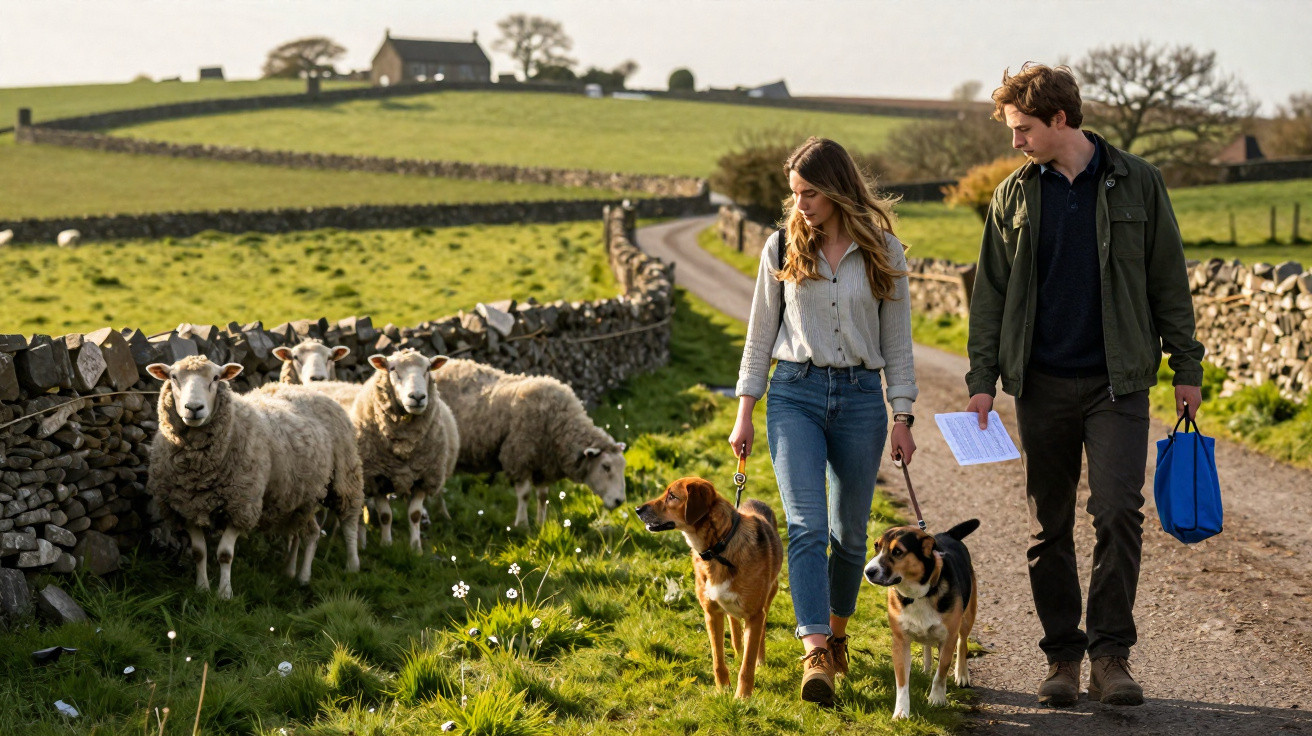
Anyone planning to walk a dog in England or Wales over the coming days should urgently reconsider their routes and routines. A new law makes the rules around walks near grazing livestock far stricter, and fines will no longer have an upper limit.
Exactly what changes on 18 March 2026
The Dogs (Protection of Livestock) (Amendment) Act 2025 comes into force on 18 March 2026. The Labour government is using it to update a long-standing set of rules dating back to 1953, with the aim of improving livestock safety and making dog owners more responsible.
“The new dog law makes it clear that even frightening or chasing livestock can be a criminal offence – and there is no upper limit on fines.”
Until now, the maximum fine in England and Wales was £1,000 when a dog “worried” sheep or other grazing animals. That fixed ceiling is being removed entirely. Depending on the circumstances, judges will be able to impose much tougher penalties, potentially reaching sums that could threaten an ordinary family’s financial security.
No bite required: chasing or frightening livestock is enough
Perhaps the most sensitive point for owners is that a dog does not have to injure an animal for an incident to become a problem. An attack involving a bite is not necessary.
Under the new rules, it is enough for a dog to:
- Chase sheep, cattle or other livestock.
- Frighten a herd or flock, or drive the animals apart.
- Cause animals so much stress that they could suffer harm, for example by panicking or fleeing.
In legal terms, “disturbing” or “worrying” livestock can therefore be enough. Even a brief chase that appears harmless may be treated as an offence. Stress and panic can cause pregnant sheep or cattle to miscarry or suffer injuries, resulting in real financial losses for farmers.
The law expressly applies beyond the middle of a field. Paths, field edges and roads immediately beside livestock pastures are also covered. Letting a dog run loose on a popular walking route next to a sheep field therefore puts the owner directly in the risk zone.
Which animals are now protected?
The scope of protection is wider than many people might expect. It is no longer just a question of the traditional farm scene with sheep and cows.
Among the animals covered by the new law are:
- Sheep
- Cattle
- Goats
- Pigs
- Horses
- Poultry on pasture, depending on how they are kept
- Camelids such as llamas and alpacas
Llamas and alpacas have become established attractions in tourist areas, and many families will know them from walking experiences or petting farms. Anyone visiting such places with a dog should remember that these animals now have the same protection as sheep and cattle.
Unlimited fines and greater police powers
The clearest change may be in the consequences. Rather than working within a fixed maximum amount, courts can set the fine according to how serious the incident is.
| Previous rules | New rules |
|---|---|
| Maximum fine of £1,000 | No upper limit on the fine |
| Limited police powers | Extended powers, including entering land |
| Less clear rules on “worrying” | Chasing, disturbing and causing panic explicitly included |
Courts can also order owners to pay the costs of catching and housing a dog and, where necessary, having it medically examined. Anyone who obstructs proceedings or is involved in repeated incidents could quickly see substantial costs accumulate.
The law also gives police new powers. They may:
- Enter land to secure a dog.
- Seize dogs to prevent further incidents.
- Take samples, such as DNA traces, to link a dog to an attack.
The message is clear: the state no longer wants to dismiss incidents involving dogs and livestock as “just bad luck”, but intends to pursue them consistently.
What this means for families with dogs day to day
Despite the tough approach, the government stresses that it does not want to ban walks. Walks and outings with dogs are expressly still welcome, provided owners act responsibly.
“Owners who keep their dogs on a lead near grazing animals generally have nothing to fear – the law targets recklessness, not ordinary walks.”
The key rules of thumb for people holidaying in England with a dog are:
- Whenever livestock can be seen or heard, keep the dog on a lead.
- Use a lead on paths beside pastures too, rather than relying on “he’ll listen”.
- Take care at gates, stable entrances and farm driveways, where a herd may suddenly appear.
Even a very well-trained dog can suddenly switch into chase mode around sheep or cattle. The sight of animals running away can trigger instincts that many owners underestimate. Relying on commands alone carries a significant legal and financial risk.
New protection for responsible dog owners
One change offers reassurance to people who look after their dogs responsibly. The law recognises that dogs can be stolen or taken from a household against their owner’s wishes.
If an incident occurs while a dog is in someone else’s hands without the owner’s consent, that may provide a defence. The owner is not automatically liable, but must be able to credibly show that the dog was actually taken or removed without permission.
That offers meaningful relief to people concerned about someone else using their dog, for example during a separation dispute or conflicts with people around them.
Why Britain is taking such a strict approach
For years, rural areas of England and Wales have seen growing numbers of reports of sheep being killed or injured, flocks panicking and heavy losses of lambs. Farming organisations have long called for tougher laws because individual incidents can quickly cause four- or five-figure losses.
The benefits and risks are distributed very unevenly: families enjoy their walk, while, if something goes wrong, the farmer is left dealing with dead animals, veterinary bills and emotional strain. The reform addresses precisely that imbalance: those enjoying the activity must also bear full responsibility.
What German dog owners should consider when travelling
The law has direct implications for holidaymakers from Germany, Austria and Switzerland staying in a motorhome or holiday cottage in Britain. The new rules apply regardless of an owner’s nationality: anyone travelling with a dog in England or Wales is automatically subject to them.
Practical advice for the next trip includes:
- Check before travelling which routes pass through grazing areas.
- Always carry at least one sturdy lead that is short enough to keep the dog close.
- When in doubt, put the dog on the lead rather than risk leaving it off.
- Explain to children in advance why the dog cannot simply “run free”.
Many walking routes, known as “public footpaths”, cross fields and pastures. Signs for visitors often give only brief warnings through pictograms rather than lengthy explanations. Anyone who does not speak English should familiarise themselves with the symbols and notices beforehand.
Legal terms explained briefly
“Livestock” is a legal umbrella term for farm animals, although the species it includes can vary from one law to another. In this case, it covers everything from traditional grazing animals to llamas and alpacas.
“Worrying livestock” does not mean a direct attack alone. It refers to any behaviour by a dog that:
- Causes the animals to panic.
- Prevents them from feeding.
- Leads to injuries, including injuries caused by fleeing or crowding together.
- Causes the farmer financial loss, for example through miscarriages.
For owners, the plain meaning is that the situation becomes serious as soon as a dog visibly unsettles a herd or flock.
Why the rules may also offer benefits
Strict as the law appears, it may be helpful for many owners. Clear requirements make it easier to explain decisions to fellow walkers, relatives and children. Someone who previously felt “overcautious” can now point to the law rather than debate whether a lead is “really necessary”.
For animals in pastures, the reform means greater calm and less stress. An owner who gets a dog used to staying on a lead around sheep or cattle from an early stage may even gain more freedom: walks are more relaxed, disagreements with farmers become less frequent, and the risk of a financially devastating fine is reduced to a minimum.















Comments
No comments yet. Be the first to comment!
Leave a Comment